

In the realm of wide-area motion imagery (WAMI), accurate multi-object tracking is crucial for surveillance and situational awareness. The latest developments from CORVUS ISR showcase how advanced algorithms are pushing the boundaries of what’s possible in real-time analysis. Their recent public tracker benchmark provides a clear comparison between two models, highlighting the significant improvements achieved by newer techniques.

Get the latest gadgets delivered free with Prime
- Fast, free delivery on millions of items
- Prime Video, Amazon Music and more included
- Member-only deals all year
The benchmark pits the traditional v1 “greedy nearest-neighbour” tracker against v2’s “confirmed-track auction” approach. The baseline v1 model employs a simple, two-pass greedy association with constant-velocity prediction, which still remains a reliable foundation. In contrast, v2 integrates a sophisticated three-tier auction association, velocity-consistency gating, and confidence-decayed coasting, resulting in notable performance gains. This evolution illustrates how the latest algorithms are tackling persistent challenges like identity switches.
Specifically, the v2 model reduces identity switches per minute by approximately 42%, across different scenarios. For example, in a standard scene with 150 movers, switches dropped from 2,042 to 1,183. When scaled up to 400 movers, the switches decreased from 14,032 to 8,040. These improvements demonstrate a significant step forward in maintaining consistent object identities, which is vital for reliable tracking in complex environments.
Understanding the importance of accurate tracking, CORVUS ISR emphasizes that identity errors are measured stringently, counting every change—even re-identifications—more strictly than conventional metrics. The goal is transparency: even under challenging conditions like occlusion, low frame rates, or noise, the models still make thousands of identity errors per minute, which are openly published. This approach promotes rigorous benchmarking and continuous improvement in the field.
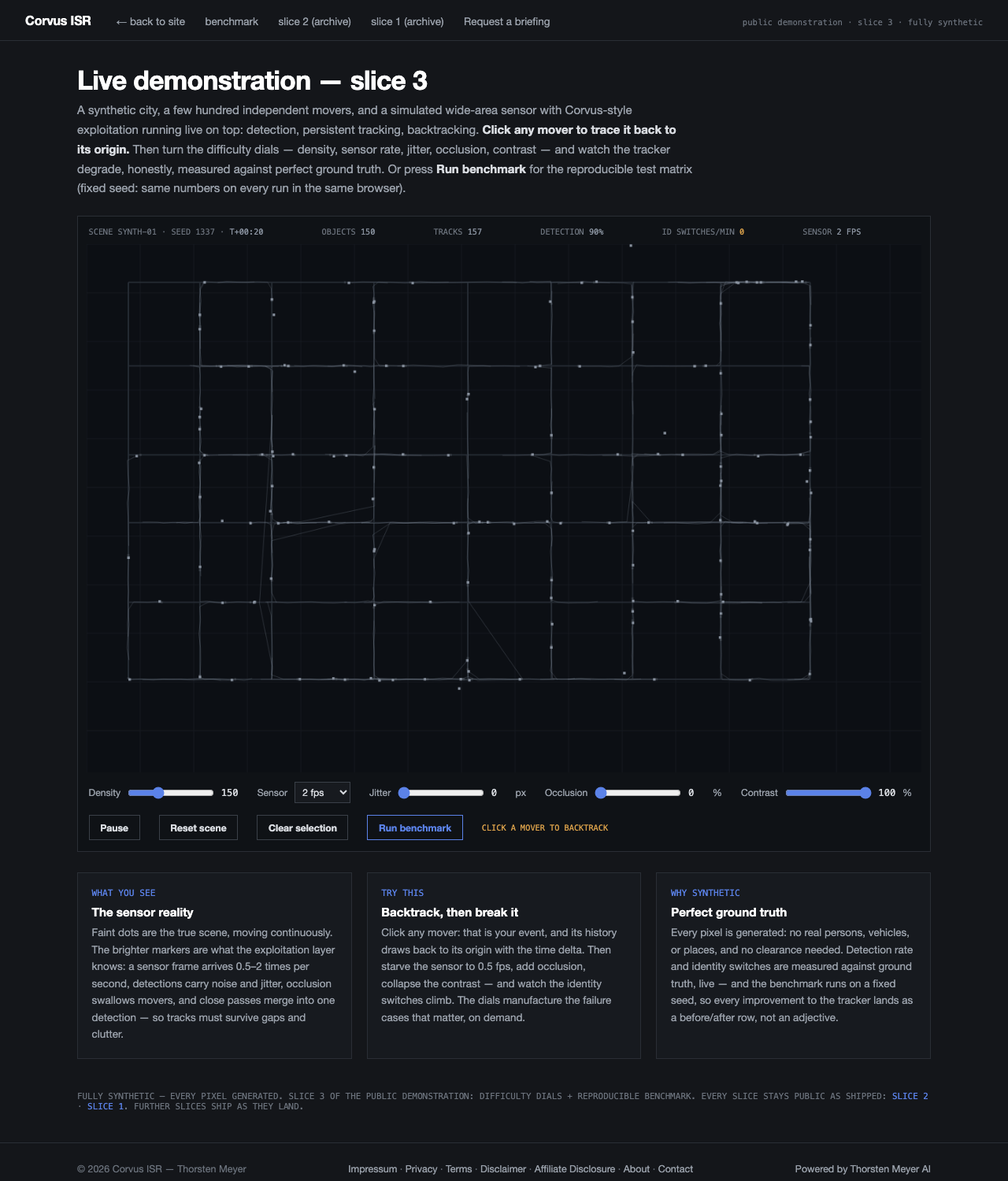
One of the most exciting aspects for tech enthusiasts is that the v2 tracker operates in real-time within a web browser. Averaging around 1.2 milliseconds per sensor tick at dense scenes with 400 objects, it surpasses typical timing budgets, making it suitable for live applications. Anyone can verify these results by visiting the live demo and clicking “Run benchmark,” with no sign-up or NDA required. The entire process is built on a synthetic, pixel-perfect environment, showcasing the power of AI-driven solutions for complex visual tasks.
Developed and reviewed by AI executors, the v2 tracker exemplifies how artificial intelligence can meet strict real-time demands, even under stressful conditions. This publicly available benchmark underscores the importance of transparent measurement, pushing the industry toward more reliable and robust multi-object tracking solutions. Interested readers are encouraged to run the benchmark themselves and see these advancements in action firsthand.
AI-based multi-object tracking software
As an affiliate, we earn on qualifying purchases.
As an affiliate, we earn on qualifying purchases.
wide-area surveillance camera system
As an affiliate, we earn on qualifying purchases.
As an affiliate, we earn on qualifying purchases.
As an affiliate, we earn on qualifying purchases.
intelligent motion detection camera
As an affiliate, we earn on qualifying purchases.
As an affiliate, we earn on qualifying purchases.
Fall Picks
fall essentials
As an affiliate, we earn on qualifying purchases.