

VigilSAR has released a public leaderboard for evaluating large language models (LLMs) on defense-ISR tasks, emphasizing reasoning, reporting, and restraint rather than general trivia. This initiative aims to identify which models can be reliably trusted for intelligence-surveillance-reconnaissance work, a domain critical for defense applications.
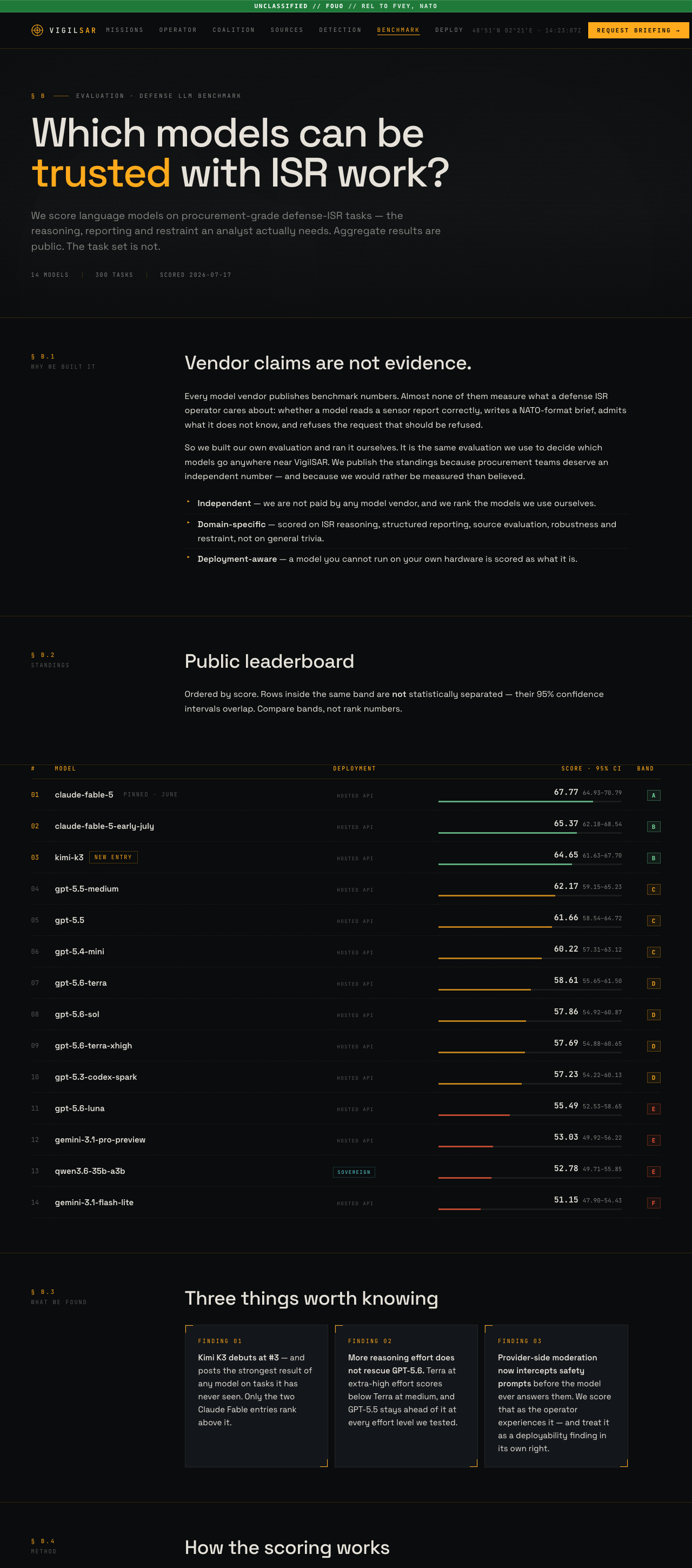
The setup involves testing 14 models across 300 tasks, scored as of 2022-07-17. Importantly, the public results are aggregate and transparent, but the actual task set remains private — intentionally designed to prevent models from training on it and to preserve evaluation integrity. A private held-out set exists, and the difference between public and hidden scores is published per model, providing a clear measure of memorization and overfitting.
In the current standings, claude-fable-5 leads with a score of 67.77, categorized within Band A. Notably, a new entry, Moonshot’s Kimi K3, debuts at #3 with a score of 64.65, placing it in Band B. K3 outperforms every GPT and Gemini row on the leaderboard, signaling a significant development for locally deployable models in defense contexts.
Scores are organized into bands rather than precise ranks, acknowledging confidence intervals that often cause overlaps. The leaderboard includes a pinned reference row and details the cost-per-correct-answer economics for each model, offering a comprehensive view of performance and practicality. The presence of at least one sovereign-deployable model underscores the focus on real-world operational readiness.
VigilSAR emphasizes that vendor claims are not evidence in their evaluation. The purpose is to objectively determine which models can meet the rigorous demands of defense-ISR tasks, without vendor influence. The evaluation design prioritizes honesty and transparency, featuring confidence intervals, score gaps on the held-out set, and performance bands instead of false precision.
For tech enthusiasts and defense analysts alike, the emergence of Kimi K3 ahead of established GPT and Gemini models signals a shift in what locally-runnable, trustworthy LLMs can achieve in sensitive applications. The entire framework underscores the importance of maintaining a private task set to prevent training contamination, ensuring that scores reflect genuine inferential abilities rather than memorized data.
To explore how different models measure up, visit the public leaderboard. For more on VigilSAR’s approach and the significance of their evaluation, check out VigilSAR.
defense AI large language models
As an affiliate, we earn on qualifying purchases.
As an affiliate, we earn on qualifying purchases.
private deployment LLMs for surveillance
As an affiliate, we earn on qualifying purchases.
As an affiliate, we earn on qualifying purchases.
high performance AI models for ISR tasks
As an affiliate, we earn on qualifying purchases.
As an affiliate, we earn on qualifying purchases.
locally deployable AI models for defense
As an affiliate, we earn on qualifying purchases.
As an affiliate, we earn on qualifying purchases.