
TL;DR

Get the latest gadgets delivered free with Prime
- Fast, free delivery on millions of items
- Prime Video, Amazon Music and more included
- Member-only deals all year
Several projects have independently reported that certain ESP32 microcontrollers can capture raw radio IQ samples through undocumented functionality. Most setups are limited to spectrum snapshots, while experimental hardware adds continuous streaming or onboard video reception; performance and chip support vary.
Several independent projects have reported that some ESP32 microcontrollers can be made to capture raw radio-frequency IQ samples, opening up experimental software-defined radio (SDR) uses beyond the chips’ built-in Wi-Fi and Bluetooth functions. The capability is undocumented and comes with substantial limits: most boards can provide spectrum snapshots rather than continuously stream data to a computer for decoding.
The ESPARGOS team, which previously used arrays of ESP32-connected antennas to estimate the direction of Wi-Fi signals, says it found firmware functionality that bypasses the chips’ usual Wi-Fi and Bluetooth operation to access raw IQ baseband samples. According to the report, supported models cover roughly 2.2–2.7 GHz; the ESP32-C5 also reaches 4.8–6.0 GHz. Reported sample rates reach 80 MS/s, with analog bandwidth varying by chip from about 13 MHz to 54 MHz.
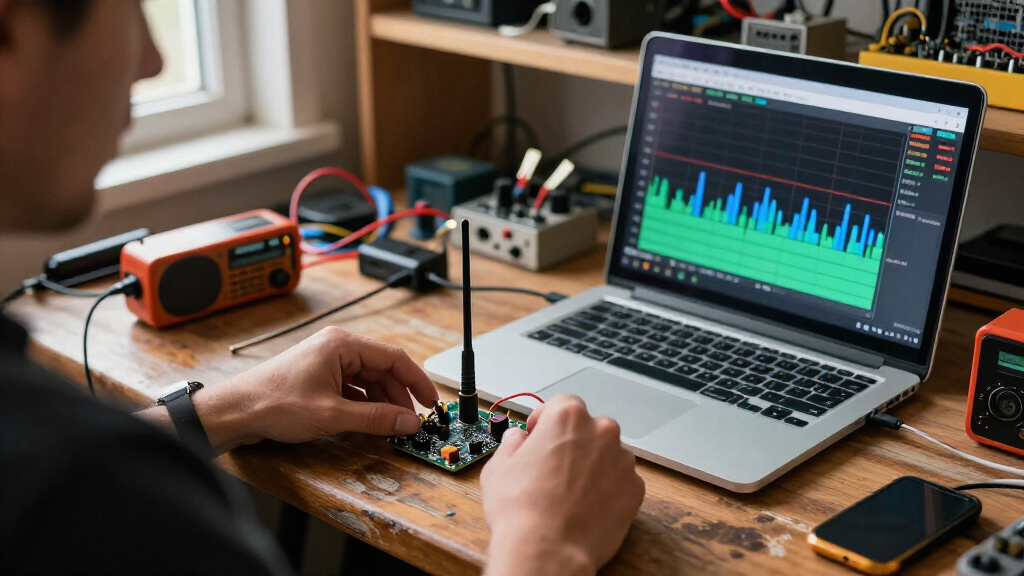
Those headline specifications do not make the boards equivalent to general-purpose PC-connected SDRs. The report says the output bandwidth is too limited for most models to stream continuously to a PC, restricting them to exporting snapshots for a spectrum analyzer. That can show energy across frequencies, but does not permit continuous demodulation or decoding on a computer using an ESP32 alone. ESPARGOS says its hardware can now capture phase-coherent samples, allowing direction-finding experiments on arbitrary signals in the 2.4 GHz band, rather than only Wi-Fi and Bluetooth.
Other projects approach the limitation differently. A developer identified as h0m3us3r published an ESP32-S3 project on GitHub on Sept. 26 and demonstrated a setup that sends IQ data continuously to a PC through an FPGA used as a USB 3 front end. The report says the prototype’s FPGA clocking produces poor phase noise, a signal-quality issue that would need to be addressed. Separately, C5VRX, first uploaded to GitHub on Aug. 13, uses an ESP32-C5 as an experimental 5.8 GHz FPV video receiver, processing signals onboard and outputting analog composite video through a resistor-based digital-to-analog converter.
From Wi-Fi Chips to Radio Experiments
The discovery could make low-cost radio experiments possible with widely available development boards, particularly for spectrum observation and direction finding. ESPARGOS’s phase-coherent capture, if it performs as described, extends the potential use of its antenna array beyond identifying Wi-Fi transmitters to locating other signals in the same band.
For hobbyists and researchers, the main distinction is between sampling a signal and having enough sustained data throughput to process it. Snapshot capture can help identify activity in a frequency range, but continuous PC streaming is generally needed for software demodulation and decoding. The FPGA prototype points toward one possible workaround, although its clocking problem remains, while the C5VRX project shows a different route: performing reception and demodulation on the microcontroller itself.
The findings are project-level demonstrations, not evidence that every ESP32 board can operate as a reliable SDR. Frequencies, bandwidth and performance depend on the chip and implementation. The work may broaden how developers use these devices, but it does not yet establish a plug-and-play replacement for dedicated SDR hardware.
Software Defined Radio SDR kit ESP32
As an affiliate, we earn on qualifying purchases.
As an affiliate, we earn on qualifying purchases.
Three Projects, Different Approaches
ESPARGOS originally used multiple antenna elements, each connected to an ESP32, to estimate the direction of arrival of Wi-Fi signals and produce a live heatmap. The new IQ-capture finding changes the range of signals its hardware may be able to study, while the team says it is not currently implementing phase-coherent transmissions because of possible misuse.
The other efforts surfaced independently, according to the October 1 report. The h0m3us3r project uses an FPGA to bridge continuous data to a PC; C5VRX instead targets reception of 5.8 GHz FPV video on the ESP32-C5. The report describes C5VRX as a work in progress that does not yet work reliably at range. An ESP-WebSDR page is also reported to let users flash firmware to many development boards through a browser and view a live spectrum and waterfall display.
“Phase-coherent IQ sample capture is now possible with their hardware.”
— ESPARGOS team, as reported by RTL-SDR.com
As an affiliate, we earn on qualifying purchases.
Performance and Support Remain Open
The report does not provide a complete model-by-model list of which ESP32 chips support IQ capture, nor does it describe independent testing of the stated frequency ranges, sample rates or bandwidth. The feature is described as undocumented, so its availability and reliability across chip revisions and development boards are not established here.
It is also unclear whether the FPGA-based ESP32-S3 prototype can resolve its phase-noise problem or sustain reliable continuous streaming in a finished design. C5VRX is explicitly described as unreliable at range, and no performance figures for its reception are provided. The ESP32-S31 is identified in the report as an exception that can stream continuously at up to 16 MS/s over Gigabit Ethernet, but a SoapySDR driver for GNU Radio and gqrx is still described as forthcoming.
As an affiliate, we earn on qualifying purchases.
Drivers and Prototypes to Watch
The near-term test for the work will be whether developers can make the experimental firmware and hardware repeatable across boards. ESPARGOS’s browser-based ESP-WebSDR offers one route for trying spectrum capture, while users will need to check the supported board and understand that a live spectrum display is not the same as a continuous PC recording or decoder.
For broader SDR use, the relevant milestones are a working SoapySDR driver for the ESP32-S31, improvements to the FPGA clocking in the ESP32-S3 setup, and greater reliability in the C5VRX receiver. The report does not give release dates for those developments. Until they arrive and are tested, the reported capability is best treated as an experimental hardware finding, not a mature SDR platform.
ESP32 radio frequency spectrum analyzer
As an affiliate, we earn on qualifying purchases.
As an affiliate, we earn on qualifying purchases.
Key Questions
What did the projects find in ESP32 chips?
They report undocumented functionality that can capture raw IQ radio samples instead of operating only through the chips’ usual Wi-Fi and Bluetooth functions.
Can a standard ESP32 decode radio signals on a PC?
Generally, not from the reported snapshot-only output. The report says most setups can export spectrum snapshots but cannot continuously stream enough data for PC-based demodulation or decoding without additional hardware. The FPGA prototype is an experimental exception.
Which frequencies are reported?
The reported range for several models is about 2.2–2.7 GHz. The ESP32-C5 is also reported to cover 4.8–6.0 GHz, though performance varies by chip and implementation.
Is the ESP32 already a replacement for an SDR receiver?
No. The projects remain experimental, and most have limits in data throughput, clocking or reception reliability. The report does not establish that the chips can replace a dedicated SDR across typical uses.
Source: hn
Halloween Picks
halloween
As an affiliate, we earn on qualifying purchases.