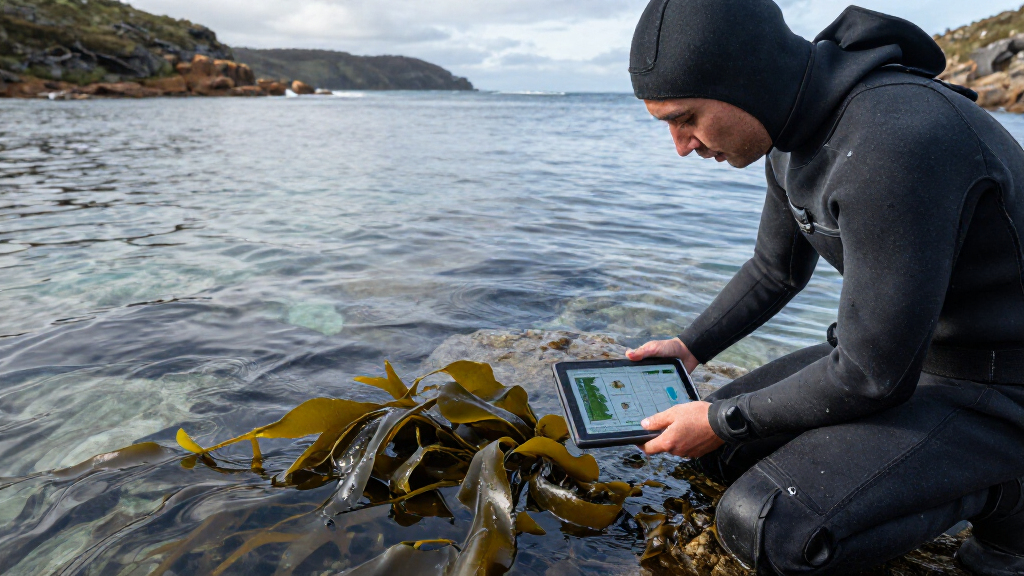

🔍 Read the full analysis: Is AI Useful In The Effort To Bring Back Tasmania’s Giant Kelp? on ThorstenMeyerAI.com

Get the latest gadgets delivered free with Prime
- Fast, free delivery on millions of items
- Prime Video, Amazon Music and more included
- Member-only deals all year
TL;DR
Google says a kelp-adapted version of its DeepVariant software helped analyze 600 wild giant kelp specimens from 40 Tasmanian coastal sites, as scientists look for candidates for selective breeding. Two Australian reference genomes have been published in a peer-reviewed journal, but the specimen analysis and claims about genetic isolation have not yet been independently documented in a paper or dataset. Whether bred kelp can survive warmer seas remains untested.
Google said on November 12 that its AI tools helped Australia’s national science agency, CSIRO, analyze the DNA of 600 wild giant kelp specimens from Tasmania, work intended to guide selective breeding as the forests face a steep decline. The announcement describes one part of a restoration effort, not a demonstration that AI or the resulting kelp can withstand warmer seas: survival in the field has not yet been tested.
According to Google’s announcement, researchers used a version of its DeepVariant software adapted to analyze kelp DNA. The specimens came from 40 sites along the Tasmanian coast. Google says the analysis found that the remaining kelp patches are genetically isolated. That result could help scientists identify distinct plants to cross in breeding trials, but the analysis and finding are reported in Google’s post and video; the source material says no paper or dataset documenting them was available yet.
The project depended on two Australian giant kelp reference genomes, which give researchers a local DNA sequence against which to compare samples. Those genomes were published in BMC Genomics in June 2026, in a peer-reviewed paper by CSIRO scientists and a Google researcher. The paper reports that the two Australian genomes differ from each other by 0.2%, while each differs from the Californian reference by 1.5%. The authors placed 98–99% of each genome into 35 pseudo-chromosomes.
Google says its DeepConsensus and DeepPolisher tools helped correct errors in raw genetic reads used to build the references. DeepVariant’s standard models were trained on human data, Google says, so researchers adapted a version for kelp. The AI processes genetic information; it does not itself test heat tolerance or restore the underwater forests.
Giant kelp · Tasmania · CSIRO with Google AI
From the reef to the lab and back: where the AI fits
Five steps, as described by CSIRO and Google. The AI works in steps 2 and 3; people do the diving, the lab work and the planting.
1Reef
Collect wild kelp
600 wild specimens from 40 sites along the Tasmanian coast, according to Google.
2Lab + AI
Build a local reference
Long-read DNA plus Google’s DeepConsensus and DeepPolisher: two Australian reference genomes, published in BMC Genomics.
AI step3AI
Read each plant
A version of DeepVariant trained for kelp finds where each specimen’s DNA differs.
AI step4Lab
Choose and cross
Distinct survivors with genetic variation and heat-tolerant traits are crossed. Selective breeding, not genetic modification.
5Reef
Replant and watch
Young kelp is attached to rocky reef in pilot tests. Warm summers show which plants survive.
Sources: Google blog post, Nov 12, 2026, and Google Research video; Scharfenstein et al., BMC Genomics, 2026; CSIRO, 2024, and CSIRO on Google Arts & Culture. The scene is a schematic, not a map or real data.
Graphic: Powered by Thorsten Meyer AI
Why Kelp Genetics Matter
Tasmania’s giant kelp decline threatens a habitat that supports fish nurseries and other marine life, including octopuses, sea stars and sea lions. CSIRO says kelp forests in the region have declined by about 95% from historic levels. The agency attributes pressure on the forests to warmer, nutrient-poor water and invading sea urchins, with the East Australian Current extending farther south.
Genetic analysis could help restoration teams choose which surviving plants to breed, and the Australian reference genomes address a practical gap: a Californian genome may not represent southern kelp well. But genomic differences alone do not show that a plant will tolerate hotter summers, persist on a reef or rebuild a forest. Those outcomes depend on breeding trials and field survival, neither of which has been established by the announcement.
Popular right now

Vitamix VX1 Professional-Grade Blender, 64 oz, Black

Roborock RockNeo Q110H Wire-Free Robot Lawn Mower

Shark WANDVAC Power PET Cordless Handheld Vacuum, White, WV410WH
As an affiliate, we earn on qualifying purchases.
From Genome Maps to Reef Trials
Google Australia and CSIRO announced the broader partnership in February 2024 with the University of Tasmania’s Institute for Marine and Antarctic Studies, The Nature Conservancy, the Great Southern Reef Foundation and the Kelp Forest Alliance. The effort included a mapping strand using satellite imagery and Google Earth Engine and Vertex AI, alongside the genomics strand discussed in the November announcement. The current news concerns genomic analysis, not a report that satellite mapping has restored kelp.
Giant kelp, Macrocystis pyrifera, is a large brown seaweed. CSIRO says plants in Tasmanian waters can grow to around 30 metres. The newly published genomes were sequenced from one plant in Victoria and one in Tasmania. Their marked difference from the Californian reference underscores why researchers sought Australian genomes before comparing many local specimens.
The next biological step described is selective breeding: crossing distinct native survivors in the lab, then planting young kelp on reefs. The source material distinguishes this from genetic modification. It does not report that the bred kelp has already been planted or shown to endure warm conditions.
“trained a version of our AI model DeepVariant to analyze our wild samples”
— Google, in its November 12, 2026 announcement video
The Missing Field Test
The central uncertainty is whether kelp selected through genomic analysis and breeding can survive warm Tasmanian summers and establish itself on reefs. The source material reports no completed field test or result on that question.
There is also a difference in the evidence available for the project’s two genomic stages. The Australian reference genomes are described in a peer-reviewed paper with public data. The claimed analysis of 600 specimens and finding of genetic isolation are described in Google’s announcement, but the source material says it could not find a paper or dataset for those results. The number and location of samples are therefore company-reported details, not independently verifiable findings in the cited material.
The reported 95% decline is attributed to CSIRO. A preprint cited in the source material, drawing on earlier research, gives a 95–98% loss of giant kelp cover in East Tasmania since 1940. These figures describe different source accounts and should not be treated as identical measurements without further detail on methods and coverage.
From Breeding to Reef Planting
Researchers plan to use genetic information to select distinct native survivors for laboratory crosses, then grow young kelp for reef planting. The source material does not give a schedule for those crosses, the first planting or publication of the 600-specimen analysis.
The next evidence that would clarify the project’s promise is documentation of the specimen analysis, followed by results from breeding and monitored reef trials. Those trials would need to show whether selected kelp can persist through warmer conditions, not just whether its DNA differs from other samples. Until then, the work is best understood as an effort to improve breeding decisions—not proof that AI has brought Tasmania’s kelp forests back.
Key Questions
What did AI do in the kelp project?
Google says a version of DeepVariant adapted for kelp analyzed DNA from 600 wild specimens. The AI helps process and compare genetic data; it does not plant kelp or directly measure whether it can tolerate heat.
Has the 600-specimen result been peer reviewed?
Not in the material available for this report. Google described the analysis and the reported genetic isolation of remaining patches in its announcement. The two Australian reference genomes, a separate step, were published in peer-reviewed BMC Genomics in June 2026.
How will researchers use the genetic findings?
The stated plan is to cross distinct native kelp survivors through selective breeding, then plant young kelp on reefs. The source does not report that these reef plantings have already happened.
Does the project show that kelp can survive warmer water?
No. The source material says the decisive test—whether bred kelp survives warmer summers in the sea—has not happened yet.
Source: ThorstenMeyerAI.com