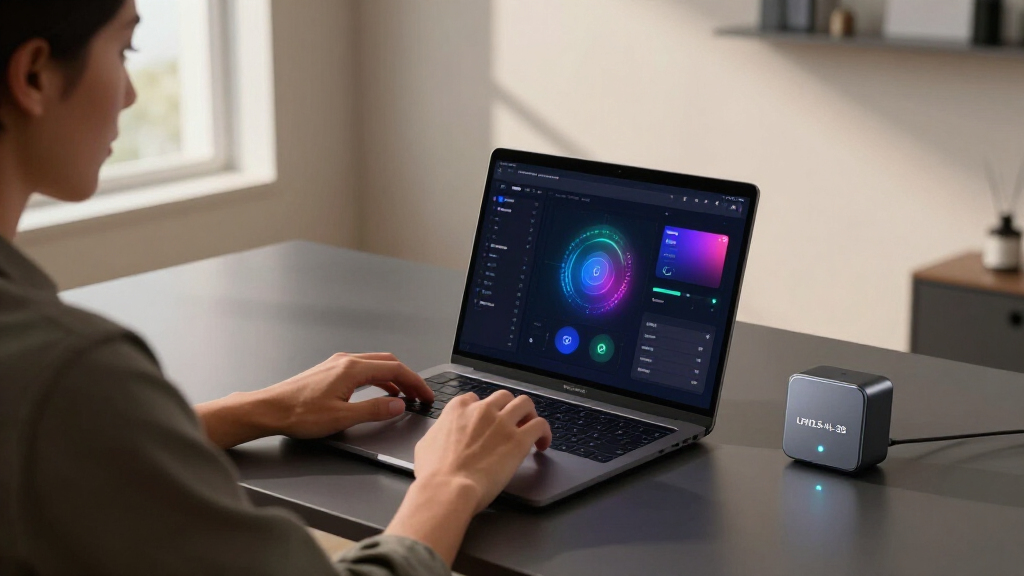

📊 Full opportunity report: Transform Your Edge Vision With LFM2.5-VL-3B AI Technology on ThorstenMeyerAI.com — validation score, market gap, and execution plan.

Get the latest gadgets delivered free with Prime
- Fast, free delivery on millions of items
- Prime Video, Amazon Music and more included
- Member-only deals all year
TL;DR
Developers have launched LFM2.5-VL-3B, a 3.1-billion-parameter AI model capable of running on local hardware. It offers enhanced visual understanding, multi-image processing, and tool calling, but independent verification is pending.
Developers have announced LFM2.5-VL-3B, a 3.1-billion-parameter vision-language model optimized for local hardware and real-time applications. You can learn more about its capabilities in the original analysis. This model aims to enhance visual understanding, multi-image analysis, and tool calling without relying on cloud processing, marking a significant step for edge AI deployment.
The LFM2.5-VL-3B model integrates a SigLIP2 400M NaFlex vision encoder with a pretrained backbone used by the LFM2.5-2.6B text model. It was pretrained on approximately 34 trillion tokens and includes four times more vision data than prior versions, covering image-caption, OCR, grounding, and instruction-following material. The model features a 128,000-token vocabulary, doubled to improve coverage of non-Latin scripts, and underwent post-training with supervised fine-tuning, knowledge distillation, and reinforcement learning techniques. For more on AI model evaluation, see this related guide.
According to developers, LFM2.5-VL-3B can process screens, documents, and images locally, reducing latency and data exposure. It reportedly achieves a processing speed of 228 tokens/sec on high-end hardware like an H100 GPU, with smaller devices like Galaxy S26 Ultra reaching about 20 tokens/sec. The model supports multiple deployment frameworks, including llama.cpp, MLX, vLLM, and ONNX, with Transformers support starting at version 5.10.1.
Performance claims include an average of 69.4 on vision benchmarks, with high scores on DocVQA and grounding tests, though these results are based on developer benchmarks rather than independent tests. To explore more about vision AI benchmarks, visit the original analysis. The model also demonstrates improved tool use, with scores rising from 26.4 to 59.5 on ToolSandbox, and from 20.5 to 32.5 on BFCL V4.
Implications of On-Device Vision-Language AI
The release of LFM2.5-VL-3B represents a notable advancement in edge AI, enabling complex visual and language tasks to be performed locally on devices such as smartphones, industrial equipment, or assistive tools. This reduces reliance on cloud servers, potentially lowering latency, improving privacy, and expanding AI accessibility in environments with limited connectivity. However, the actual impact depends on independent validation and real-world application performance, which are still forthcoming.
portable external monitor for laptops
As an affiliate, we earn on qualifying purchases.
As an affiliate, we earn on qualifying purchases.
Development Timeline and Prior Models
The LFM2.5-VL-3B builds on previous models like LFM2-VL-3B, with a focus on enhancing screen understanding, object grounding, multi-image analysis, and function calling. Earlier models demonstrated promising capabilities but lacked comprehensive independent benchmarking. The new model’s announcement aligns with ongoing industry efforts to deploy more capable vision-language models directly on consumer hardware, reflecting a broader trend toward privacy-preserving, real-time AI applications.
“Our most capable vision-language model you can run on your own hardware.”
— Thorsten Meyer
As an affiliate, we earn on qualifying purchases.
Unverified Performance and Deployment Details
It is not yet confirmed how closely the developer-reported benchmark scores and throughput will match independent evaluations or real-world deployments. Details on hardware configurations, precision levels, power consumption, and safety handling remain undisclosed, raising questions about the model’s robustness and practical effectiveness across diverse environments.
As an affiliate, we earn on qualifying purchases.
Next Steps for Validation and Adoption
Independent testing on various consumer devices, real-world applications, and safety assessments are expected to follow. Further transparency about hardware specifics and performance metrics will clarify the model’s suitability for commercial and industrial use. Developers and users will likely monitor early deployments and third-party evaluations in the coming months.
As an affiliate, we earn on qualifying purchases.
Key Questions
What is LFM2.5-VL-3B?
It is a 3.1-billion-parameter vision-language model designed to process text and images, including documents, screens, and multiple-image inputs, for local deployment.
Can LFM2.5-VL-3B run without internet access?
Yes, the developers claim it can operate fully on-device, fitting in about 3 GB of memory, but actual performance depends on hardware and workload specifics.
What improvements does this model have over previous versions?
It offers enhanced screen understanding, object grounding, multi-image analysis, and better support for non-Latin scripts, along with improved tool-calling capabilities.
Are the performance claims verified by independent tests?
No, the reported benchmark scores are from developer evaluations, and independent verification is still pending.
What are potential applications for LFM2.5-VL-3B?
Possible uses include document extraction, interface assistance, visual question answering, object detection, and local tool calling in various devices and systems.
Source: ThorstenMeyerAI.com
Fall Picks
fall essentials
As an affiliate, we earn on qualifying purchases.