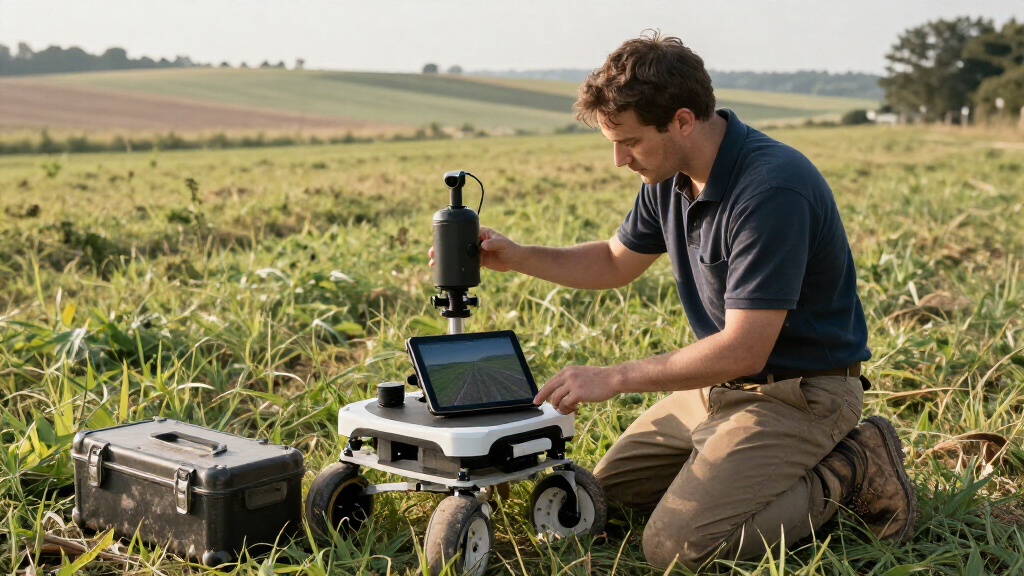
🔍 Read the full analysis: From Fieldwork To AI: The Changing Meaning Of A Job on ThorstenMeyerAI.com

Get the latest gadgets delivered free with Prime
- Fast, free delivery on millions of items
- Prime Video, Amazon Music and more included
- Member-only deals all year
TL;DR
A Nov. 3 ThorstenMeyerAI.com report uses farming to examine how technology can sharply reduce a sector’s share of employment over time. It cites historical estimates that about 73.7% of the US labor force worked in agriculture in 1800, compared with roughly 1.5% today, while an ILO estimate puts the global agricultural workforce at 928 million in 2025. The report argues that this long change offers lessons for debates about AI, but its prediction that automation could reach 90% of a sector within decades is the author’s thesis, not an established forecast.
ThorstenMeyerAI.com published a report on Nov. 3 tracing how tools, fertilizer and higher-yield crops reshaped agricultural work, from an estimated 73.7% of the US labor force in 1800 to about 1.5% today. The second installment of its “Work After Work” series argues that farming’s long employment shift can inform discussions of AI and jobs, while stressing that the transformation took generations and is still incomplete worldwide.
The historical figures in the report show a change in farming’s share of work, not a sudden disappearance of farm labor. The 1800 US estimate comes from economic historian Stanley Lebergott, in a series later published by the US Census Bureau. It counted 1.4 million agricultural workers in a labor force of 1.9 million people aged 10 and older. The source notes that pre-1840 figures are estimates and that enslaved people were included in the labor force figure; it describes “about three in four” as the more appropriate summary.
The report traces the change through a sequence of developments. A steel plough associated with John Deere in 1837 helped farmers work sticky Midwestern soil; machinery such as reapers, threshers and tractors followed. Later, synthetic fertilizer and improved crop varieties raised yields. The report cites India’s wheat harvest rising from 12.3 million tonnes in 1964-65 to 26.4 million tonnes in 1971-72, alongside the spread of short-straw wheat varieties in the 1960s.
Its central point is that agriculture produced more food with a much smaller share of workers in some countries, rather than that food production stopped needing people. The report gives an International Labour Organization estimate of 928 million agricultural workers worldwide in 2025, about one in four workers. It says agriculture accounts for about 43% of workers in India, about 1.5% in the United States and about 1% in Germany. The figures use different national and international sources and refer to different populations and periods.
Farming’s Lesson for AI Jobs
The agricultural shift matters to current debates because it offers a historical example of technology changing the amount and kind of labor needed in a major sector. The report’s evidence also cautions against treating automation as an instant event: farming’s employment share fell over roughly two centuries in the United States, with changes in machinery, crop science and inputs accumulating over time.
That history does not establish how quickly AI will affect office or other work. Farming is a comparison, not a direct forecast. Its relevance is that productivity gains can coexist with large changes in employment patterns, while food production and other economic activity continue. Workers, employers and policymakers may need to track both the tasks technology changes and the jobs and skills that grow alongside it.
The global figures add a further qualification. Even as agriculture accounts for a small share of employment in some wealthy economies, it remains a major source of work elsewhere. Any account of automation that focuses only on the United States or Germany misses the different stages of economic change across countries.
Popular right now

Ninja Luxe Café Mini Plus Espresso and Drip Coffee Machine with AutoFroth, Stainless Steel (ES351)

Breville BES870BTR Barista Express Espresso Machine, Black Truffle

Ninja Crispi Glass Air Fryer (Stone) – 4‑in‑1
As an affiliate, we earn on qualifying purchases.
A Long Shift in Farm Work
The report is Episode 2, “How the economy is built,” in the “Work After Work” series. Its previous installment divided the economy into field, factory and office; this one uses agriculture as an example of how a sector’s employment share can change. The installment says its next episode will address machinery’s role in farming.
The source draws on estimates rather than a single comparable global dataset. Alongside Lebergott’s US historical series, it cites reconstructions for Japan and Germany and national statistics for China and India. For example, it gives estimates of roughly 85% in Japan in 1872 and 83.5% in China in 1952 working in the primary sector. Those historical categories can include forestry and fishing as well as farming, and the report notes that some early counts underrepresented women working on family farms.
It also challenges the idea that fewer farmers necessarily mean less food. The report says global cereal production increased 4.2-fold from 1961 while the population grew 2.7-fold, and that US farm output in 2023 was nearly three times its 1948 level with only a small rise in total inputs. These comparisons are presented as evidence of productivity growth, not as proof that all agricultural work has been automated or that gains were evenly distributed.
“The share fell long before the headcount.”
— Thorsten Meyer, author of the Nov. 3 report
Limits of the AI Comparison
The report does not provide a defined measure for its projection that automation could reach “up to 90%” of a sector, nor does it identify which sector, jobs or tasks the figure would cover. The estimate is expressly presented as the author’s thesis; it should not be read as a consensus forecast or a confirmed outcome.
It is also unclear how directly farming’s history can predict AI’s effect on other industries. The report describes agricultural changes unfolding across centuries and through several kinds of technology, but does not offer a comparable timeline or employment model for AI. Its historical statistics come from sources with differing definitions, dates and methods, and some early values are reconstructed estimates rather than census counts.
The article’s global workforce figure is an ILO estimate for 2025, while national employment shares are given for different places and periods. The report does not set out a single methodology that makes each figure directly comparable. It also does not detail how agricultural employment changes affected wages, working conditions, migration or the distribution of productivity gains.
The Series Turns to Machinery
The report says Episode 3 will cover farm machinery, continuing its account of how agricultural work changed. That installment may add detail on the movement from hand tools and animal power to mechanized production.
For the AI question, the next useful evidence will be measured changes in work: which tasks are automated, how quickly employers adopt the tools, and whether jobs are eliminated, reshaped or created elsewhere. The report does not announce a specific AI employment study or a timetable for testing its 90% thesis, so that forecast remains unresolved.
Key Questions
What did the report say happened to US farm employment?
It cites an estimate that 73.7% of the US labor force worked in agriculture in 1800, compared with about 1.5% today. The 1800 figure is a historical estimate, not a census count.
No. The report says the US farm-worker headcount continued rising until about 1910, when it reached 11.8 million, even as agriculture’s share of the labor force fell.
How many people still work in agriculture worldwide?
The report cites an ILO estimate of 928 million in 2025, or about one in four workers worldwide. It presents this as an estimate, not a count of people whose work has been fully or partly automated.
Does the report predict that AI will automate 90% of jobs?
No confirmed prediction is given. The author says automation could become “up to 90%” of a sector within a decade or a few decades, but labels this his thesis, not a fact, and does not define the sector or measurement.
What is the next installment about?
The report says Episode 3 will cover farm machinery. It does not give a publication date in the supplied material.
Source: ThorstenMeyerAI.com