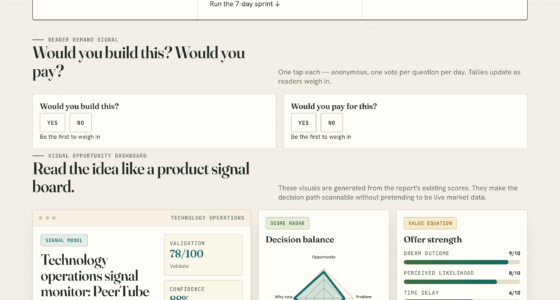

📊 Full opportunity report: A Skill Is A Folder, Not A Prompt: What Anthropic Learned Running Hundreds Of Them on ThorstenMeyerAI.com — validation score, market gap, and execution plan.
TL;DR
Anthropic has demonstrated that modeling AI capabilities as ‘Skills’—folders containing instructions, scripts, and data—significantly enhances agent reliability and organizational knowledge. This approach shifts from prompts to structured assets, with broad implications for AI deployment.
Anthropic has introduced a new approach to building AI agent capabilities, emphasizing that a Skill is a folder containing instructions, scripts, and reference materials, not just a prompt. This redefinition aims to improve consistency, onboarding, and knowledge retention within organizations deploying AI agents, marking a significant shift in how AI workflows are structured and maintained.
According to a detailed write-up from Anthropic’s Claude Code engineer, a Skill is best understood as a container—like a folder—that holds instructions, reference documents, runnable scripts, templates, data, configuration, and hooks. This contrasts sharply with the common misconception that Skills are merely saved prompts or markdown notes. The folder-based model allows AI agents to discover, read, and execute the contents dynamically, creating a durable, reusable asset for organizational processes.
Anthropic’s internal experiments with hundreds of Skills across its engineering organization have shown that this structure leads to more consistent output regardless of who runs the agent, simplifies onboarding by codifying tribal knowledge, and enables compound improvement over time as Skills are refined with each edge case. The company emphasizes that developing a high-quality Skill justifies dedicating an engineer-week, as it becomes an asset that appreciates in value.
Anthropic identified nine core categories of Skills, ranging from library and API references to infrastructure operations, with verification and testing Skills considered the most valuable for ensuring output quality. The approach also involves careful design of the description and scripts within each Skill to trigger appropriate actions, avoiding redundancy and ensuring relevance.
A Skill is a folder, not a prompt
Anthropic published what it learned running hundreds of Skills across its own engineering org. Read as a business memo, the point is bigger than a coding trick: this is how ad-hoc prompting becomes durable institutional capability — the SOPs your agents actually follow, versioned and shared.
“A Skill is just a clever markdown prompt you save in a file.”
A folder the agent can discover, read & run — instructions, scripts, references, templates, config & on-demand hooks.
The knowledge of how your organization actually operates can be captured, versioned, shared & executed — and the thing capturing it is a humble folder with a script and a gotchas list inside. For the builder, that’s context engineering with real tools attached. For whoever owns the budget, it’s the difference between AI that starts from zero every morning and an asset that compounds. Caveats: best practices are still evolving, checked-in Skills cost context, and curation beats accumulation. Start with one Skill, one gotcha, and the category that catches your mistakes.
Transforming AI Capabilities into Reusable Organizational Assets
This development signals a shift from ad-hoc prompting to structured, maintainable AI workflows that embed tribal knowledge directly into the agent’s capabilities. For organizations, this means more reliable, scalable, and explainable AI deployment, reducing the reliance on repeated manual instructions and fostering continuous improvement. The approach could set a new standard for operationalizing AI in enterprise settings, making AI agents more like integrated tools than ephemeral prompts.

AI-Driven Development Lifecycle: How Artificial Intelligence is Reshaping Software Engineering, Teams, and Organizations
As an affiliate, we earn on qualifying purchases.
As an affiliate, we earn on qualifying purchases.
From Prompt Engineering to Asset Building in AI Deployment
Until now, most teams using AI coding agents relied on manually re-entering instructions daily, leading to inconsistency and inefficiency. Anthropic’s recent publication builds on broader industry efforts to formalize AI capabilities, but its key innovation is framing these as persistent, versioned assets—Skills—rather than transient prompts. This approach aligns with ongoing trends toward operational AI, emphasizing reliability, scalability, and institutional memory.
Anthropic’s internal experiments with hundreds of Skills across nine categories reveal that refining and cataloging these assets can substantially improve output quality and reduce onboarding time. The company advocates for investing engineer time into developing high-quality Skills as a strategic asset, not a cost.
“A Skill is a container for how your organization actually does a thing—tribal knowledge, guardrails, tools—not just a prompt.”
— Thorsten Meyer, AI engineer at Anthropic

Linux Basics for Hackers: Getting Started with Networking, Scripting, and Security in Kali
As an affiliate, we earn on qualifying purchases.
As an affiliate, we earn on qualifying purchases.
Unclear Aspects of Skill Implementation and Adoption
While Anthropic’s internal results are promising, it remains unclear how broadly this approach has been adopted outside its organization or how easily other teams can implement similar systems. Details about the specific technical requirements, integration challenges, and scalability across different organizational contexts are still emerging. Additionally, the long-term impact on AI reliability and maintenance costs has yet to be fully evaluated.

Bridging Knowledge, Data, and AI: Harnessing the Semantic Layer Framework to Drive Intelligence
As an affiliate, we earn on qualifying purchases.
As an affiliate, we earn on qualifying purchases.
Next Steps for Broader Adoption and Validation
Anthropic is expected to publish more detailed case studies and technical documentation to facilitate adoption by other organizations. Further research and experimentation will likely assess how Skills integration impacts large-scale AI deployment, maintenance, and continuous improvement. Industry watchers anticipate that other AI developers may adopt similar frameworks if proven effective, potentially transforming enterprise AI workflows.

Agentic AI Playbook: A Practical Guide to Design, Build and Scale AI Agents
As an affiliate, we earn on qualifying purchases.
As an affiliate, we earn on qualifying purchases.
Key Questions
How does a Skill differ from a prompt?
A Skill is a folder containing instructions, scripts, and reference materials, enabling dynamic discovery and execution, whereas a prompt is a static instruction or question sent to an AI model.
Why is organizing Skills as folders more effective?
Folders allow for reusable, versioned assets that include not just prompts but also tools, data, and guardrails, leading to more consistent and maintainable AI behaviors.
Can this approach improve AI reliability in enterprise settings?
Yes, by embedding tribal knowledge and operational procedures directly into Skills, organizations can reduce errors, improve consistency, and streamline onboarding.
What are the main categories of Skills identified by Anthropic?
They include library references, product verification, data analysis, business automation, code scaffolding, quality review, deployment, runbooks, and infrastructure operations.
Source: ThorstenMeyerAI.com