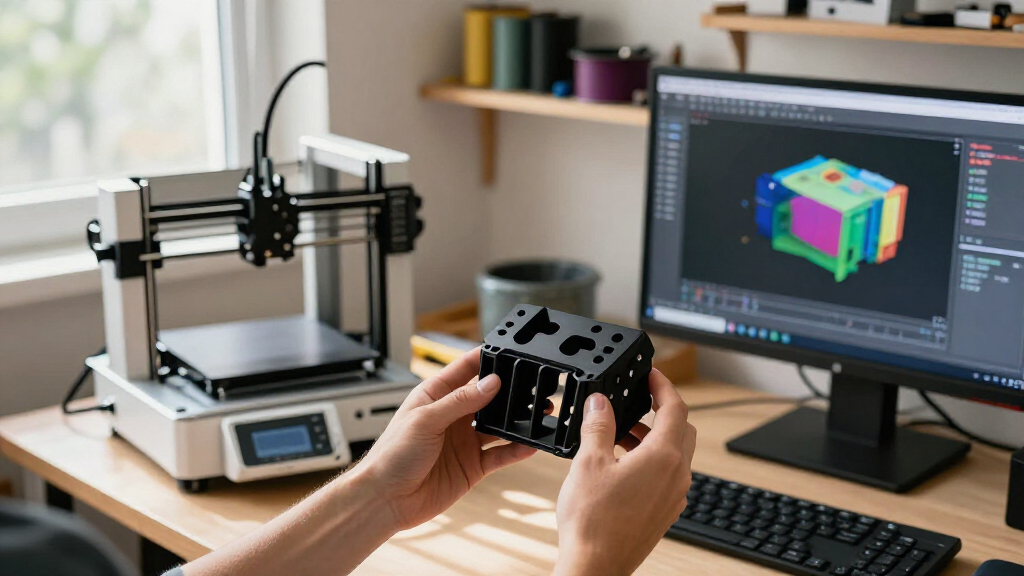
🔍 Read the full analysis: AI In 3D Printing: Better Part Design Or Just More Hype? on ThorstenMeyerAI.com

Get the latest gadgets delivered free with Prime
- Fast, free delivery on millions of items
- Prime Video, Amazon Music and more included
- Member-only deals all year
TL;DR
AI is already being used to propose lighter part designs and monitor some 3D printing errors, according to NASA and University of Cambridge examples cited by ThorstenMeyerAI.com. The source says these tools do not remove the need for engineers to check designs and test printed parts, while text-to-CAD remains research rather than a dependable route from prompt to part.
AI tools can help engineers shape 3D-printed parts and detect some printer errors, but they do not yet make a part reliable without human review and testing, according to a November 29 report from ThorstenMeyerAI.com. The report points to NASA generative-design work and a University of Cambridge printer-monitoring system as practical examples, while describing text-to-CAD as research rather than a trusted production tool.
In the NASA example described by the report, engineers specify a part’s loads, connection points and areas that must remain clear. Generative-design software then proposes shapes that meet those constraints. A paper by NASA research engineer Ryan McClelland compares a bracket for the EXCITE balloon telescope: two engineers spent two days on a conventional design, while the AI-assisted process took about 30 minutes of engineering work to enter requirements and roughly one hour of computation. Those are timings for that example, not a general guarantee of savings.
The report also describes a Cambridge system for material-extrusion printers that uses a camera to identify and correct common nozzle errors during a print. That is a different task from designing a part: it monitors the manufacturing process rather than proving the finished object is sound. The report says AI-generated text-to-CAD is still at the research stage; software producing a model or executable code does not establish that the geometry is correct, printable or safe.
Across these applications, the stated limitation is that AI works from inputs and data, not physical experience. NASA engineer McClelland has warned that an algorithm “can sometimes make structures too thin.” The report says NASA’s AI-designed parts still undergo conventional stress analysis and testing, and that the agency has standards for printed flight hardware. It offers no evidence that AI monitoring or design tools replace those checks.
From idea to printed part: where AI looks over your shoulder
The orange marker shows where AI helps today. The last word still belongs to a real test.
Design: you set the loads, bolts and keep-out zones. The software proposes the shape.
Check: simulation predicts how the part bends. Only a real test shows how strong it is.
Print: a camera next to the nozzle spots common errors and corrects them during the print.
Every step: AI guesses from patterns. For parts that carry weight, people still test.
Design Speed Still Needs Engineering Checks
For engineers, generative design may reduce the time spent exploring shapes, particularly when a part has defined loads and restricted areas. But the output is only as sound as the requirements entered. Missing a force, fastener, clearance or manufacturing constraint can produce a model that looks efficient while failing the actual job. Faster design is not the same as verified design.
For home users, the nearer-term application described is a printer camera that flags problems as they arise. Such monitoring could help catch visible errors earlier, but it should be treated as an aid, not a guarantee. A camera cannot by itself establish the strength or safety of a finished part. For components that bear weight, protect people or are used in flight, physical testing and qualified human review remain central.
Popular right now

Hisense 55E6QF 55-Inch E6 Cinema Series 4K QLED Smart Fire TV

Dyson V8 Cordless Vacuum

Roborock F25 GT Gen 2 Cordless Wet-Dry Vacuum Mop
As an affiliate, we earn on qualifying purchases.
From CAD Model to Printed Part
The report follows the typical workflow: a designer creates a dimensioned model in computer-aided design (CAD), engineers analyze how it may respond to forces, and slicing software converts the model into layer-by-layer machine instructions. A printer then builds the object by adding material in successive layers. The source notes that failures can occur during fabrication and that reprinting is common, which helps explain the appeal of monitoring tools.
Different printing methods create different monitoring challenges. The Cambridge example concerns material extrusion, in which a nozzle deposits material, commonly plastic filament. Resin printing and powder-based metal printing use other processes, so findings about a nozzle-camera system should not automatically be applied to every type of 3D printer. The report also notes that legal rules affect AI-generated work: it says purely AI-made output does not receive U.S. copyright and that inventorship requires a human. Those points are legal context, not evidence about a design’s technical quality.
Reliability Beyond the Demonstrations
The source does not provide the Cambridge system’s error-detection rates, the number or range of prints tested, or independent evidence of performance across printer models and materials. It also does not give enough detail to compare the NASA bracket’s final weight, stiffness or test results with the conventional design. The reported time figures apply to one case and should not be generalized to other engineering projects.
It remains unclear when text-to-CAD systems will be dependable for production use, or how broadly camera-based correction will work outside the reported setup. The report identifies no single performance benchmark that establishes when an AI-designed or AI-monitored part is safe. Those questions remain especially important for parts with safety-critical roles.
Human Validation Remains the Next Step
The next step for any AI-assisted part remains the established engineering process: review the requirements and model, assess likely stresses and manufacturing constraints, then test the printed component for its intended use. The report does not announce a new product launch, regulatory change or timetable for wider deployment. Instead, it describes tools already being explored and the checks that continue to accompany them.
As generative-design and monitoring systems are evaluated in more settings, useful evidence will include measured error rates, repeatability across machines and materials, and test results for finished parts. Until such results are available for a specific tool and use case, AI is best understood as assistance within the workflow—not a substitute for engineering responsibility.
Key Questions
Can AI design a 3D-printed part on its own?
Not reliably on the evidence described in the report. Generative-design software can propose shapes after engineers enter constraints, but people still need to check the inputs and validate the result.
What did NASA’s design example show?
The report says NASA engineers used generative-design software for a bracket for the EXCITE balloon telescope. A NASA paper gives about 30 minutes to encode the requirements and roughly one hour of computing for the AI-assisted process, compared with two days of work by two engineers on the conventional design. These figures refer to that case.
Can AI tell whether a printed part is safe?
No safety determination is established by the examples in the report. A printer camera may detect certain process errors, but the report says parts still need engineering review and physical testing, particularly when they carry loads or protect people.
Is text-to-CAD ready for dependable production use?
The report characterizes text-to-CAD as research, not a tool that can yet be trusted to turn a sentence into a correct, safe part. A generated model or code that runs does not prove the design is fit for use.
Source: ThorstenMeyerAI.com