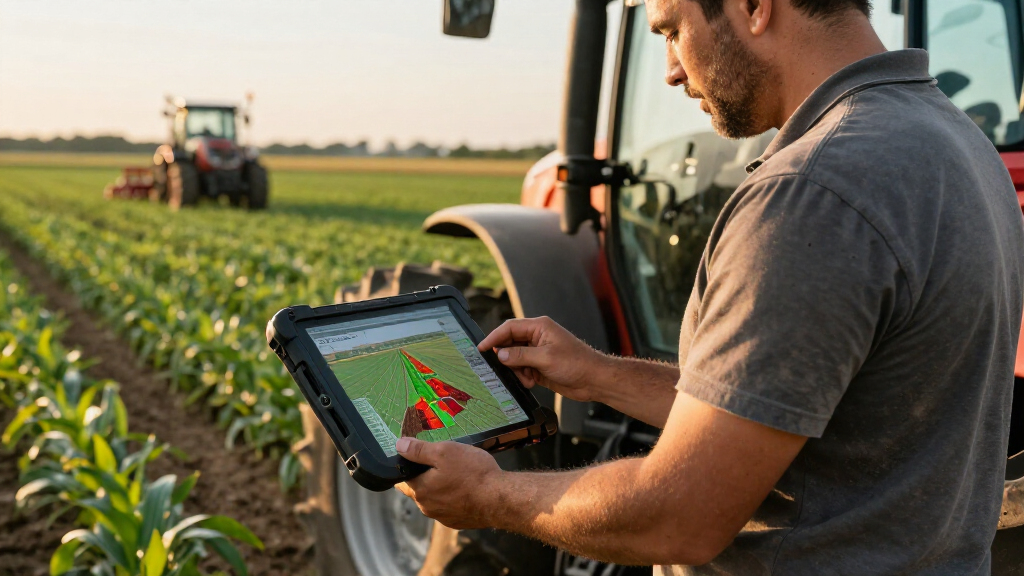
🔍 Read the full analysis: What AI Adoption Looks Like On Today’s Farms on ThorstenMeyerAI.com

Get the latest gadgets delivered free with Prime
- Fast, free delivery on millions of items
- Prime Video, Amazon Music and more included
- Member-only deals all year
TL;DR
Farm automation is established in some tasks, including satellite-guided tractors and robotic milking, but it is uneven across farms and crops. Data in the source show that large farms adopted precision tools earlier, while labor-intensive strawberry harvesting remains difficult to automate. The figures describe precision agriculture and farm machinery broadly; they do not establish that every system uses AI.
Farm automation is already changing tractor guidance and dairy milking, but it has not displaced workers across the sector: a November 29 report from ThorstenMeyerAI.com describes adoption concentrated on large farms and in tasks that are easier to mechanize, while strawberry picking remains largely manual. The evidence points to a varied picture of agricultural technology—not a single wave of AI replacing farm labor.
U.S. Department of Agriculture data cited in the report show auto-steer systems were used on 5.3% of planted U.S. corn acres in 2001 and 58% in 2016. By 2019, guidance systems were used on more than half of the acres planted to corn, soybeans, winter wheat and cotton, though the figures come from different years for each crop. These systems help guide machinery; the figures alone do not show that all such equipment uses AI.
Adoption looks less widespread when counted by farms rather than acres. The USDA’s 2025 survey found 22% of U.S. farms used at least one precision agriculture practice in the previous 12 months, down from 27% in 2023. The category includes GPS guidance, yield monitoring, soil mapping, variable-rate applications, drones, electronic tagging, precision feeding and robotic milking. In 2016, guidance was used by 73% of the largest corn farms and 10% of the smallest, according to the report’s cited USDA data.
In Germany, the national statistics office counted 8,800 dairy farms using automatic milking systems in 2023, or 19% of the country’s dairy farms. Harvesting soft fruit remains a different challenge. A 2024 University of California cost study cited by the report found that harvesting accounted for about two-thirds of costs in organic strawberries. The report says commercial strawberry robots now operate on table-top systems, rather than picking fruit in conventional soil-grown fields.
Infographic 01 · Precision farming
Most acres, not most farms
Satellite steering took over most of America’s big crop fields, but only about one US farm in five uses any precision farming. The big farms adopt first.
US corn · share of planted acres with auto-steer (ERS, ARMS)
Guidance systems by 2019 · share of planted acres (ERS)
US farms using any precision agriculture practice · share of farms (NASS)
US corn farms using guidance, 2016 · by farm size (ERS)
Germany, 2023 · dairy farms with milking robots (Destatis)
Acre shares (ERS, by crop and survey year) and farm shares (NASS) are different measures and not directly comparable. Before 2018, ERS “guidance” means auto-steer without lightbars. NASS counts GPS guidance, yield monitoring, soil mapping, variable rate, drones, electronic tagging, precision feeding and robotic milking.
Sources: USDA ERS, EIB-248 (2023); USDA ERS, Amber Waves (April 2023); USDA NASS, Technology Use (August 2025); Destatis press release 204 (23 May 2024).
Powered by Thorsten Meyer AI
Automation Favors Large Farms and Easier Tasks
The figures matter because farm automation is not evenly distributed. A technology can cover a large share of acreage without being used by most farms, since large operations tend to manage more land and adopt equipment earlier. The USDA data cited in the report show a sharp difference in guidance-system use between the largest and smallest corn farms.
That unevenness affects how readers should interpret claims that farming is already automated. GPS guidance can reduce the need for a person to steer a tractor continuously, and robotic milking can change the timing and routine of dairy work. But neither development means that all farm jobs or tasks have been automated. Harvesting delicate fruit still requires a level of handling that the report describes as difficult for current machines.
The labor stakes are visible in the report’s count of 398,258 temporary farm jobs certified for H-2A guest workers in U.S. fiscal 2025, compared with just over 48,000 in fiscal 2005. Certification counts do not, by themselves, explain labor demand or prove that automation caused a change. They do show why the limits of mechanization matter to farms that rely on seasonal workers.
Popular right now

KitchenAid Artisan 5-Quart Tilt-Head Stand Mixer, Almond Cream (KSM150PS)

Roborock F25 BX Cordless Wet/Dry Vacuum Cleaner

Dyson Cyclone V10 Origin Cordless Vacuum
As an affiliate, we earn on qualifying purchases.
From Yield Maps to Robotic Milking
The report traces precision farming’s development to tools introduced from the 1990s onward. USDA Economic Research Service data place the arrival of commercial yield monitors in 1993. Yield maps and soil maps followed, along with variable-rate technology that can alter the amount of seed or fertilizer applied across a field. Guidance aids appeared in the mid-1990s, with automatic steering following in the late 1990s.
A change to civilian GPS helped make satellite positioning more useful. On May 1, 2000, the U.S. government ended its deliberate degradation of the civilian GPS signal. The subsequent growth in tractor guidance shows how adoption can accelerate when infrastructure and equipment align. In dairy barns, robotic milking systems have a longer commercial history: the report says Dutch company Lely installed a prototype on two farms in 1992 and launched its system in 1995.
The strawberry example highlights the difference between navigating a field and handling individual produce. A 2014 review of 50 harvesting robots, as summarized in the source, reported an average success rate of 66% and 33 seconds per fruit, and found none on the market at that time. Those results describe the review’s historical evidence, not the performance of every current robot.
“Most acres, not most farms.”
— Thorsten Meyer, ThorstenMeyerAI.com
How Much Work Robots Can Replace
The source combines statistics from different years, countries and measures, so they do not provide a single current count of AI use on farms. The USDA’s precision agriculture category includes several practices, not all of which are AI systems. The report also gives no consistent measure of how much labor a guidance system or milking robot replaces, or how adoption affects farm employment and costs.
The strawberry evidence has limits as well. The 2014 review predates current commercial systems, while the source’s description of table-top strawberry robots does not specify their scale, output or labor savings. It remains unclear how widely those systems are used and whether they can work economically in conventional fields. The provided source also cuts off during its comparison of agricultural employment shares across regions, so no further figures from that section can be confirmed here.
Evidence to Watch on Farms
The next useful measures are updated adoption figures that separate farm size, crop, technology and acreage, alongside data on equipment costs, reliability and labor hours. For harvest robots, readers will need field-scale results rather than demonstrations alone: how quickly machines can pick delicate produce, what share of fruit they can harvest successfully, and whether farms can afford to use them.
Until those details are available, the evidence supports a task-by-task account: guidance systems and robotic milking are established in parts of agriculture, while strawberry picking remains a difficult case. Further claims about employment effects or the pace of AI adoption should be judged against clearly dated data and a defined measure of what counts as AI.
Key Questions
Are most U.S. farms using precision agriculture?
No. The USDA survey cited in the report found 22% of U.S. farms used at least one precision agriculture practice in 2025. The figure was 27% in 2023. Adoption by acreage can be higher because large farms operate more land.
Does tractor auto-steer mean the tractor is using AI?
Not necessarily. The source reports use of guidance systems, including GPS-based auto-steer, but does not establish that every system uses AI. Precision agriculture covers a range of tools and practices.
Are robots picking strawberries commercially?
The source says some strawberry robots are working commercially on table-top systems. It does not give their scale or labor savings, and says soft fruit in conventional soil-grown fields remains difficult to harvest mechanically.
How common are milking robots in Germany?
Germany’s statistics office counted 8,800 dairy farms with automatic milking systems in 2023, equal to 19% of the country’s dairy farms, according to the report.
Source: ThorstenMeyerAI.com