
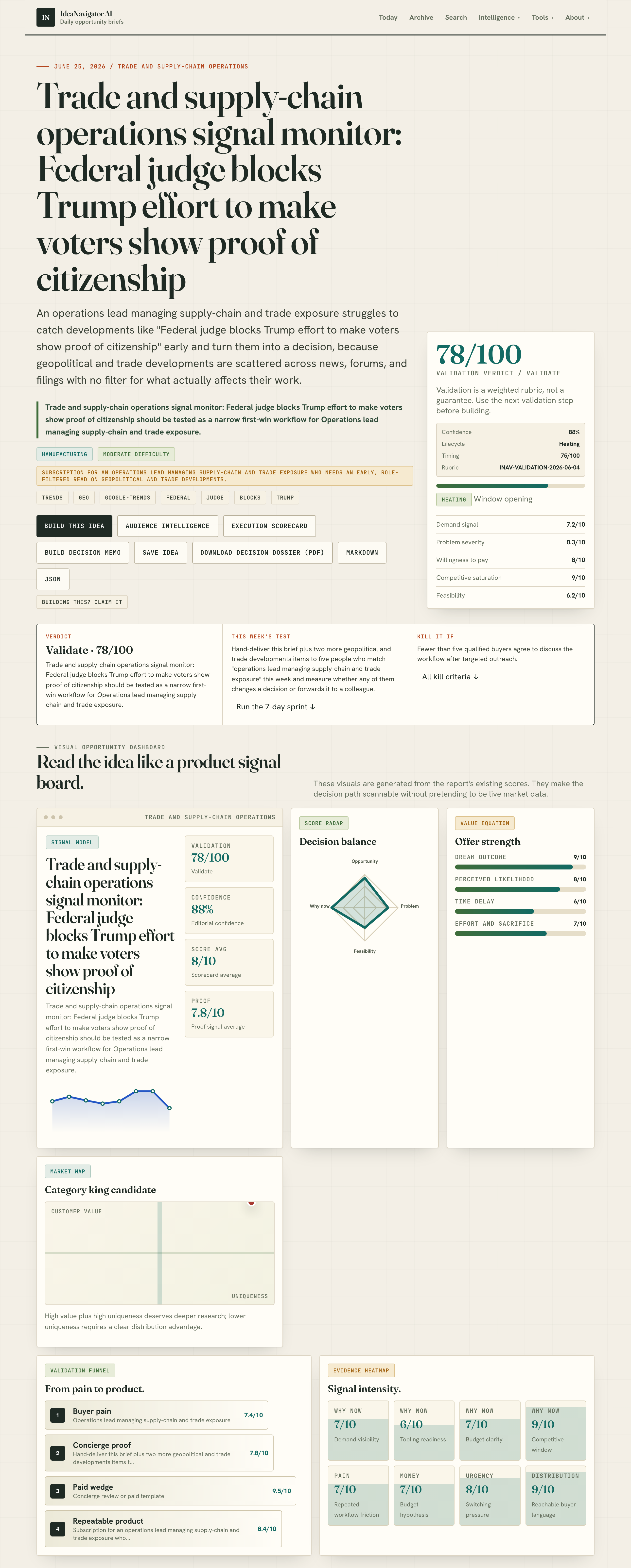
📊 Full opportunity report: Trade and supply-chain operations signal monitor: Federal judge blocks Trump effort to make voters show proof of citizenship on IdeaNavigator AI — validation score, market gap, and execution plan.

Get the latest gadgets delivered free with Prime
- Fast, free delivery on millions of items
- Prime Video, Amazon Music and more included
- Member-only deals all year
TL;DR
A federal judge has blocked Donald Trump’s effort to enforce proof-of-citizenship requirements for voters. This decision affects election procedures and has implications for trade and supply-chain operations tracking political developments.
A federal judge has blocked former President Donald Trump’s attempt to require voters to show proof of citizenship, marking a significant legal setback for that effort. The ruling impacts ongoing election procedures and is relevant for operations managing trade and supply-chain exposure, as political developments can influence market stability and regulatory environments.
The decision was issued by a federal district court, which found that the effort to mandate proof of citizenship was unlawful. This legal action effectively halts the implementation of the requirement, which was part of Trump’s broader efforts to tighten voting regulations. The ruling is viewed as a victory for voting rights advocates and legal opponents of the measure.
Trade and supply-chain operations monitoring suggest that political and legal developments like this can influence market stability, regulatory policies, and international trade relations. The decision’s timing, amid rising geopolitical tensions, underscores the importance of role-specific, real-time updates for operations leaders managing these exposures.
Implications for Trade and Political Stability
This ruling is significant because it reflects the ongoing legal contest over voting laws, which can have ripple effects on political stability and regulatory environments affecting trade. For operations managing supply-chain exposure, such legal decisions can signal shifts in policy that impact tariffs, import/export regulations, and geopolitical relations, ultimately influencing market conditions and risk assessments.
Popular right now

Dreame L40 Ultra Gen 2 Robot Vacuum and Mop with 25,000 Pa Suction

Apple AirPods Pro 3 Wireless Earbuds with Active Noise Cancellation

Samsung The Frame Pro LS03HW 65-inch Neo QLED TV with 27-Month Axiom Care
As an affiliate, we earn on qualifying purchases.
Legal Battles Over Voting Laws and Trade Impacts
In recent years, efforts to alter voting laws have become a focal point of political contention, with various legal challenges shaping the landscape. The specific effort to require proof of citizenship was part of a broader push by Trump and allies to tighten election security. The legal setback in this case follows similar rulings that have blocked restrictive voting measures. These developments occur against a backdrop of heightened geopolitical tensions, trade disputes, and evolving international trade policies, making timely monitoring essential for operations teams.
Unresolved Impacts on Future Voting and Trade Policies
It remains unclear how this ruling will influence future attempts to enforce similar voting restrictions or how it might affect broader trade policies linked to election outcomes. The legal landscape around voting laws continues to evolve, and further court actions or legislative responses are possible. For more on trade and supply-chain operations, see this monitoring resource.
Next Legal and Political Developments to Watch
Legal challenges to voting laws are likely to continue, with potential appeals or new legislation in different states. Additionally, trade and supply-chain operations teams should monitor political signals and legal rulings that could impact international trade relations, tariffs, and regulatory environments. The next key milestone is upcoming court decisions or legislative actions related to voting and trade policies.
Key Questions
What was the specific legal issue addressed by the court?
The court addressed the legality of former President Trump’s effort to require voters to show proof of citizenship, ruling that it was unlawful.
How might this ruling affect future voting laws?
The ruling could set a legal precedent that limits similar efforts to impose proof-of-citizenship requirements, influencing future voting legislation.
What are the potential trade implications of this legal decision?
While primarily a voting rights case, the decision impacts political stability, which can influence trade negotiations, tariffs, and market confidence.
Will this ruling impact international trade relations?
Indirectly, yes. Political stability and legal consistency are factors in international trade; this ruling supports a stable legal environment.
What should operations managers monitor next?
They should watch for further legal rulings, legislative actions on voting laws, and geopolitical developments that could influence trade policies and market conditions.
Source: IdeaNavigator AI