
📊 Full opportunity report: A Privacy-Focused Approach To Parental Consent Management on IdeaNavigator AI — validation score, market gap, and execution plan.

Get the latest gadgets delivered free with Prime
- Fast, free delivery on millions of items
- Prime Video, Amazon Music and more included
- Member-only deals all year
TL;DR
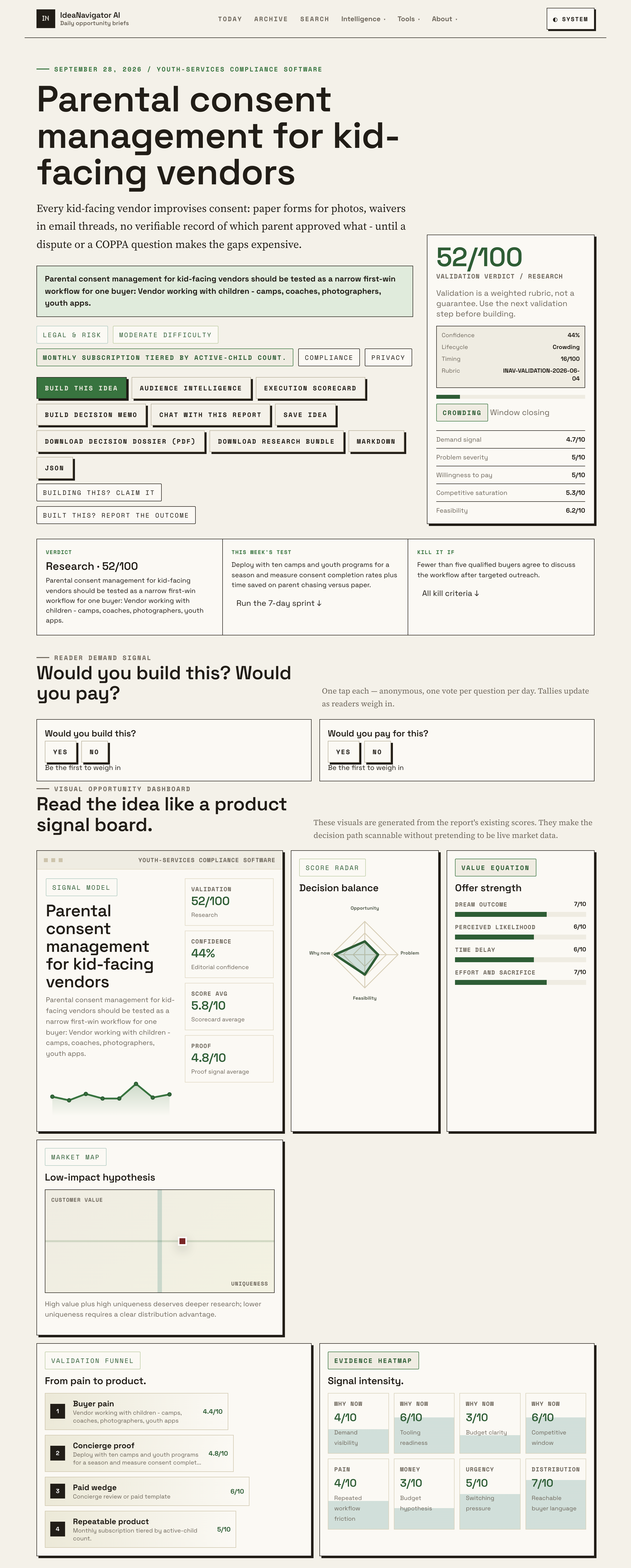
IdeaNavigator AI has published a product concept for a privacy-focused parental consent management platform aimed at small vendors serving children — camps, coaches, photographers and youth apps. The concept proposes vendor-branded mobile consent flows with per-child consent ledgers, expiry tracking and audit exports, monetized as a monthly subscription tiered by active-child count. It remains an unvalidated idea, with validation proposed through a pilot across ten camps and youth programs.
IdeaNavigator AI has published a product concept for a privacy-focused parental consent management platform aimed at small businesses that serve children — summer camps, sports coaches, photographers and youth apps. The concept responds to a documented gap: these vendors typically handle consent through paper forms, emailed waivers and scattered records, leaving them exposed when a parent disputes photo use or a regulator raises questions under the Children’s Online Privacy Protection Act (COPPA). The idea is framed as a narrow, buildable first product rather than a broad enterprise compliance suite.
According to the concept, the proposed product would give each vendor a vendor-branded consent flow that parents complete on their smartphones. Rather than one generic permission, the flow would cover distinct consent categories — photo use, data collection, medical authorization and liability waivers — so that a camp director or photographer could show exactly what a given parent agreed to, for which child, and when.
The design places identity verification at its center, but calibrates it to risk. The concept describes identity verification appropriate to the risk tier, an acknowledgment that verifying a parent’s identity for a summer camp photo release need not carry the same friction as a higher-stakes authorization. Each child would have a per-child consent ledger, a running record of what has been approved and refused, along with expiry tracking so that time-limited permissions lapse rather than silently persisting indefinitely.
For vendors facing a dispute or a regulatory inquiry, the concept proposes an instant audit export — the ability to produce a verifiable record of which parent approved what without reconstructing history from email threads. The business model outlined is a monthly subscription tiered by active-child count, which the concept positions as affordable for small operators because cost scales with actual usage rather than flat enterprise pricing.
Why Small Youth Vendors Are Exposed
The concept targets a compliance blind spot that rarely makes headlines until it becomes a liability. A camp that collects photo permissions on paper, a coach who stores waivers in an inbox, and a youth photographer with no verifiable record of which parent approved image use all share the same structural problem: consent exists, but it cannot be demonstrated when challenged. According to the concept’s framing, disputes and COPPA questions make those gaps expensive only after the fact.
The timing argument rests on two converging pressures. Children’s privacy enforcement is expanding, through COPPA updates and a growing patchwork of state privacy laws, and parents are increasingly likely to challenge how photos and data about their children are used. Together, these forces push even very small vendors — the market segment least equipped to build compliance tooling in-house — toward defensible consent records. A lightweight, subscription-based tool lowers the barrier for operators who cannot afford legal review or custom software.
The Paper-Form Status Quo in Youth Services
The concept sits in the youth-services compliance software market, a category that has historically been dominated by registration and payments platforms rather than consent-specific tooling. Camps and youth programs commonly run consent on improvised infrastructure: printed photo releases collected at check-in, waiver language buried in registration emails, and medical authorizations kept in binders. The concept argues this improvisation worked acceptably when parental expectations and regulatory attention were lower, but that the environment has shifted.
IdeaNavigator AI frames the idea explicitly as a narrow first-win workflow for a single buyer type — the vendor working directly with children — rather than an attempt to serve schools, districts or large platforms at launch. That scoping reflects a common product-strategy judgment: consent management for large institutions involves procurement cycles and integration demands that a small startup cannot initially satisfy, while a camp buying a tool before the summer season can decide quickly.
What Is Still Only a Concept
The publication is a product concept, not a released product. No company, founding team or shipping software is identified, and no customers are claimed. Several elements remain undefined: the concept does not specify which identity-verification methods would map to which risk tiers, how verification would satisfy regulators in practice, or how the per-child pricing would translate into actual subscription figures.
It is also unclear how the proposed tool would interact with COPPA’s specific verifiable-consent requirements for online services aimed at children, which carry standards that a self-reported parent attestation may not meet in all cases. Whether an audit export from a third-party tool would be accepted as sufficient evidence in a dispute or inquiry is likewise untested. The concept does not claim any pilot results, and no completion-rate or time-saved data exists yet.
The Ten-Camp Pilot Test
The concept’s own proposed next step is a bounded field test: deploy the consent flows with ten camps and youth programs for a full season, then measure two specific outcomes — consent completion rates and time saved chasing parents compared with paper processes. Those metrics would determine whether the workflow genuinely reduces administrative burden or simply digitizes the same friction.
Anyone building on the concept would need to resolve the open questions around identity verification, regulatory alignment and pricing before that pilot. The seasonal nature of the youth-services market also sets the clock: a camp-season pilot is the natural validation window, and missing it means waiting roughly a year for comparable conditions. No pilot has been announced as underway.
Source: IdeaNavigator AI
Key Questions
Is this an available product I can buy today?
No. It is a published product concept from IdeaNavigator AI. No shipping software, company or customer base has been announced, and the concept itself proposes a validation pilot before further development.
Who would the platform be for?
The target buyer is any small vendor working directly with children — camps, coaches, photographers and youth apps — that currently manages consent through paper forms and email and lacks a verifiable record of parental approvals.
How would the platform make money?
Through a monthly subscription tiered by active-child count, so a small program with few participants pays less than a large camp. Specific pricing has not been set out in the concept.
What makes this approach privacy-focused?
The design emphasizes per-child consent ledgers, risk-tiered identity verification, consent expiry tracking and audit exports, so records are granular, time-limited and demonstrable rather than indefinite and unverifiable.
How would anyone know whether the idea actually works?
The concept proposes deploying with ten camps and youth programs for one season and measuring consent completion rates and time saved against paper-based workflows. No such pilot has been run or announced yet.
Source: IdeaNavigator AI
Halloween Picks
halloween
As an affiliate, we earn on qualifying purchases.