📊 Full opportunity report: Improving Social Care Access With AI-Powered Benefit Check Solutions on IdeaNavigator AI — validation score, market gap, and execution plan.

Get the latest gadgets delivered free with Prime
- Fast, free delivery on millions of items
- Prime Video, Amazon Music and more included
- Member-only deals all year
TL;DR
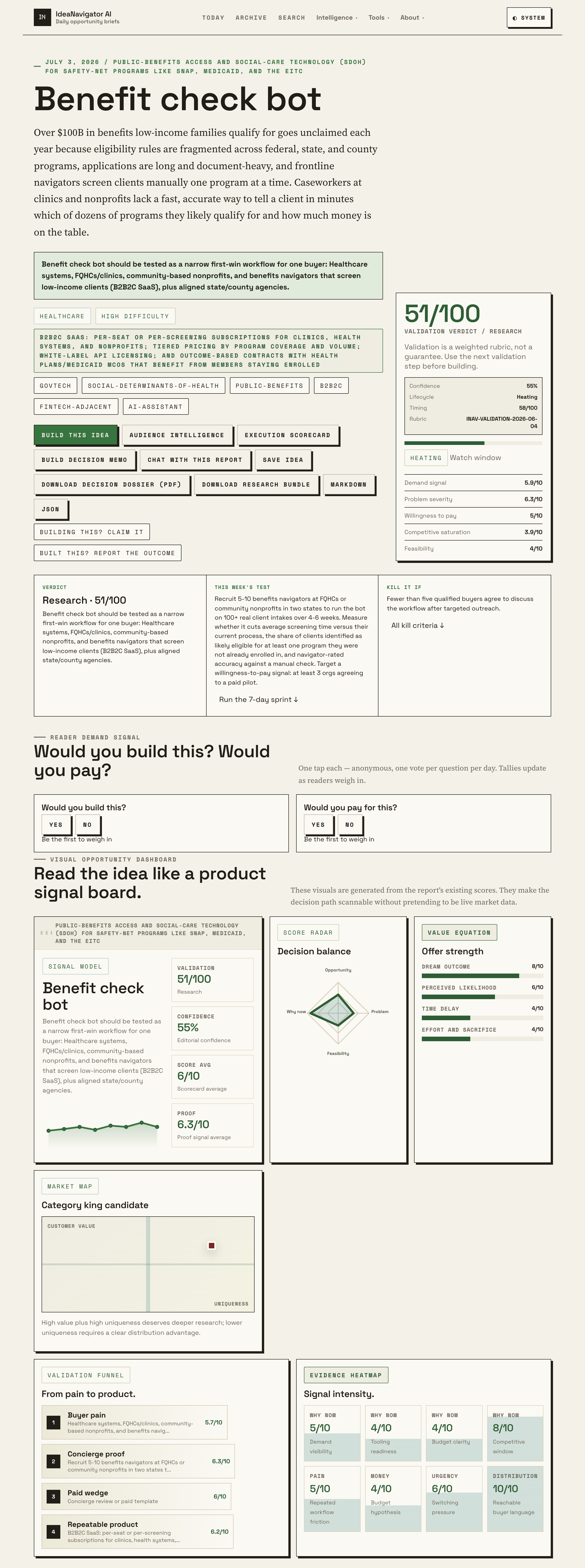
A new AI-driven benefit screening tool is being tested to help clinics and nonprofits quickly identify eligible low-income clients for benefits like SNAP and Medicaid. It aims to reduce manual effort and increase access to unclaimed benefits, filling a significant gap left by a nonprofit closure.
Potential to Transform Benefits Access for Low-Income Families
This AI-powered screening solution could significantly enhance the efficiency and reach of social care programs, helping to close the estimated $100 billion annual benefits gap for low-income families. By reducing manual screening time and increasing accuracy, the tool may enable more eligible individuals to access vital assistance quickly, especially amid increased redeterminations following Medicaid unwinding. Its deployment could also relieve overburdened caseworkers and improve overall program enrollment rates, making social safety-net systems more effective and equitable.benefit eligibility screening software
As an affiliate, we earn on qualifying purchases.
As an affiliate, we earn on qualifying purchases.
Post-Nonprofit Closure and Pandemic-Driven Benefits Redeterminations
The closure of Benefits Data Trust in 2024, a nonprofit that had been screening and enrolling clients across seven states, left a gap in outsourced benefits access. Meanwhile, the post-pandemic period has seen a surge in Medicaid redeterminations, forcing millions through eligibility checks that strain existing resources. These factors have created a pressing need for scalable, automated solutions that can assist frontline workers in efficiently identifying benefits eligibility across multiple programs. Advances in conversational AI now make it feasible to deliver multilingual, multi-program screening at near-zero marginal cost, a significant shift from traditional manual processes and call-center-based approaches.As an affiliate, we earn on qualifying purchases.
Uncertainties Around Pilot Outcomes and Adoption Challenges
It is not yet clear how effectively the pilot will reduce screening times, improve eligibility detection, or be adopted by frontline workers at scale. The success depends on real-world performance, user acceptance, and integration with existing workflows, which are still being evaluated during the pilot phase.AI-powered benefits eligibility checker
As an affiliate, we earn on qualifying purchases.
As an affiliate, we earn on qualifying purchases.
Next Steps Include Pilot Evaluation and Broader Deployment Planning
The pilot testing will run over 4-6 weeks, during which participating organizations will measure screening efficiency, accuracy, and user satisfaction. If results are positive, developers plan to expand the tool to additional states and programs, refine features based on feedback, and pursue broader licensing and integration opportunities. Stakeholders will also explore outcome-based contracts with health plans to incentivize improved enrollment and retention.Medicaid and SNAP application assistance tools
As an affiliate, we earn on qualifying purchases.
As an affiliate, we earn on qualifying purchases.
Key Questions
How does the benefit check bot work?
The bot is a conversational tool that asks clients a series of yes/no and multiple-choice questions to assess eligibility for various social programs, then provides an estimated benefit amount and next steps for application.
Who is testing this AI tool?
Five to ten benefits navigators at Federally Qualified Health Centers and community nonprofits across two states are participating in the pilot.
What benefits programs does it screen for?
The initial version covers programs such as SNAP, Medicaid, EITC, WIC, and LIHEAP.
When will the pilot results be available?
The pilot is expected to run over 4-6 weeks, with results assessed shortly afterward to determine wider deployment plans.
Will this replace human benefits navigators?
The tool is designed to assist, not replace, frontline workers by reducing manual screening workload and increasing accuracy.
Source: IdeaNavigator AI
Fall Picks
fall essentials
As an affiliate, we earn on qualifying purchases.