
TL;DR

Get the latest gadgets delivered free with Prime
- Fast, free delivery on millions of items
- Prime Video, Amazon Music and more included
- Member-only deals all year
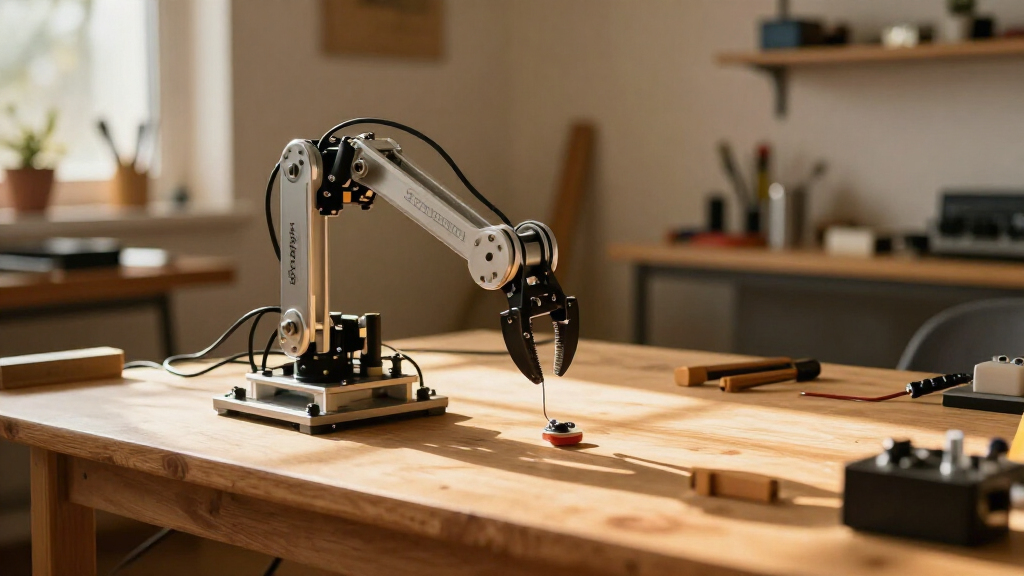
Neufangled Robotics has presented Stringman, a $795 open-source robot that moves a gripper through a room using lines suspended from four ceiling-mounted anchors. The company says it can carry an average payload of 1.9 kilograms in a specified room configuration, but those performance figures come from the maker, and independent verification is not provided in the source material.
Neufangled Robotics is presenting Stringman, an $795 open-source robot that uses four ceiling-mounted anchors and tensioned lines to move a gripper around a room. The company says the system can carry an average payload of 1.9 kilograms in a 7-by-7-by-3-meter room, offering a different approach to moving objects than a conventional robot arm or floor-based mobile robot.
Stringman’s four lines run from anchors mounted near the ceiling to a shared gripper, letting the system position objects within the space beneath them. Neufangled says the robot reaches floors and areas that may be difficult for wheeled or legged machines when the floor is cluttered. Unlike a fixed-base arm, its operating area is defined by the room and anchor placement, not just the reach of a single arm.
The company lists a maximum payload of up to 2.2 kilograms near the floor and an average payload of 1.9 kilograms for its stated room configuration. Those figures are calculated at a 28-newton line-tension limit and exclude the 638-gram gripper and marker. Neufangled also reports a traverse speed of about 0.4 meters per second. The source does not provide an independent performance test.
The listed hardware includes 3D-printed parts, a Raspberry Pi Zero 2 W on the gripper and Raspberry Pi 3A+ units at the anchors; a separate computer runs the controller. The robot uses cameras at two anchors and a camera on the gripper, with 5 GHz Wi-Fi listed for system connectivity, while the gripper itself uses 2.4 GHz. The maker says installation requires secure mounting to wall studs or structural columns, connecting the lines and running a calibration process that takes about five minutes.
A Different Kind of Room-Scale Reach
Stringman’s central proposition is that room coverage need not require a mobile base or long robot arm. By suspending the gripper from above, it can work across a broad floor area without driving through obstacles on the ground. That could be useful in a home lab where equipment is spread between workstations, or where floors are too crowded for a mobile robot.
The cost and performance comparisons on Neufangled’s site are the company’s own calculations, not independent benchmarks. It compares Stringman with a 0.75-meter, seven-actuator arm using the same model of direct-drive actuator, and says its room-scale system has a higher average payload in the specified setup. It also claims roughly 500 times the work-area volume per dollar compared with a research arm. These comparisons depend on the chosen room, payload assumptions and what counts as usable work area; they should not be read as a general finding about all robot arms.
The design also makes trade-offs visible: the robot’s reach comes from lines crossing the room and hardware mounted near the ceiling. Neufangled says the lines sit overhead when the robot is parked, but they remain part of the installed system. A suitable room, secure mounting points and clearance from low-hanging objects are prerequisites, limiting where it can be used.
Popular right now

Dreame L40 Ultra Gen 2 Robot Vacuum and Mop with 25,000 Pa Suction

Dreame G10 Pro Wet and Dry Vacuum Mop

Apple AirPods Pro 3 Wireless Earbuds with Active Noise Cancellation
As an affiliate, we earn on qualifying purchases.
How the Cable System Works
In a cable-driven robot, multiple lines position a shared tool by changing their lengths and tensions. Stringman places four anchors near the room’s ceiling corners, creating a work area within them. According to Neufangled, the motors share the lifting load, so the payload varies with the gripper’s position; the company says it is highest near the center, where the lines distribute the load more evenly.
The project is presented as open source and OSHWA certified. Neufangled says it has published mechanical CAD, circuit-board designs, software, STL files, a bill of materials and a build guide. It describes local-network operation, with the interface served locally and AI models running on the owner’s hardware; remote access is an optional account-linked feature, according to the site.
The maker reports about 1,000 hours of testing in real homes accumulated so far. That is a company-reported test history, rather than a published independent evaluation. The source also describes Python API and MCP-server support aimed at home-lab workflows and agent-driven control, alongside options for collecting training data and using robot-learning models.
““Tension is all you need.””
— Neufangled Robotics, describing the design
Performance and Installation Questions
The available source is a product presentation from Neufangled, not an independent review or test report. It does not explain the measurement procedure behind the payload and speed figures, provide results across different room layouts, or specify how those figures change with repeated use and varying line angles. The reported 1,000 testing hours are not accompanied by a test log or breakdown of failures.
Installation is also room-dependent. The company specifies rooms with dimensions within stated limits and requires anchors to be secured to studs or structural columns. It says rooms with low objects near the center may not be suitable, while anchor placement can keep lines clear of a ceiling fan in some configurations. How well the system performs in homes with different layouts, mounting materials and everyday activity is not established in the supplied information.
Neufangled says the motors relax when line tension reaches 28 newtons, allowing the lines to be pulled loose. That description is not a substitute for independent safety testing, and the source does not provide details about certification beyond OSHWA certification of the open-source project. It also does not state whether the $795 price includes shipping, taxes, a computer for control or all required installation hardware.
Availability and Independent Testing
The company’s site provides design files, a bill of materials, build instructions and software for people interested in assembling Stringman. Prospective builders will need to confirm that they have suitable mounting points, adequate ceiling clearance and a computer capable of running the controller. The source does not specify a shipping schedule, production volume or a retail purchase process beyond presenting the system at a listed price of $795.
The next useful evidence would include independent measurements of payload, repeatability, speed and reliability across rooms with different dimensions, as well as further detail about installation and safety. Until such results are available, the stated specifications and comparisons should be treated as manufacturer-reported figures. The source does not give a date for a further announcement or testing milestone.
Key Questions
What is Stringman?
Stringman is a four-motor, cable-driven robot from Neufangled Robotics. Ceiling-mounted anchors suspend a gripper that can move through the space beneath them.
How much does it cost, and what can it carry?
Neufangled lists the robot at $795. The company reports an average payload of 1.9 kilograms and up to 2.2 kilograms near the floor in a specified room setup, excluding the gripper and marker. Those figures have not been independently verified in the provided material.
Does it work in any room?
No. The maker specifies room-size limits and says the anchors must be secured to wall studs or structural columns. Low-hanging objects near the center of the work area may prevent installation; suitable clearance and mounting points are needed.
Is Stringman open source and locally controlled?
Neufangled says it has published the mechanical CAD, circuit-board designs and control software, and that Stringman can operate on a local Wi-Fi network with models running on the owner’s computer. Remote operation is described as an optional account-linked feature.
How well has it been tested?
The company reports approximately 1,000 hours of testing in real homes. The supplied information does not include independent test results or a detailed record of those trials.
Source: neufangled.com