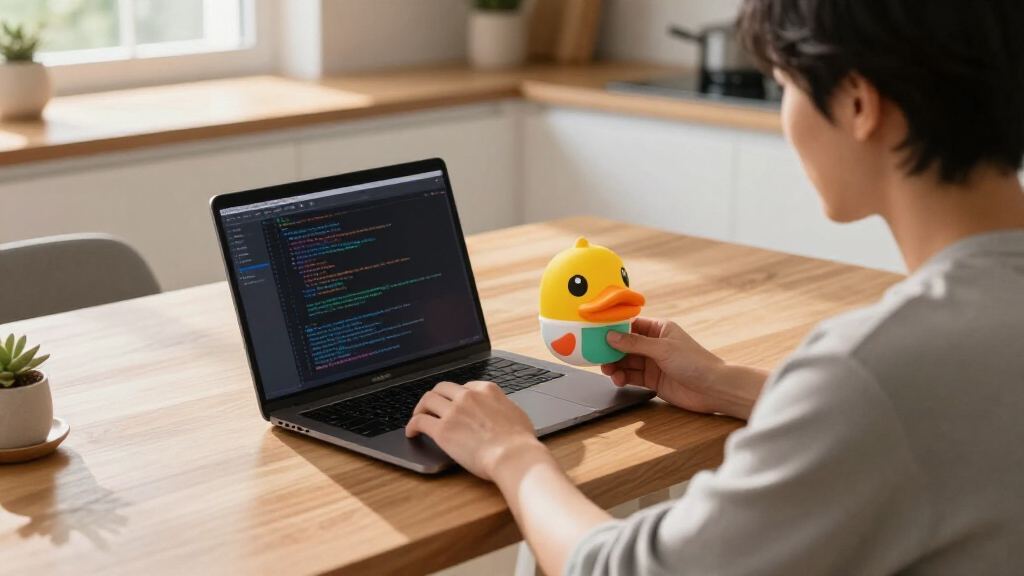
📊 Full opportunity report: The Microduck Toy Masks A Robust Open Stack AI Engine on ThorstenMeyerAI.com — validation score, market gap, and execution plan.
TL;DR
Hugging Face unveiled Microduck, a compact robot with a fully open reinforcement learning platform, aiming to democratize physical AI development. The device is designed for movement, learning, and experimentation at a low cost.
Hugging Face has introduced Microduck, a small, affordable robot equipped with a fully open reinforcement learning platform, marking a significant shift in accessible embodied AI development. Priced at $399 and available for preorders, the robot is designed to be a flexible, learnable platform for developers and researchers, not just a toy.
Microduck is a 25cm tall, lightweight bipedal robot built in collaboration with Pollen Robotics, featuring 15 motors, IMUs for balance, a camera, microphone, WiFi, Bluetooth, and LiDAR. Its articulated beak doubles as a gripper capable of lifting objects up to 800 grams. The robot can perform movements such as waddling, sitting, crouching, recovering from falls, following laser pointers, and rollerblading in demo videos.
Preorders started on March 14, 2024, with shipments expected before Christmas. While the hardware impresses for its price, experts caution that the robot’s demonstrations—like rollerblading and sock retrieval—are curated highlights, and real-world reliability will require extensive tuning. The device includes sensors and cameras that collect data in the home environment, raising privacy considerations.
Hugging Face is doing to robotics what it did to model weights: making the substrate open, cheap, and forkable. The duck is the marketing. Open embodied RL at $399 is the story.
Open Reinforcement Learning Platform for Embodied AI
This launch signifies a major step toward democratizing physical AI development. By providing an open, affordable, and forkable platform, Hugging Face aims to lower barriers for developers and researchers, enabling broader experimentation and innovation in robotics. The emphasis on open-source tools mirrors the company's success with open model weights in software, now applied to tangible, embodied systems. This could accelerate progress in robotics, making advanced AI behaviors accessible outside of well-funded labs, and fostering a new wave of community-driven robotics projects.affordable open source robotics kit
As an affiliate, we earn on qualifying purchases.
As an affiliate, we earn on qualifying purchases.
Background on Open-Source Robotics and Hugging Face's Strategy
Hugging Face has established itself as a leader in open AI models, promoting transparency and community collaboration. The company's recent acquisition of Pollen Robotics in April 2025 expanded its focus into embodied AI and robotics. The Microduck project builds on this strategy, aiming to replicate the success of open software in the physical realm. Historically, robotics has been dominated by proprietary systems and high costs, limiting widespread experimentation. The open-source movement in AI, exemplified by Hugging Face, has challenged this paradigm, and Microduck represents a deliberate effort to extend this approach into embodied, physical AI systems.
Prior initiatives like the Reachy Mini demonstrated the company's interest in accessible, programmable robots. Microduck takes this further by integrating reinforcement learning, making the platform capable of learning new behaviors through trial and error, with open tools available for developers to modify and expand.
"Our goal is to make embodied AI as approachable and open as software development. Microduck is a step toward that future, where anyone can teach a robot new tricks."
— Clem Delangue, CEO of Hugging Face
micro robot with reinforcement learning platform
As an affiliate, we earn on qualifying purchases.
As an affiliate, we earn on qualifying purchases.
Security and Privacy Concerns Surrounding Open Robotics
While the platform is openly accessible, questions remain about data privacy and security, especially given recent incidents involving open AI infrastructure. The device's sensors collect data in home environments, raising privacy considerations that users should evaluate. Additionally, the security implications of an open, network-connected robot are still being assessed, with potential risks of hacking or misuse not fully understood at this stage.
As an affiliate, we earn on qualifying purchases.
Next Steps for Development and Community Engagement
Hugging Face plans to release detailed documentation, training tools, and community forums to support developers in customizing and expanding Microduck's capabilities. The company also aims to gather feedback from early adopters to improve hardware reliability and software robustness. Future updates may include new movement behaviors, expanded sensor integration, and enhanced safety features. The broader goal is to foster a community of open-source developers contributing to embodied AI advancements.
robot with IMUs and LiDAR for experimentation
As an affiliate, we earn on qualifying purchases.
As an affiliate, we earn on qualifying purchases.
Key Questions
Can Microduck perform household chores?
No, Microduck is designed as a learning and experimentation platform, not a household robot. Its demonstrations, like sock retrieval, are curated highlights, and real-world reliability will require extensive tuning.
What makes Microduck's AI platform open?
The SDK, simulation environment, and reinforcement learning training stack are all available on GitHub, allowing developers to read, fork, and retrain the system freely.
Are there privacy concerns with Microduck?
Yes, since the robot includes cameras, microphones, and sensors that operate in home environments, users should consider data privacy and security implications when deploying the device.
Will Hugging Face's acquisition by Nvidia affect Microduck?
While the acquisition is still unconfirmed, it suggests potential strategic alignment, but the open platform approach is likely to continue regardless of corporate ownership changes.
Source: ThorstenMeyerAI.com