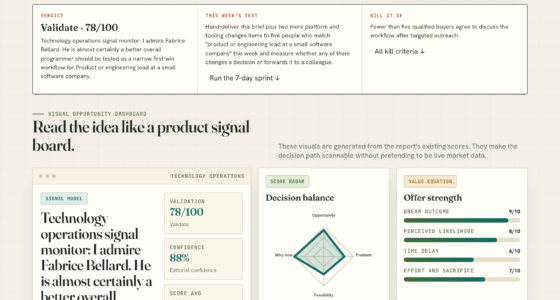

📊 Full opportunity report: Single Digits: The April That Closed the Open-Weight Gap on ThorstenMeyerAI.com — validation score, market gap, and execution plan.

Get the latest gadgets delivered free — and shop member deals
- Fast, free delivery on millions of items
- Access to Prime Big Deal Days deals on October 6–7
- Prime Video, Amazon Music and more included
TL;DR
In April 2026, the gap between open-weight and closed models closed to single digits on key benchmarks, challenging the premium pricing of proprietary AI APIs. This shift impacts enterprise AI costs, model selection, and regulatory considerations.
In April 2026, the performance gap between open-weight and proprietary closed models on major AI benchmarks has narrowed to a single-digit margin, fundamentally altering enterprise AI economics and strategic choices. This marks a turning point, with open models now rivaling closed models on key tasks at a fraction of the cost, according to recent benchmark data.
During April 2026, six labs released major open-weight models, including DeepSeek V4-Pro, Qwen 3.6-35B-A3B, Llama 4, Gemma 4, Mistral Small 4, and Zhipu AI’s GLM-5. These models achieved benchmark scores within a few points of leading closed proprietary models across categories such as reasoning, coding, and multimodal tasks. The performance gap, previously exceeding 30 points in some cases, has now shrunk to below 10 points in all evaluated areas, according to industry sources.
This convergence has significant implications for enterprise AI deployment. The cost advantage of open models—hosting on own infrastructure rather than paying per token API fees—means that organizations can now operate at a fraction of previous costs while maintaining comparable performance. The crossover point, which once took years, now occurs within months, dramatically shifting the economics of AI adoption and scaling.
Implications for Enterprise AI Cost and Strategy
The narrowing of the performance gap means enterprises can now consider open-weight models as a viable alternative to expensive proprietary APIs, potentially reducing costs by up to 90%. This shift also alters model selection strategies, emphasizing routing and workflow integration over model exclusivity. Additionally, the increased availability of high-performing open models raises questions about data sovereignty, licensing, and regulatory compliance, especially as some open models originate from Chinese labs with different licensing terms.
enterprise AI model hosting solutions
As an affiliate, we earn on qualifying purchases.
As an affiliate, we earn on qualifying purchases.
April 2026 Industry Model Releases and Benchmark Trends
Throughout April 2026, multiple AI labs released high-capacity open-weight models, including DeepSeek V4-Pro with one trillion parameters, and others from Alibaba, Meta, Google, Mistral, and Zhipu AI. These releases followed recent benchmark evaluations showing that open models now outperform previous expectations, closing the gap with closed models on tasks such as reasoning, code generation, and multimodal understanding.
Historically, proprietary API models commanded premium prices due to their superior performance and closed weights. However, recent advances in distillation, open training, and inference hardware have enabled open models to achieve comparable results, challenging the previous market dominance of closed models.
“The benchmark gap between open and closed models is now in the single digits on every evaluation enterprises actually pay for.”
— Thorsten Meyer
open-weight AI models for business
As an affiliate, we earn on qualifying purchases.
As an affiliate, we earn on qualifying purchases.
Uncertainties Around Long-Term Model Performance and Adoption
While benchmark scores show promising convergence, it remains unclear how open models will perform in real-world, large-scale enterprise deployments over time. Questions about robustness, fine-tuning, safety, and regulatory compliance for open weights are still unresolved, and the long-term durability of this performance parity is uncertain.
As an affiliate, we earn on qualifying purchases.
Next Steps in Open-Weight AI Development and Market Dynamics
Expect closed-model labs to intensify efforts to raise the performance bar, potentially re-opening the gap temporarily. Meanwhile, enterprises are advised to pilot open-weight models for cost savings and flexibility. Regulatory discussions around licensing, sovereignty, and inference hardware are likely to intensify as open models become more competitive and widespread.
AI model deployment infrastructure
As an affiliate, we earn on qualifying purchases.
As an affiliate, we earn on qualifying purchases.
Key Questions
What does the narrowing gap mean for AI pricing models?
The cost advantage of open models makes proprietary API pricing less justifiable, prompting enterprises to consider self-hosted solutions and altering the economics of AI deployment.
Are open models now as reliable as closed proprietary ones?
Benchmark scores suggest comparable performance on specific tasks, but real-world robustness, safety, and compliance remain areas needing further validation.
Will this trend continue, or is it a temporary convergence?
Industry experts believe this is a sustained trend, but the pace of future improvements by closed labs is uncertain, and re-competition could temporarily widen gaps again.
How does this impact licensing and data sovereignty concerns?
Open models from Chinese labs and others introduce new considerations around licensing terms, licensing restrictions, and regulatory compliance, influencing procurement decisions.
Source: ThorstenMeyerAI.com
Fall Picks
fall essentials
As an affiliate, we earn on qualifying purchases.