
This checklist is for anyone planning a home media upgrade and sorting out which parts of a setup deserve attention first. It covers a projector, soundbar, screen, HDMI switcher, TV backlight kit, and universal remote.

Get the latest gadgets delivered free with Prime
- Fast, free delivery on millions of items
- Prime Video, Amazon Music and more included
- Member-only deals all year
The sections are organized by the role each pick can play in a home media setup: display, sound, screen, connections, lighting, and control. Use the list to focus on the part of your setup you want to improve, then consider how each item fits with the equipment you already have.
Before choosing, check your room, screen or TV size, available connections, and the devices you want to control. Read each section’s look-for list as a prompt to confirm fit and compatibility against your own setup.
Streaming device
A streaming device is a useful slot to consider when you want a projector-centered setup. The WiMiUS G2 Smart Projector with Google TV combines the streaming-device and projector roles in its product name, so begin by deciding whether that pairing matches the way you plan to use your room. Think about where it will sit, what surface you will project onto, and whether you want a separate screen in the setup.
A common buying mistake is focusing on the streaming label while overlooking placement and screen fit. Measure the available wall or screen area, consider the distance between the projector and viewing position, and check that the intended setup works with the room’s layout. Also list the other devices you expect to connect and confirm the projector’s available connection options before choosing. The product name identifies Google TV, but it does not specify every compatibility detail you may need.
Compare the product’s listed capabilities with your own requirements before committing. If your plan relies on specific apps, devices, or room arrangements, verify those details in the product information. A careful check of room layout and connections helps you decide whether this pick belongs in your upgrade checklist.
What to look for:
- Measure the planned projection area and viewing distance.
- Check placement options against your room layout.
- Confirm the listed streaming features meet your needs.
- Review available connections for your other devices.
WiMiUS G2 Smart Projector with Google TV

The WiMiUS G2 combines Google TV streaming, voice control, and built-in live TV channels with a native 1080p image, 4K decoding, HDR10, and 1100 ANSI brightness. It includes MEMC motion smoothing, 30W Dolby Audio, automatic focus and keystone correction, Wi-Fi 6, Chromecast, and multiple ports for home or outdoor entertainment.
Pros:
- Built-in Google TV with voice control and streaming apps
- Automatic focus and image correction simplify setup
- MEMC motion smoothing supports sports and fast-action viewing
- Multiple wired and wireless connectivity options
Cons:
- Displays 4K-labeled video at its native 1080p resolution
- Daytime viewing may depend on having curtains drawn
Best for: People considering a projector-based media setup
Not ideal for: Setups that require unconfirmed connection or app support
Bottom line: Check the room, projection surface, and listed capabilities before choosing the WiMiUS G2.
Soundbar
Sound deserves its own place in a home media checklist because the listening setup can shape how you use a room. The JBL Bar 1300XMK2 Dolby Atmos Soundbar with Detachable Speakers, Black names detachable speakers as a central feature, making it worth considering if that arrangement suits your space. Before deciding, picture where the main soundbar and speakers would go and how those positions relate to your seating.
A frequent mistake is choosing a soundbar based on its feature wording alone, without checking room fit and connections. Measure the area around the display and nearby surfaces, and make sure there is room for the soundbar and any speakers in the configuration you intend to use. Review the product details for the connections and control options your existing equipment requires. The name includes Dolby Atmos, but confirm the information for the particular setup and devices you plan to use.
Think through everyday use as well: where components will sit, how you will reach controls, and whether the speaker arrangement works with the room rather than obstructing it. Checking placement and compatibility first can help keep the audio upgrade aligned with the rest of the media setup.
What to look for:
- Measure space for the soundbar and detachable speakers.
- Plan speaker positions around your seating and room layout.
- Confirm connection options for your display and other equipment.
- Check product details against the audio setup you want.
JBL Bar 1300XMK2 Dolby Atmos Soundbar with Detachable Speakers, Black

The JBL Bar 1300XMK2 is an 11.1.4-channel home theater soundbar system with Dolby Atmos and DTS:X spatial audio, detachable wireless surround speakers, and a 12-inch wireless subwoofer. It offers up to 1570 watts of output, MultiBeam 3.0 room tuning, PureVoice 2.0 dialogue enhancement, and Bluetooth playback from the detachable speakers.
Pros:
- Detachable wireless surround speakers
- Supports Dolby Atmos and DTS:X
- 12-inch wireless subwoofer with up to 1570 watts of output
- PureVoice 2.0 enhances dialogue clarity
Cons:
- Availability can vary
Best for: Viewers who want a soundbar with detachable speakers
Not ideal for: Rooms without suitable space for the speaker arrangement
Bottom line: Confirm placement and connection needs before adding the JBL Bar 1300XMK2.
Projector screen
A projector screen gives a projection setup a defined viewing surface, and the PropVue 100-Inch 16:9 Projector Screen with Tripod Stand names both its 100-inch format and tripod stand. Those details make fit the first question: measure the area where the screen will be used and consider how its size relates to the room and seating. A screen that suits the available space is easier to work into the planned setup.
One common mistake is assuming the screen’s stated size alone settles the choice. Check the dimensions and setup details in the product information, then compare them with your room, viewing position, and projector placement. Consider where the tripod stand can sit and whether the intended surface will be clear and usable. Also confirm that the projector and screen arrangement makes sense together, including the aspect ratio named in the product title.
Think about how the screen will fit into your routine and where it will be positioned when in use. Check the listed setup requirements and make sure they align with your space and the rest of your equipment. Careful attention to screen size and stand placement helps avoid choosing a screen that is awkward to position.
What to look for:
- Measure the available area for a 100-inch screen.
- Check the stated 16:9 format against your projection plan.
- Confirm the tripod stand can fit where you intend to use it.
- Compare screen placement with projector location and seating.
PropVue 100-Inch 16:9 Projector Screen with Tripod Stand
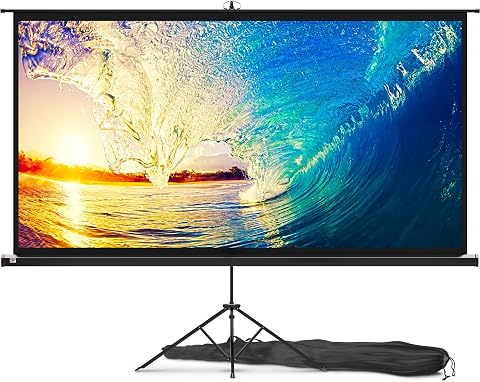
This portable 100-inch projector screen has a 16:9 format, 1.1 gain, and a 160-degree viewing angle for movies and presentations indoors or outdoors. Its adjustable height, stable tripod, quick three-step setup, and fitted carry bag make it easy to transport and use in different venues.
Pros:
- Portable design includes a fitted carry bag
- Quick three-step setup
- Adjustable height with a stable tripod stand
- Suitable for indoor and outdoor use
Cons:
- Weighs 17.6 pounds, which may be heavy for some users
Best for: People planning a projection setup with room for a tripod
Not ideal for: Spaces that cannot accommodate the stated screen size
Bottom line: Measure the room and confirm the screen format and stand placement suit your projector.
HDMI switcher
An HDMI switcher can be a useful checklist item when several devices need to connect through one display input. The listed HDMI 2.1 Switch is described as 4 in 1 out, so consider whether that input and output arrangement matches the number and type of devices in your setup. Make an inventory of what you want to connect before comparing the product details.
A common mistake is treating the format numbers in a product name as a guarantee that every connected device will work as intended. Check the listed capabilities against the requirements of your sources, display, and cables, including any specific resolution or refresh-rate needs. Confirm how switching is handled and whether the described remote meets your control preferences; the supplied name ends with “Remo,” so review the complete product listing for its exact included accessories and details.
Count the devices you need to connect now and consider whether the stated input arrangement fits the setup you have in mind. Verify compatibility across the whole signal path, including the display and cables. A little checking before purchase can help prevent a switcher from becoming a mismatch in an otherwise planned system.
What to look for:
- Count the devices you need to connect and compare with four inputs.
- Confirm the output arrangement fits your display setup.
- Match listed resolution and refresh-rate support to your devices.
- Check switching controls and included accessories in the full listing.
- Verify compatibility across sources, cables, and display.
HDMI 2.1 Switch, 4 in 1 Out, 8K@60Hz, 4K@240Hz HDMI Switcher with Remote Support

This HDMI 2.1 switch allows you to connect four HDMI sources to a single display, supporting up to 8K resolution and high refresh rates for smooth visuals. It features remote control operation, compatibility with various devices, and supports advanced HDR and audio formats.
Pros:
- Supports ultra-high resolutions up to 8K with high refresh rates
- Easy remote control and manual switching with LED indicators
- Compatible with a wide range of gaming and media devices
Cons:
- Requires external power supply via USB
- Does not support one source to multiple displays (not a splitter)
- HDMI cables for 8K should be 3 meters or shorter for optimal performance
Best for: Setups routing several HDMI sources to one display
Not ideal for: Systems requiring capabilities not confirmed in the listing
Bottom line: Check the full specifications and signal-chain compatibility before choosing this switcher.
TV backlight kit
A TV backlight kit is a display-related addition to consider when planning the area around a television. The Govee HDMI 2.1 AI Sync Box 2, 8K/4K @144Hz, RGBWIC for 55-65 Inch TVs names a 55–65-inch TV range, which gives you a concrete fit check to start with. Confirm your TV’s size and measure the available space around it before evaluating the rest of the product details.
A common mistake is checking only the TV size and overlooking the connections and devices involved. Review the listing to understand how the sync box fits into your setup, then compare its stated HDMI and display capabilities with your sources, television, and cables. Confirm that the devices you want to use can connect through the arrangement you plan. The product name includes specific format and refresh-rate figures, so verify the complete requirements for your intended configuration.
Consider the room layout, where the TV sits, and whether the kit’s listed components suit that placement. Check TV size and HDMI compatibility together rather than treating either as a standalone decision. This helps you determine whether the kit fits both the television and the rest of the system.
What to look for:
- Confirm your TV falls within the stated 55–65-inch range.
- Measure available space around the television.
- Check HDMI compatibility with sources, TV, and cables.
- Compare stated format and refresh-rate support with your setup.
Govee HDMI 2.1 AI Sync Box 2, 8K/4K @144Hz, RGBWIC for 55-65 Inch TVs

The Govee HDMI 2.1 AI Sync Box 2 supports up to 8K at 60Hz and 4K at 144Hz, enabling seamless screen and lighting synchronization for large TVs. It features AI-powered image recognition, advanced color blending with RGBWIC LEDs, and compatibility with various smart ecosystems for immersive gaming and entertainment experiences.
Pros:
- Supports high-resolution gaming with 8K and 4K at high refresh rates
- AI-powered image recognition for dynamic lighting effects
- Seamless integration with smart home ecosystems
Cons:
- Automatic signal switching not supported with multiple devices
- Color saturation may decrease when using HDR or Dolby Vision
- Complex setup may require app adjustments
Best for: Owners of TVs in the stated size range checking HDMI fit
Not ideal for: TVs outside the stated range or setups with unconfirmed compatibility
Bottom line: Verify TV size, connections, and the full capability details before choosing the Govee kit.
Universal remote
A universal remote can be a useful part of an upgrade when you want to consider how the equipment in your media area will be controlled. The SofaBaton X2 Universal Remote with Hub and Charging Dock names a hub and charging dock, so think about where those pieces would fit and which devices you expect the remote to operate. Make a list of the equipment you want to control before deciding whether this pick suits your setup.
A common mistake is assuming that a universal remote supports every device or control method you own. Check the complete product details against your specific television, audio equipment, and other components. Confirm what the hub does in the planned arrangement, what connections or setup steps are required, and whether the listed controls match how you prefer to use the system. The product name alone does not establish support for every device.
Consider where the remote, hub, and dock will live in everyday use. Check that the charging dock has a practical place and that the hub can be positioned as required by the listing. Reviewing device support and placement together helps you judge whether this remote can fit into your media routine.
What to look for:
- List the devices you want the remote to control.
- Confirm support for each device in the full product details.
- Check the hub’s placement and setup requirements.
- Choose a practical location for the charging dock.
SofaBaton X2 Universal Remote with Hub and Charging Dock

The SofaBaton X2 controls compatible entertainment and smart home devices using IR, Bluetooth, RF, and Wi-Fi, with a hub for whole-home signal coverage. Customize buttons and macros, launch multi-device activities with one tap, and use Alexa, Google Assistant, or Home Assistant integrations.
Pros:
- Supports multiple connection protocols and Matter
- Customizable buttons, macros, and one-touch activities
- Works with Alexa, Google Assistant, and Home Assistant
- Hub provides 360-degree signal coverage
Cons:
- Optional IR repeaters are sold separately
- Setup and customization require the SofaBaton app
Best for: People seeking a remote setup with a hub and dock
Not ideal for: Setups where device support has not been confirmed
Bottom line: Check device compatibility and component placement before choosing the SofaBaton X2.
When you plan the order of your upgrade, start with the needs that affect the rest of the setup: display and room fit, then connections and sound, followed by lighting and control. Write down your existing devices and requirements before selecting products, and confirm compatibility in the full listings. This helps you prioritize what your setup needs first.
Take the checklist one section at a time and measure before you choose. A few minutes spent checking fit and connections can make the overall upgrade easier to plan. Use the items that match your room and equipment, and enjoy building a media setup that feels right for your home.