
TL;DR

Get the latest gadgets delivered free with Prime
- Fast, free delivery on millions of items
- Prime Video, Amazon Music and more included
- Member-only deals all year
Athens-based artist Theo Triantafyllidis, winner of the 2026 Frieze Artist Award, will present Feral Metaverse (Spider), 2026, at Frieze London from Oct. 14–18. The work pairs a climbable spider sculpture with a multiplayer digital environment, and its development included Google’s Gemini AI tools.
Athens-based artist Theo Triantafyllidis, winner of the 2026 Frieze Artist Award, will present a giant climbable spider sculpture connected to a multiplayer virtual world at Frieze London from Oct. 14–18. Called Feral Metaverse (Spider), 2026, the participatory work links physical play and a shared digital environment, with Google Arts & Culture among its co-producers.
The installation invites visitors to climb on the spider-shaped structure and help one another get aboard. The experience then extends to a shared digital world, where players collaborate, move together and form what the project describes as temporary collective bodies. The physical and digital parts are designed to connect, rather than operate as separate attractions.
Frieze and Google Arts & Culture say the award supports artists developing ambitious work at pivotal points in their careers. For this project, Triantafyllidis expanded his team to include sculptors, fabricators, textile designers, game developers and civil engineers. The work is co-commissioned and co-produced with Forma, in collaboration with Google Arts & Culture.
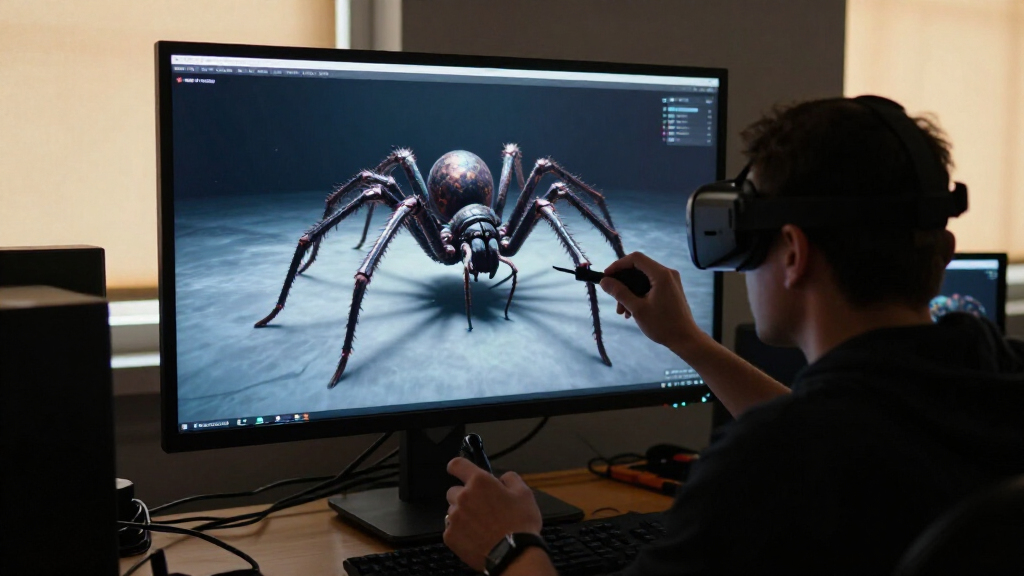
The team also used Google’s Gemini during development, according to Google’s Oct. 6 account. It was used to help generate sketches, character designs, backdrops and 3D renders that informed the game’s visual design. The project description presents AI as one tool in a broader production process involving artists and technical specialists; it does not detail how much of the final work came from AI-generated material.
A Sculpture Built for Cooperation
The project makes cooperation part of the visitor experience: people are encouraged to watch one another, share advice and learn as they climb and play. That design links the physical installation to the multiplayer game, where participants must interact in a common environment. The work’s subject and format therefore meet in its central activity: making something together.
It also offers a public example of how an artwork can move between sculpture, performance and game design. Visitors encounter a tangible structure at an art fair, then enter a digital space that extends the work beyond the climb itself. The project’s use of Gemini also places generative AI within a specific creative workflow, though Google’s description does not provide an independent assessment of the tool’s contribution or effects.
As an affiliate, we earn on qualifying purchases.
From Award to Feral Metaverse
The Frieze Artist Award supports artists in creating new work, and the 2026 commission gives Triantafyllidis a platform at Frieze London. The fair takes place in The Regent’s Park from Oct. 14 to 18. The announcement describes Triantafyllidis as an artist working across video games, live simulations, performances and physical installations, often building playful worlds around complex phenomena.
In Google’s account, the spider became the project’s central figure because Triantafyllidis sees spiders as engineers. The artist’s description of them as “strange, intelligent and unexpectedly tender” informs the work’s approach: a structure that may look intimidating from a distance is described as soft and inviting up close. The project’s physical and digital elements are intended to let visitors experience that contrast through touch and shared play.
““spiders are the original engineers.””
— Theo Triantafyllidis, as quoted in Google’s project announcement
As an affiliate, we earn on qualifying purchases.
Details Still to Be Confirmed
The announcement does not specify the sculpture’s dimensions, materials, visitor capacity or safety arrangements. It also does not describe how long each digital session lasts, what equipment visitors will use, or whether the multiplayer world will be accessible outside the fair. Those practical details may affect how visitors experience the work, but they are not provided in the source material.
Google says Gemini helped generate visual-development material, but offers no breakdown of which outputs were retained, changed or discarded, nor how the team evaluated them. The announcement presents the project as collaborative, but does not attribute individual design decisions to particular team members. The announced dates and venue are clear; further operational information remains unreported.
As an affiliate, we earn on qualifying purchases.
The Work Opens in October
Feral Metaverse (Spider), 2026 is scheduled to be on view at Frieze London in The Regent’s Park, Oct. 14–18, 2026. Google Arts & Culture says it will publish more about how the work was made. Visitor access details and any further information about the digital experience were not included in the Oct. 6 announcement.
As an affiliate, we earn on qualifying purchases.
Key Questions
Who made Feral Metaverse (Spider)?
Theo Triantafyllidis, an Athens-based artist and winner of the 2026 Frieze Artist Award, created the work with an expanded team of sculptors, fabricators, textile designers, game developers and civil engineers.
Where and when can visitors see the spider sculpture?
The work is scheduled for Frieze London in The Regent’s Park from Oct. 14–18, 2026. The announcement does not provide more detailed visitor-access information.
How does the virtual world connect to the sculpture?
Visitors are invited to climb the spider structure, then take part in a shared multiplayer digital environment where players collaborate and move together. The announcement does not explain the specific equipment or session format.
Was generative AI used to make the work?
Google says the team used Gemini to help generate sketches, character designs, backdrops and 3D renders during development. The source does not state how much of that material appears in the finished work or how it was revised.
Source: rss
Halloween Picks
halloween
As an affiliate, we earn on qualifying purchases.