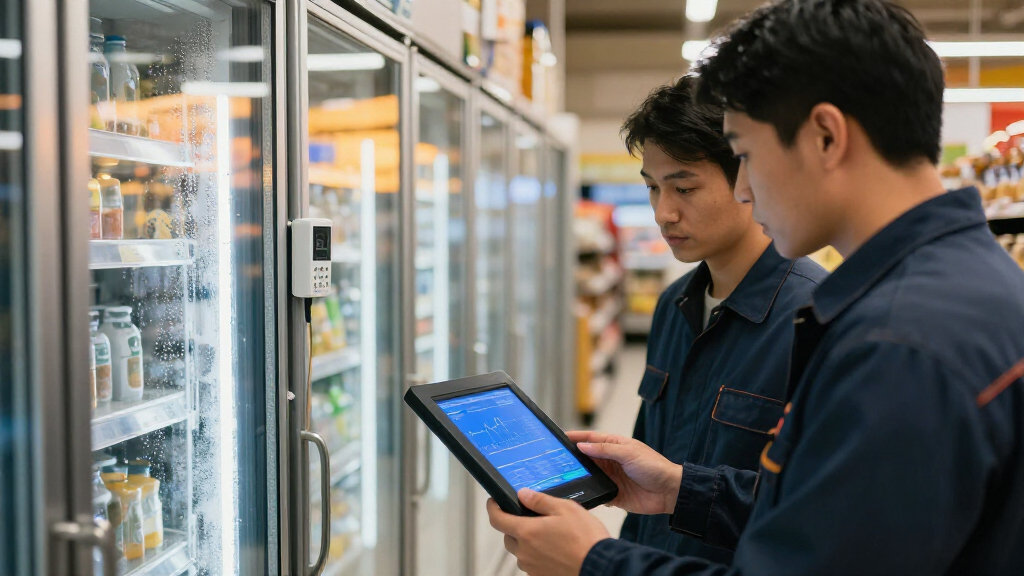
🔍 Read the full analysis: How To Think About AI In Supermarket Refrigeration Security on ThorstenMeyerAI.com

Get the latest gadgets delivered free with Prime
- Fast, free delivery on millions of items
- Prime Video, Amazon Music and more included
- Member-only deals all year
TL;DR
Retailers and media reported that more than 115 stores across at least six countries experienced refrigeration problems overnight on November 1–2, 2026. Belgian investigators are examining the incidents, which reportedly resemble an October attack in France; who was responsible and whether AI played any role remain unknown.
More than 115 stores in at least six European countries reported refrigeration disruptions overnight on November 1–2, after attackers apparently changed settings on internet-accessible controllers. Retailers and authorities have reported the incidents, but the responsible party has not been identified, and no source has confirmed AI was used.
Reports from Belgium, the Netherlands, Sweden, Luxembourg, Ireland and Estonia describe systems switched into defrost or heating modes; Finnish authorities and retailer Kesko also reported temperature anomalies at a few smaller stores. The reported count varies by source and remains provisional. At a Delhaize store in Eeklo, Belgium, freezers were reportedly set to 50 °C, while a Proxy Delhaize in Hoepertingen reported temperatures of 15 °C and estimated food losses of at least €60,000, according to local reporting cited by VRT NWS.
Retailers described incidents at individual outlets rather than a uniform outage across their networks. Ahold Delhaize said an IT incident affected refrigeration systems at several dozen stores. Carrefour Belgium reported 15 affected stores out of 700, saying the issue involved a few refrigeration units, mainly freezers. Sweden’s Coop reported seven affected stores among more than 800, with effects ranging from stopped units to one system beginning to generate heat. Several companies said affected sites operated outside their central networks or used separate equipment.
Belgian refrigeration installer Sabcobel said the systems were reached remotely through store controllers and that the mechanism matched the earlier French incidents. Its chief executive told Belgian media that technicians began disconnecting installations overnight. The company said about 20 of the several hundred installations it manages in Belgium were affected. These accounts point to building-control equipment as the immediate target, but the precise access route for each incident has not been publicly established.
Retail infrastructure · Incident briefing · November 2026
How To Think About AI In Supermarket Refrigeration Security
A reported cyber incident disrupted supermarket refrigeration across Europe. The equipment and operational risks are becoming clearer; the attacker, full toll and any role for AI remain unknown.
stores reported affected across at least six countries. Counts remain provisional and vary by source.
AI status: unconfirmed. No source has established that AI was used in these incidents.
01 / What was reported
When cold systems became targets
Reports describe changed controller settings, not a uniform outage across every retailer or store.
Defrost or heating modes
Retailers in Belgium, the Netherlands, Sweden, Luxembourg, Ireland and Estonia described refrigeration systems switched into defrost or heating modes. Finland also reported anomalies at a few smaller stores.
Different effects by site
Carrefour Belgium reported 15 affected stores out of 700. Sweden’s Coop reported seven among more than 800. Ahold Delhaize said several dozen stores were affected.
A Proxy Delhaize in Hoepertingen estimated food losses at at least €60,000, according to local reporting cited by VRT NWS. The full loss total is unknown.
02 / The system at risk
Operational technology has real-world consequences
A refrigeration incident can create food, repair and continuity costs without affecting checkout software or customer accounts.
Remote controller
Connected store equipment manages refrigeration settings.
Settings change
Reports describe defrost or heating behavior at some sites.
Temperature rises
Freezers may fail to hold safe operating conditions.
Business impact
Food loss, repairs, unit closures or store disruption may follow.
“We have identified an IT incident affecting the refrigeration systems in several dozen stores.”
Ahold Delhaize“Currently 15 of our 700 stores are affected, both in Flanders and Wallonia.”
Carrefour Belgium03 / Evidence and uncertainty
Keep the known facts separate from open questions
Belgium’s federal prosecutor has opened an investigation. Public reporting is still incomplete.
Multiple retailers described refrigeration disruptions overnight on November 1–2, 2026.
Installer Sabcobel said the mechanism resembled a French wave on October 11–12. Similarity does not establish the same perpetrators.
The responsible party, motive, precise access route at each site and final store count have not been confirmed.
No source has confirmed AI use. A broad warning about AI-related cyber activity is not evidence for this incident.
Reports establish disruption and potential operational harm. Responsibility, coordination between waves and any AI involvement remain unverified.
04 / Defensive lens
What connected businesses can review
These are practical review points, not claims that every affected store shared the same weakness.
Check remote management
Review whether refrigeration interfaces are exposed online, who can reach them, and whether access is limited to approved users and paths.
Include building systems
Account for refrigeration controllers in asset inventories, monitoring and incident response, including equipment outside central networks.
Plan for store operations
Coordinate IT, facilities, refrigeration providers and store teams around isolation, temperature checks, repairs and food-loss assessment.
Traceability / What to watch
From incident reports to confirmed findings
Retailer updates and the investigation may refine the public picture over time.
Quick answers
Key questions
How many stores were affected?
Reports cite more than 115 across at least six countries, with additional anomalies reported in Finland. The total is provisional and differs by source.
Has anyone confirmed AI was used?
No. General warnings about AI and cyber activity do not establish a role for AI in these refrigeration incidents.
Who carried out the attacks?
No perpetrator has been identified publicly, and no group has claimed responsibility. Belgium is investigating.
Why mention smaller or independent stores?
Some affected sites reportedly operated outside central networks or used separate equipment, which can create different monitoring and protection needs.
When Store Freezers Become Cyber Targets
The incidents show how a cyberattack on building systems can cause direct operational and financial harm without disrupting checkout software or customer accounts. If refrigeration fails long enough, retailers may have to discard food, close units or stores, and arrange repairs. The Hoepertingen loss estimate illustrates the potential cost, though damage will differ by location and the full total is not known.
The reported concentration in smaller or independently operated outlets also highlights a security gap: equipment outside a chain’s central network may not receive the same monitoring or protection. That does not establish that every independent system is vulnerable. It does mean that companies relying on connected refrigeration need to account for those devices in access controls, network security and incident response.
The reports do not establish an AI connection. Belgium’s cyber centre has warned more generally about attacks involving AI, but that broad warning is not evidence that AI was used here. For readers and businesses, the distinction matters: the confirmed issue is disruption to refrigeration controllers, while the attacker’s identity, motive and tools remain unknown.
Popular right now

Dyson Airwrap i.d. Multi-Styler for Straight and Wavy Hair

Bose QuietComfort Wireless Earbuds with Active Noise Cancellation, Dewdrop Mint

Dyson W1 PencilWash Cordless Wet and Dry Floor Cleaner with Dock
As an affiliate, we earn on qualifying purchases.
A Similar French Incident in October
The November reports follow a separate wave in France on the night of October 11–12. France’s Paris prosecutor’s office counted about 700 victims, according to the source material. On October 12, France’s CERT-FR warned that remote-management interfaces for refrigeration controllers were exposed online contrary to good practice, and said campaigns were probably still ongoing.
Belgian installer Sabcobel described the later incidents as using the same mechanism as the French wave. That is a reported technical comparison, not proof that the same people carried out both attacks. The incidents also do not establish that all affected stores used identical equipment or were accessed in precisely the same way. Public reporting has identified specific Danfoss controller models as targets, but has not supplied a complete technical account for every country.
“We have identified an IT incident affecting the refrigeration systems in several dozen stores.”
— Ahold Delhaize
The Attacker and Full Toll Remain Unknown
The reported store totals differ across outlets and may change as retailers and authorities verify incidents. Some reports count more than 115 affected stores across at least six countries; other accounts give different figures for Belgium and individual chains. A final, independently confirmed total, the full value of spoiled goods and the number of systems restored have not been reported.
Belgium’s federal prosecutor has opened a criminal investigation. No group has claimed responsibility, and authorities have not publicly attributed the incidents to a person, organization or state. The precise entry method and whether the November incidents were coordinated with the French wave are also unconfirmed. There is no confirmed evidence of AI use; general warnings about AI-related cyber activity do not answer that question for these incidents.
Investigations and Store Repairs Continue
Retailers and refrigeration providers are working to restore affected equipment and assess food losses, while Belgian authorities investigate. Store-level reports and official updates may refine the incident count and clarify which controller models or configurations were involved. The source material does not give a timetable for a final investigation report.
Businesses with connected refrigeration can use the incident as a prompt to review whether remote-management interfaces are exposed online, who can access them, and whether building systems are monitored separately from corporate IT. Those are defensive measures, not findings that every affected store had the same weakness. The next confirmed developments to watch are updated retailer counts, technical findings from authorities and any formal attribution.
Key Questions
What happened to the supermarket refrigeration systems?
Retailers in several European countries reported refrigeration problems overnight on November 1–2, 2026. Reports describe controllers switched into defrost or heating modes, leaving some freezers unable to maintain normal temperatures.
How many stores were affected?
Reports cited in the source material put the number at more than 115 across at least six countries, with additional reports of anomalies in Finland. Counts differ among outlets and are not yet a final verified total.
Has anyone said AI was used in the attacks?
No. Authorities have issued broader warnings about cyberattacks involving AI, but no source has confirmed that AI played a role in these refrigeration incidents.
Who carried out the attacks?
No perpetrator has been identified publicly, and no group has claimed responsibility. Belgium’s federal prosecutor has opened an investigation.
Why were smaller or independent stores mentioned?
Some retailers said affected locations operated outside their central networks or used their own refrigeration equipment. That may help explain differences in protection and monitoring, but reporting has not established a single cause for every store’s exposure.
Source: ThorstenMeyerAI.com