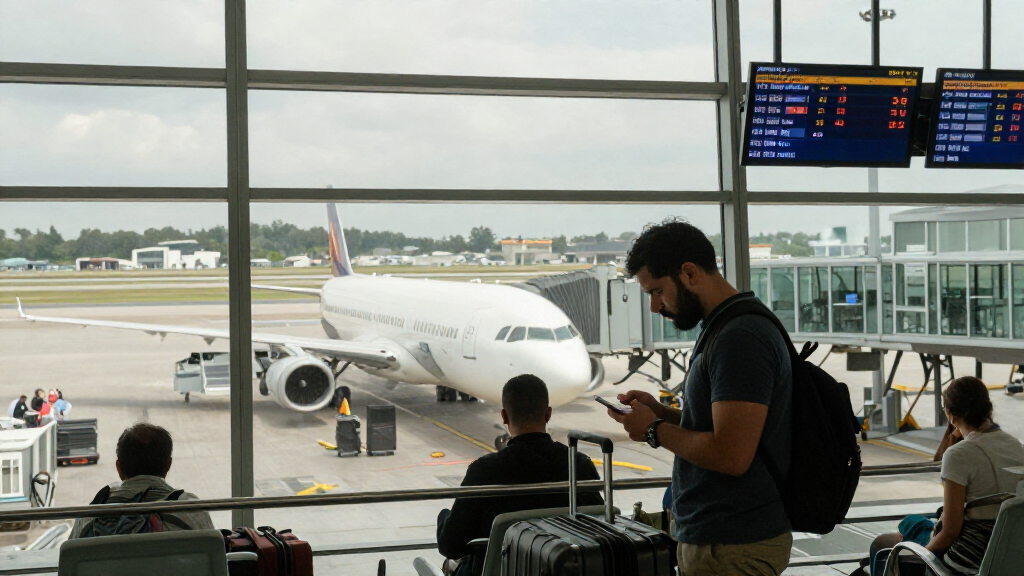

🔍 Read the full analysis: How The FAA Flight Halt Affected Airports Nationwide on ThorstenMeyerAI.com

Get the latest gadgets delivered free with Prime
- Fast, free delivery on millions of items
- Prime Video, Amazon Music and more included
- Member-only deals all year
TL;DR
The FAA halted departures at airports nationwide on Nov. 13 after communications and radar instability affected air traffic facilities, according to Transportation Secretary Sean Duffy and FAA advisories. The stop lasted about four hours and 23 minutes; the exact root cause remains unresolved, and flight cancellation totals include disruptions beyond the halt itself.
The Federal Aviation Administration halted departures at U.S. airports nationwide on Friday, Nov. 13, after communications problems affected air traffic control facilities, disrupting flights for about four hours and 23 minutes. The stoppage began at 3:53 p.m. Eastern Time and was lifted at about 8:16 p.m., according to FAA advisories; officials have not published a written report establishing the system failure’s root cause.
FAA Command Center advisories show that disruption started with problems affecting flights into Chicago. At 3:21 p.m., the center reported arrival delays and airborne holding at O’Hare due to equipment issues. It stopped departures to O’Hare from across the United States and several Canadian airports at 3:28 p.m., citing equipment and communications issues. Chicago Midway followed at 3:31 p.m.
Transportation Secretary Sean Duffy said the FAA experienced instability in radar and communications at en route centers and approach control facilities around 3:36 p.m. The FAA issued the nationwide ground stop at 3:53 p.m., directing departing aircraft to remain on the ground. Its advisory said inbound international flights would be handled case by case. The agency said technicians were investigating communication issues affecting multiple air route traffic control centers and described its account as preliminary.
Duffy said more than 3,500 aircraft were airborne when the halt began and fewer than 400 were still in the air by 8 p.m. He said medevac flights, life-saving cargo and law enforcement flights were permitted to continue. The FAA began allowing departures as facilities recovered and coordinated releases with its Command Center. Its cancellation advisory listed 8:16 p.m. as the time the nationwide stop ended; Duffy said airspace reopened at 8:15 p.m.
FAA ground stop · Nov 13, 2026 · times ET (UTC−5)
Unreliable data, a full stop, a slow restart
What the FAA Command Center’s advisories and Transportation Secretary Sean Duffy describe, step by step.
US airspace (schematic)
plane (schematic)airports
3,500+ planes in the airwhen the stop began, Duffy says Fewer than 400still airborne by 8 p.m. ET, Duffy says Restartground stop cancelled; flights resume slowly
What the FAA and Duffy said
- 3:21 p.m.Chicago O’Hare: arrival delays “due to equipment issues”FAA advisory 106
- 3:36 p.m.Radar and communications unstable at centers and TRACONs nationwideDuffy
- 3:54 p.m.“All airports are ground stopped”; departures heldFAA advisory 111
- 4:20 p.m.Airborne holding expected at “any and all airports”FAA advisory 116
- 8 p.m.Fewer than 400 planes still airborne, down from 3,500+Duffy
- 8:16 p.m.Nationwide ground stop cancelled; Duffy: airspace reopened at 8:15 p.m.FAA advisory 005
Sources: FAA Air Traffic Control System Command Center advisories 106, 111 and 116 (Nov 13) and 005 (Nov 14, 2026, UTC dates); Transportation Secretary Sean Duffy at the White House briefing, Nov 13 (transcript: Roll Call Factba.se) and on X (as quoted by Fox Business); BBC News, Nov 14. Durations: own calculation from advisory event times (2026: 20:53 to 01:16 UTC; 2023: 12:20 to 14:00 UTC). The radar picture is a schematic, not real traffic.
Graphic: Powered by Thorsten Meyer AI
How the Halt Reached Travelers
A nationwide departure hold affects more than passengers waiting at gates. When aircraft cannot leave, airlines can lose the planned sequence of flights, crews and aircraft needed to operate later trips. The FAA’s advisories show that, after the national restriction ended, it continued issuing ground stops for individual airports and airlines as carriers worked through the resulting disruption.
The impact also crossed borders. Eurocontrol suspended US-bound departures from its member states between 22:00 UTC on Nov. 13 and 05:00 UTC on Nov. 14, according to an account citing the agency’s notice. BBC News reported that Sydney Airport held US-bound flights and Air Canada cancelled flights between Canada and the United States. These measures show how trouble in U.S. air traffic operations can affect international schedules, even when flights originate elsewhere.
FlightAware counted 9,159 cancellations within, into or out of the United States on Friday, and 3,515 more by 7:58 a.m. Eastern Time Saturday. Those totals cover all cancellations during those periods, not only flights affected by the ground stop. They should not be read as a count of cancellations caused by the FAA failure alone.
Popular right now

Dyson V15 Detect Cordless Vacuum

Bose QuietComfort Wireless Bluetooth Headphones – Active Over‑Ear Noise Cancelling with Mic, USB‑C Charging, Deep Bass, up to 24 h Playtime,

TCL 55-Inch T7 Series 4K QLED Smart Google TV (55T7)
As an affiliate, we earn on qualifying purchases.
From Chicago Delays to a National Stop
The FAA’s advisories trace an escalation over roughly half an hour. Earlier notices that afternoon cited weather and traffic conditions; the first advisory in the timeline to identify equipment issues concerned arrivals at O’Hare. After departure restrictions spread to O’Hare and Midway, the Command Center activated a diversion recovery tool for all airports at 3:30 p.m.
Once the nationwide stop was in place, the Command Center reported expected airborne holding at airports across the country and extended flight-plan drop times at en route centers to 240 minutes. That change kept filed flight plans active longer while aircraft waited. At 5:46 p.m., the FAA said the stop remained in effect because of a communications failure and that flights would be allowed to depart as facilities recovered, with coordination from the Command Center.
The FAA’s 2023-commissioned review describes 21 en route centers, which largely manage aircraft flying between airports. Their role helps explain why a problem affecting communications and radar at multiple facilities could require a broad restriction rather than a response limited to one airport. The available advisories document the operational response; they do not establish a final technical explanation for what failed.
“ALL AIRPORTS ARE GROUND STOPPED.”
— FAA Command Center advisory
The Failure’s Cause Is Unresolved
No written root-cause report has been published, so the precise equipment failure and the full sequence that led to the nationwide order remain unclear. Duffy attributed the problem to overloaded older analog telecommunications switches and routers that delivered inconsistent data. That is the secretary’s account, not a published final technical finding from the FAA.
Mullin said officials had seen “zero evidence” of a cyberattack and that the issue appeared mechanically driven, but he said they were not ruling out a cyberattack. Duffy and the maker of the FAA’s new SMART air-traffic tool said SMART was not connected to the failed equipment. The sources do not establish that all possible causes have been ruled out.
It is also not possible from the reported cancellation totals to isolate how many cancellations resulted specifically from the ground stop. The figures include other causes of cancellations on Friday and Saturday. The precise number of affected passengers and the time needed for the full network to return to normal are not provided.
FAA Investigation and System Funding
The FAA said technicians were investigating, but the available source material does not give a publication date for a final report or a confirmed deadline for one. A written account of the failure would be needed to clarify which equipment malfunctioned, why the problem spread across facilities and what repairs or safeguards are planned.
Duffy has argued that the episode points to the need to replace older air traffic control infrastructure and called for $50 billion in congressional funding. He warned, “You will have more of these” unless Congress pays for a new system. That is his prediction and funding argument, not a confirmed forecast or an established finding about how often another halt will occur. The next concrete developments are the FAA’s technical findings and any congressional decisions on modernization funding.
Key Questions
When did the nationwide FAA ground stop begin and end?
The FAA’s advisory timeline places the stop’s start at 3:53 p.m. Eastern Time on Nov. 13 and its cancellation at 8:16 p.m. The FAA issued the announcement at 3:54 p.m.; Duffy said airspace reopened at 8:15 p.m.
What caused the FAA to halt departures?
The FAA cited communications issues affecting multiple air route traffic control centers. Duffy described instability in radar and communications and blamed overloaded older telecom equipment, but the FAA has not published a final root-cause report.
Was the disruption caused by a cyberattack?
Officials said they had seen no evidence of a cyberattack, but Homeland Security Secretary Markwayne Mullin said they were not ruling one out. The cause has not been conclusively established in a published technical report.
How many flights were cancelled?
FlightAware counted 9,159 cancellations within, into or out of the United States on Friday and another 3,515 by 7:58 a.m. Eastern Time Saturday. Those are all-cause totals, not counts limited to cancellations caused by the ground stop.
Did international flights face restrictions?
Yes. The FAA said inbound international flights would be handled case by case during the stop. Eurocontrol also suspended US-bound departures from its member states for a period overnight, while reports described holds and cancellations affecting flights from Australia and Canada.
Source: ThorstenMeyerAI.com