
TL;DR

Get the latest gadgets delivered free with Prime
- Fast, free delivery on millions of items
- Prime Video, Amazon Music and more included
- Member-only deals all year
Google DeepMind introduced Genie 4 on October 27, describing it as a real-time model for interactive worlds with generated audio and text-directed changes. The demos are company-selected, access is limited to trusted testers, and DeepMind says scenes can drift after a few minutes.
Google DeepMind announced Genie 4 on October 27, describing it as a real-time model that generates interactive scenes with sound and text-directed changes. The company’s demonstrations show users moving through generated environments and altering them with prompts, but the system is not publicly available and DeepMind says scenes can drift during extended use.
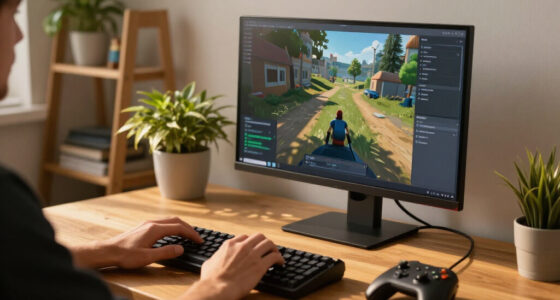
DeepMind says users can steer a scene with keyboard and mouse controls, then enter instructions to change details such as the weather, camera view, people or objects. The model generates the next frames as the scene unfolds, rather than rendering a fixed clip. DeepMind also says Genie 4 generates audio alongside imagery, including environmental sounds, music and character dialogue. These are vendor-reported capabilities; the announcement provides no benchmark figures for image quality, responsiveness or sound.
The company says Gemini 3.8 Flash can interpret goals, break them into steps and monitor the generated scene between user inputs. In one research demonstration, DeepMind describes a model called Gemini 4 Argon planning a task involving Apptronik’s Apollo humanoid, while Genie 4 simulated the robot playing checkers. The source material says this was a simulation; no physical robot took part.
DeepMind has shown the system to trusted testers. It says access is coming to Google AI Ultra subscribers through Project Genie and to early Gemini API partners, but it has not announced a release date or API price. The source material identifies Google AI Ultra as a $200-a-month tier. TechCrunch and Bloomberg, as cited by heise, have reported scenes lasting about two minutes; that duration does not appear in DeepMind’s own description.
World Models · Early Access · October 27, 2026
From Prompt to Place: Exploring What Google’s Genie 4 Can Do
A real-time model for interactive worlds, with generated sound and text-directed changes. The demos are company-selected, access is limited, and scenes can drift over time.
Explore while the world unfolds
Unlike a fixed clip, a world model generates what happens next in response to actions and instructions.
Move through scenes
DeepMind says users can steer generated environments with keyboard and mouse controls as new frames appear.
Change details by text
Prompts can request changes to weather, camera views, people, or objects within the scene.
Generate sound too
The model is described as generating environmental sounds, music, and character dialogue alongside imagery.
Evidence boundary: These are vendor-reported capabilities. The announcement provides no benchmark figures for image quality, responsiveness, or sound.
From instruction to interaction
DeepMind describes a loop in which people act, the model responds, and a planning model can interpret the evolving scene.
Enter a world
Start exploring a generated environment with keyboard or mouse.
Give direction
Use text to request a new view, weather, person, or object.
Generate next frames
Genie 4 produces the scene as it unfolds, with audio alongside imagery.
Plan between inputs
DeepMind says Gemini 3.8 Flash can interpret goals, break them into steps, and monitor the scene.
Early experiments, open questions
Potential uses are intriguing, but the announcement does not establish measured gains or reliable production performance.
Creative work and simulation
- Testers have tried film previsualization and game prototyping, according to DeepMind.
- A research demo paired a simulated Apptronik Apollo humanoid with a planning model while Genie 4 simulated a checkers scene.
- The source describes a simulation; no physical robot took part.
Reliability and transfer
- No benchmark comparisons independently measure improvements over Genie 3.
- A simulated environment does not show that robot training transfers to real-world tasks.
- Waymo’s reported use of Genie 3 is separate from the Genie 4 research demonstration.
From short clips to live scenes
Each generation expanded what DeepMind says its world models can create and sustain.
Genie
Simple 2D worlds. Its research paper described an 11-billion-parameter model trained on unlabeled internet videos.
Genie 2
3D worlds from a single image, lasting up to a minute; real-time operation required a lower-quality version.
Genie 3
Introduced as a real-time world model, with reported 720p at 24 frames per second and consistency for a few minutes.
Genie 4’s emphasis: more realistic scenes, native audio generation, and live text instructions. DeepMind has not published benchmark comparisons showing how much these improve on Genie 3.
What the announcement says—and leaves open
Genie 4 does not rely on a stored 3D map or a traditional game engine, according to DeepMind. Consistency remains a key question.
“a few minutes of continuous interaction”Google DeepMind
Details and objects “can shift or drift over time.”Google DeepMind
“our first real-time world model to generate audio natively”Google DeepMind
Some media reports, cited by heise, put scene length at about two minutes. That specific duration does not appear in DeepMind’s own description. DeepMind also says video and audio outputs carry an invisible SynthID watermark; practical detectability after editing or reposting is not detailed.
A wider release has no date
DeepMind says it plans to expand access beyond trusted testers, but timing and commercial terms remain unspecified.
Trusted testers
The system is not publicly available in the source material.
Project Genie
Access is planned for Google AI Ultra subscribers. The source identifies the tier at $200 per month.
Gemini API partners
Early partners are expected to get access; no API price or public launch date has been announced.
Key questions
The clearest takeaways from the available announcement and cited reporting.
What is Google Genie 4?
A world model that DeepMind says generates interactive visual scenes in real time, responds to controls and text prompts, and creates audio alongside visuals.
Can the public use it now?
No. Access is described as limited to trusted testers, with Project Genie and early Gemini API partner access planned later.
How long can a scene last?
DeepMind says “a few minutes” and warns details may drift. The roughly two-minute figure comes from media coverage, not DeepMind’s own text.
When will it launch, and what will it cost?
No public release date or Gemini API price has been announced. Google AI Ultra is identified in the source as $200 per month.
Interactive Worlds for Early Testing
If the demonstrations translate into reliable tools, Genie 4 could let creators explore a scene while it is being generated, rather than asking an AI to produce a finished clip and then starting over to change it. DeepMind reports that testers have tried film previsualization and game prototyping. These are early use cases described by the company, not evidence of broad commercial adoption or measured productivity gains.
The model may also matter to robotics research. DeepMind’s demonstration shows how a simulated environment could be paired with an AI system that plans actions, but it does not establish that Genie 4 can reliably train robots for real-world tasks. The source material says Waymo uses the predecessor, Genie 3, in its driving simulator; that is separate from the Genie 4 research demonstration.
Generated scenes that include matching sound could make synthetic media harder for viewers to distinguish from recorded footage. DeepMind says Genie 4’s video and audio outputs carry an invisible SynthID watermark. The announcement does not detail how that watermark performs in practice or how reliably it remains detectable after editing or reposting.
Popular right now

Bose QuietComfort Wireless Bluetooth Headphones with Active Noise Cancellation, Mic, USB‑C Charging, Deep Bass, 24‑Hour Battery – White Smok

Bose QuietComfort True Wireless Earbuds with Active Noise Cancellation, Black

Dyson Cyclone V10 Origin Cordless Vacuum
As an affiliate, we earn on qualifying purchases.
From Short Clips to Live Scenes
Genie 4 follows several generations of work described by DeepMind. The first Genie, introduced in February 2024, generated simple two-dimensional worlds; its research paper described an 11-billion-parameter model trained on unlabeled internet videos. Genie 2, announced in December 2024, generated three-dimensional worlds from a single image and could maintain them for up to a minute, though real-time operation required a lower-quality version.
In August 2025, DeepMind presented Genie 3 as its first real-time world model, reporting 720p resolution at 24 frames per second and consistency for a few minutes. Genie 4’s announcement emphasizes more realistic scenes, generated audio and live text instructions. DeepMind has not published benchmark comparisons that independently measure how much these capabilities improve on Genie 3.
A world model differs from a conventional video generator because it predicts what comes next in response to a user’s actions and prompts. DeepMind says Genie 4 does not rely on a stored three-dimensional map or a traditional game engine. That approach allows an interactive presentation, while also leaving open how consistently the model can preserve objects and locations as a user moves through a scene.
““a few minutes of continuous interaction””
— Google DeepMind
Limits, Access and Open Questions
It is not yet clear how Genie 4 performs across tasks beyond DeepMind’s selected demonstrations. The company has released no benchmark numbers in the source material, and the reported two-minute scene length comes from media coverage rather than DeepMind’s announcement. The company’s own wording says interactions can continue for a few minutes and warns that details may drift.
Public access timing, Gemini API pricing and the eventual availability of Project Genie remain unspecified. The announcement also does not establish whether the system will be dependable enough for production workflows, or whether its simulated environments will transfer to real-world robotics. Those questions require access beyond the current trusted-tester phase and evidence from use outside curated demos.
A Wider Release Has No Date
DeepMind says it plans to bring Genie 4 to Google AI Ultra subscribers through Project Genie and to early partners using the Gemini API. The company has not given a launch date, API price or broader access schedule. For now, the next concrete development is whether those testers receive access and what performance limits they report in use.
Key Questions
What is Google Genie 4?
Genie 4 is a world model that Google DeepMind says generates interactive visual scenes in real time and responds to user controls and text prompts. DeepMind also says it generates audio alongside the visuals.
Can the public use Genie 4 now?
No public release is described in the source material. DeepMind says access is limited to trusted testers, with Project Genie access for Google AI Ultra subscribers and early Gemini API partners planned for later.
How long can a Genie 4 scene last?
DeepMind describes “a few minutes of continuous interaction” and says details can drift over time. TechCrunch and Bloomberg, as cited by heise, have reported scenes of about two minutes; that specific duration is not in DeepMind’s own text.
Does Genie 4 use a real robot in its robotics demo?
No. The source material describes a simulation involving Apptronik’s Apollo humanoid. It says no physical robot took part in the demonstration.
When will Genie 4 be widely available, and what will it cost?
DeepMind has not announced a public release date or Gemini API price. The source material says Google AI Ultra costs $200 a month and describes access through Project Genie as coming soon.
Source: Thorsten Meyer AI