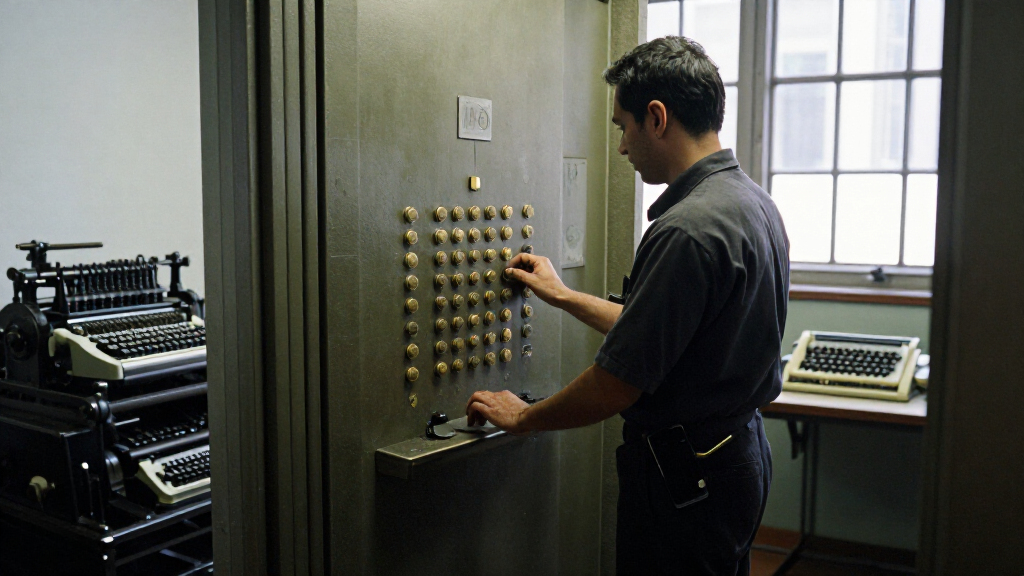
🔍 Read the full analysis: Elevator Operators To Typesetters: Jobs Transformed By Technology on ThorstenMeyerAI.com

Get the latest gadgets delivered free with Prime
- Fast, free delivery on millions of items
- Prime Video, Amazon Music and more included
- Member-only deals all year
TL;DR
A November 21, 2026, article from ThorstenMeyerAI.com examines how automation reshaped elevator operators, typists and typesetters. It reports that economist James Bessen found only one of 271 occupations from the 1950 U.S. census had largely disappeared because of automation, while stressing that the historical record does not show that a 1945 strike caused the shift to automatic elevators.
ThorstenMeyerAI.com published a report on November 21 tracing how automatic elevators, word-processing technology and computer typesetting changed three occupations, using the history to examine present concerns about AI and jobs. The report says the evidence points more often to tasks changing than entire occupations disappearing, while warning that jobs centered on a narrow set of tasks can contract sharply.
The report recounts the 1945 Manhattan building workers’ strike, which TIME reported involved 16,600 elevator operators and other building workers across 2,100 buildings. The walkout lasted five and a half days and ended after Gov. Thomas Dewey called for an impartial arbitrator. The article says the strike is often presented as the moment building owners decided to adopt automatic elevators, but it found no document establishing that the strike caused the change.
Automatic systems were already being developed. Otis’s company history says it offered a recorded voice for its Autotronic elevators in 1948 while attendants were still present. In 1950, an unattended Autotronic system opened at the Atlantic Refining Building in Dallas. U.S. census counts cited by the article put elevator operators at about 97,000 in 1950, falling to about 77,000 in 1960 and 37,000 in 1970. The report notes that today’s BLS category for elevator work covers installers and repairers, not the former operator role.
The article also tracks office typing and print production. It says the United States had 985,000 word processors and typists in 1988, compared with about 40,400 in 2025, and describes the decline of traditional typesetting as computers entered print shops. In Germany, a three-week strike in 1978 sought to keep text design work in the hands of skilled print workers; the apprenticeship was merged into a media-design trade in 1998. These histories are presented as different paths of technological change, not evidence that every job exposed to new tools disappears.
Infographic 01 · The number to remember
The one job automation wiped out
Elevator operators rose with the skyscrapers and fell with the automatic elevator. Of 271 occupations in the 1950 census, it is the only one that automation largely wiped out.
US elevator operators · census · thousands
Story vs. evidence
- Documented (TIME, 8 Oct 1945): 16,600 elevator operators and building workers on strike in 2,100 Manhattan buildings for five and a half days.
- Documented (Otis, company account): 1948 a recorded voice to help passengers trust automatic elevators; 1950 the first building with Otis high-speed, no-operator elevators (Dallas).
- Not documented: that the strike made owners switch to automatic elevators. A popular story; no source we found shows it.
Census figures: economically active persons 14 and over, each census in its own classification (1950 in the 1950 classification). Today the BLS publishes no separate count of elevator operators; installers and repairers are a different occupation.
Sources: US Census Bureau, Historical Statistics of the United States (1975), series D 233-682 (row D 587); J. Bessen, How Computer Automation Affects Occupations (2016); TIME, 8 Oct 1945; Otis company history; BLS Employment Projections 2025-35 (27 Aug 2026).
Powered by Thorsten Meyer AI
Why Task-Based Jobs Shrink Faster
The cases show why a single headline about “technology replacing jobs” can obscure different outcomes. Elevator operation and routine typing involved tasks that machines could take over with little need to preserve the old job structure. Other occupations absorbed new tools while retaining human responsibilities. The distinction matters to workers, employers and policymakers trying to judge whether AI will remove positions, change day-to-day duties, or create demand for different skills.
The report cites economist James Bessen’s analysis of 271 detailed occupations in the 1950 census, followed through 2010. Bessen concluded that only one—the elevator operator—had largely disappeared because of automation. That finding does not mean automation had little effect: the report emphasizes that machines often replaced parts of jobs. It also does not establish what AI will do. Rather, it cautions against treating a task’s automation as proof that an entire occupation is about to vanish.
Office work remains a large employment category even as its routine tasks change. The source says the BLS projected in August 2026 that office and administrative support would be the fastest-shrinking major occupational group through 2035, partly because of AI tools. That is a forecast, not a count of jobs already lost, and the source does not provide the projection’s precise percentage here. Readers should distinguish that outlook from the historical employment figures.
Popular right now

Vitamix VX1 Professional-Grade Blender, 64 oz, Black

De'Longhi COM630BK All-in-One Coffee and Espresso Machine

Samsung 65-Inch S90H OLED 4K Smart TV Bundle with HW-B630F Soundbar, Subwoofer, and Screen Cleaner (2026)
As an affiliate, we earn on qualifying purchases.
From Manual Lifts to Digital Text
Elevator operators helped passengers use manually controlled lifts as buildings grew taller. Their numbers increased from about 13,000 in 1900 to 87,000 in 1940, according to census figures cited in the report. Automatic elevators did not become common simply because the machinery existed: passenger trust and building practices also mattered. Otis’s reported use of recorded announcements while attendants remained in place illustrates the gradual introduction of the technology.
The typing pool grew alongside the typewriter and expanding office administration. The source says the census counted 3.9 million stenographers, typists and secretaries in 1970, up from 134,000 in 1900. Word processors and personal computers later changed how text was produced and handled. In print shops, computer-based production also changed typesetting work; the German strike and subsequent apprenticeship merger offer one example of workers contesting and adapting to that shift.
The historical comparison has limits. Census categories change over time, and job counts alone do not establish why an occupation grew or declined. Bessen’s study, as summarized in the source, attempted to account for occupations that were renamed or merged, and distinguished automation from jobs lost for other reasons, such as declining demand or the obsolescence of an earlier technology.
““We were hurting our best friends—the garment workers.””
— David Sullivan, Local 32-B union leader, as quoted by TIME in 1945
What the Record Cannot Establish
The source does not establish that the 1945 strike directly prompted building owners to install automatic elevators. The article says it found no document demonstrating that causal link, and treats it as a popular account rather than a confirmed fact. TIME’s contemporary report gives the strike’s scale as 16,600 workers in 2,100 buildings; later retellings may use larger figures, according to the source.
Several figures also need careful interpretation. The 2025 count of about 40,400 word processors and typists and the 1988 count of 985,000 are reported as employment observations, but the source does not provide detailed category definitions or a comparison methodology. The BLS outlook for office and administrative support is a projection, not a guarantee. The source likewise does not specify which AI tools or task changes will account for particular future job losses.
The historical cases cannot settle how AI will affect occupations now. They show examples of automation and adaptation, but do not offer a precise forecast for the number of jobs AI may eliminate or transform. The timing, scale and distribution of future changes remain uncertain.
The Next Measure Is Office Work
The next indicator in the source’s account is the BLS projection for office and administrative support through 2035, released in August 2026. Actual employment data over time will show how those projections compare with hiring and job losses, though changes in occupational definitions and the wider economy will also affect the totals.
For workers and employers, the practical issue is how AI tools alter specific duties and what new skills or responsibilities follow. The historical examples suggest that monitoring task changes, rather than assuming every occupation disappears, offers a clearer way to track the effects. The source article does not name a new study or policy milestone that would resolve the forecast; the next evidence will come from subsequent labor statistics and workplace adoption.
Key Questions
Did the 1945 strike cause elevator operators to be replaced?
The source does not establish that it did. It says the strike is often linked to the move to automatic elevators but that it found no document proving the strike caused building owners to make that change.
How many occupations did Bessen find were largely automated away?
In his analysis of 271 detailed occupations from the 1950 U.S. census through 2010, Bessen identified one—the elevator operator—as largely disappearing because of automation. The finding does not mean automation left other occupations unchanged; it often took over particular tasks.
What happened to typist employment?
The source reports 985,000 U.S. word processors and typists in 1988 and about 40,400 in 2025. It attributes the broad decline to changes including word processors and personal computers, while the figures should be read with the source’s occupational categories in mind.
Does the report predict that AI will eliminate office jobs?
No specific number of jobs eliminated by AI is established. The source cites a BLS projection issued in August 2026 that office and administrative support would shrink fastest among major occupational groups through 2035, partly because of AI tools. That is a forecast, not a confirmed outcome.
Source: ThorstenMeyerAI.com