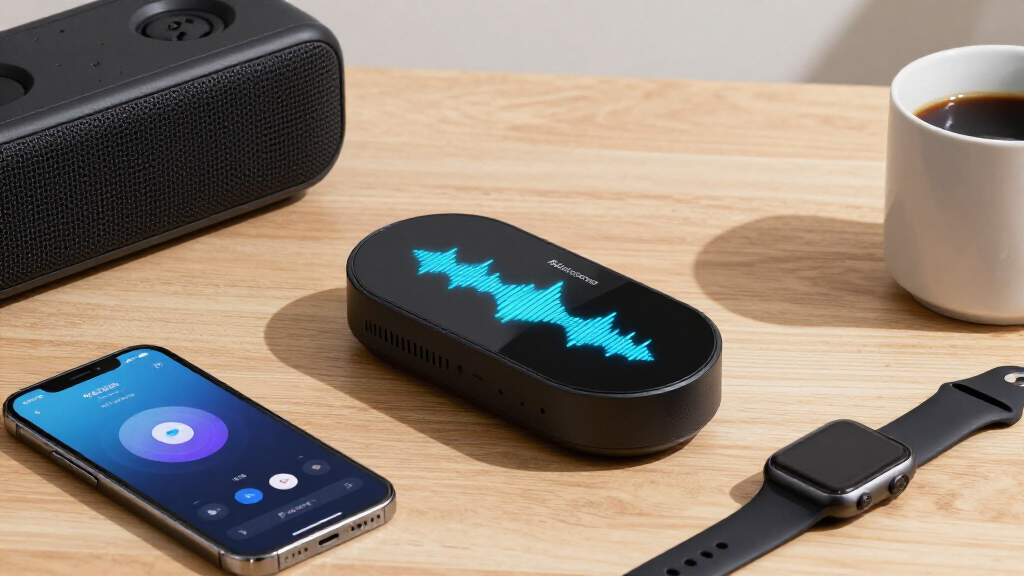

📊 Full opportunity report: The Ultimate Solution For Multilingual, Low-Latency AI Voice Agents on ThorstenMeyerAI.com — validation score, market gap, and execution plan.

Get the latest gadgets delivered free with Prime
- Fast, free delivery on millions of items
- Prime Video, Amazon Music and more included
- Member-only deals all year
TL;DR
NVIDIA has extended its open-weights Magpie text-to-speech model to include Arabic, Korean, and Brazilian Portuguese, increasing language support to 12. Hugging Face highlights improved speech quality and customization for developers, with performance benchmarks based on NVIDIA hardware.
NVIDIA has expanded its Magpie multilingual text-to-speech (TTS) model to include Modern Standard Arabic, Korean, and Brazilian Portuguese. This update brings support for a total of 12 languages, offering developers a self-hosted, low-latency solution for multilingual voice agents. The release aims to improve control over latency, data residency, and customization, particularly for enterprise and privacy-sensitive applications, as detailed in the original analysis.
The Magpie model, which features 364 million parameters, now supports languages including English, Spanish, French, German, Italian, Vietnamese, Mandarin, Hindi, Japanese, Arabic, Korean, and Brazilian Portuguese. Each language has male and female voices based on shared multilingual speaker representations. Hugging Face reports that the update also improved speech quality in existing languages through adjustments in training data and model architecture, which is discussed in this detailed coverage.
Additionally, the release extends features like code-switching capabilities for Hindi and Japanese, utilizing International Phonetic Alphabet-based grapheme-to-phoneme processing and custom pronunciation dictionaries. NVIDIA’s performance documentation indicates a time to first audio of 32 milliseconds on B200 hardware and throughput of about 320 times real-time at 64 concurrent streams, based on server-side measurements. These benchmarks suggest potential for sub-200-millisecond conversational response pipelines, although comprehensive end-to-end latency data remains unavailable; for more insights, see the original analysis.
Implications for Multilingual Voice Agent Development
The expansion of Magpie to support three additional languages enhances the capabilities of voice agents in diverse markets, especially where privacy, data residency, and low latency are critical. The open model allows for customization, domain-specific tuning, and integration into cascaded speech systems, making it attractive for enterprise, healthcare, and customer support deployments. However, the actual performance in real-world applications and across different hardware remains to be independently verified.
multilingual text-to-speech AI software
As an affiliate, we earn on qualifying purchases.
As an affiliate, we earn on qualifying purchases.
Background on Magpie and Multilingual TTS Advances
NVIDIA’s Magpie model, introduced earlier in 2026, is part of a broader trend toward open, customizable TTS models aimed at reducing dependency on proprietary solutions. Prior to this update, Magpie supported 9 languages, with ongoing efforts to improve speech naturalness and flexibility. The model’s architecture, based on frame stacking and transformer components, is designed to optimize inference speed and quality, especially for cascaded voice systems where speech synthesis is one stage among others.
Hugging Face has been a key partner in hosting and promoting access to the model, highlighting improvements in speech quality and multilingual handling. The release aligns with industry efforts to enable more localized, privacy-conscious voice solutions without sacrificing performance or flexibility.
“The addition of Arabic, Korean, and Brazilian Portuguese significantly broadens the applicability of Magpie for global voice agent deployment, especially in regions with strict data privacy needs.”
— Thorsten Meyer, AI Researcher
low latency voice synthesis hardware
As an affiliate, we earn on qualifying purchases.
As an affiliate, we earn on qualifying purchases.
Unverified Aspects of Performance and Deployment
It is not yet clear how Magpie’s latency and speech quality compare with other state-of-the-art models under identical conditions. The provided benchmarks are NVIDIA-specific and do not include independent testing or listening scores for the new languages. Additionally, real-world deployment metrics, such as total end-to-end latency and operating costs, remain unreported, leaving questions about practical performance and scalability.
self-hosted AI voice agent solutions
As an affiliate, we earn on qualifying purchases.
As an affiliate, we earn on qualifying purchases.
Next Steps for Validation and Broader Adoption
Developers and deployers are expected to conduct independent evaluations of Magpie’s performance across different hardware and real-world scenarios. Future releases may include additional languages and benchmark data, along with more detailed performance metrics. Industry observers anticipate that further testing will clarify the model’s suitability for latency-sensitive, multilingual voice agent applications at scale.
professional multilingual TTS voices
As an affiliate, we earn on qualifying purchases.
As an affiliate, we earn on qualifying purchases.
Key Questions
What new languages does NVIDIA’s Magpie support?
NVIDIA’s Magpie model now supports Arabic, Korean, and Brazilian Portuguese, in addition to existing languages.
Can I customize or fine-tune the Magpie model for my application?
Yes, the open Hugging Face checkpoint allows for research, fine-tuning, and domain-specific customization by developers.
What are the performance benchmarks for Magpie on NVIDIA hardware?
Benchmarks include a 32-millisecond time to first audio on B200 hardware and throughput of about 320 times real-time at 64 concurrent streams, based on NVIDIA measurements.
When will more languages or independent performance data be available?
NVIDIA and Hugging Face have not announced specific timelines for additional languages or independent benchmark results.
How does Magpie improve multilingual voice agent deployment?
It offers low-latency, customizable speech synthesis with support for code-switching and privacy-focused on-premises hosting, making it suitable for enterprise applications.
Source: ThorstenMeyerAI.com
Halloween Picks
halloween
As an affiliate, we earn on qualifying purchases.