
TL;DR

Get the latest gadgets delivered free — and shop member deals
- Fast, free delivery on millions of items
- Access to Prime Big Deal Days deals on October 6–7
- Prime Video, Amazon Music and more included
IdeaClyst is a digital war room designed for founders to quickly validate, critique, and develop ideas. It combines AI-driven council, discovery, and local-first storage for smarter decision-making, saving time and money.
Imagine you’re staring at three promising ideas, each vying for your attention. The clock’s ticking, and the stakes are high. You need a space—real or virtual—where your team can gather, dissect, challenge, and refine those ideas. That’s the essence of a war room for innovation.
Enter IdeaClyst. It’s not just a tool; it’s a dedicated digital battlefield where founders test assumptions, uncover hidden opportunities, and build a clear plan—without leaving their laptop. Think of it as your idea’s home base, a place where clarity replaces chaos and conviction replaces hope.
This article takes you inside IdeaClyst, revealing how it acts as a central hub for innovation, helping you make smarter decisions faster—and avoid costly mistakes in the process.A war room for your next idea
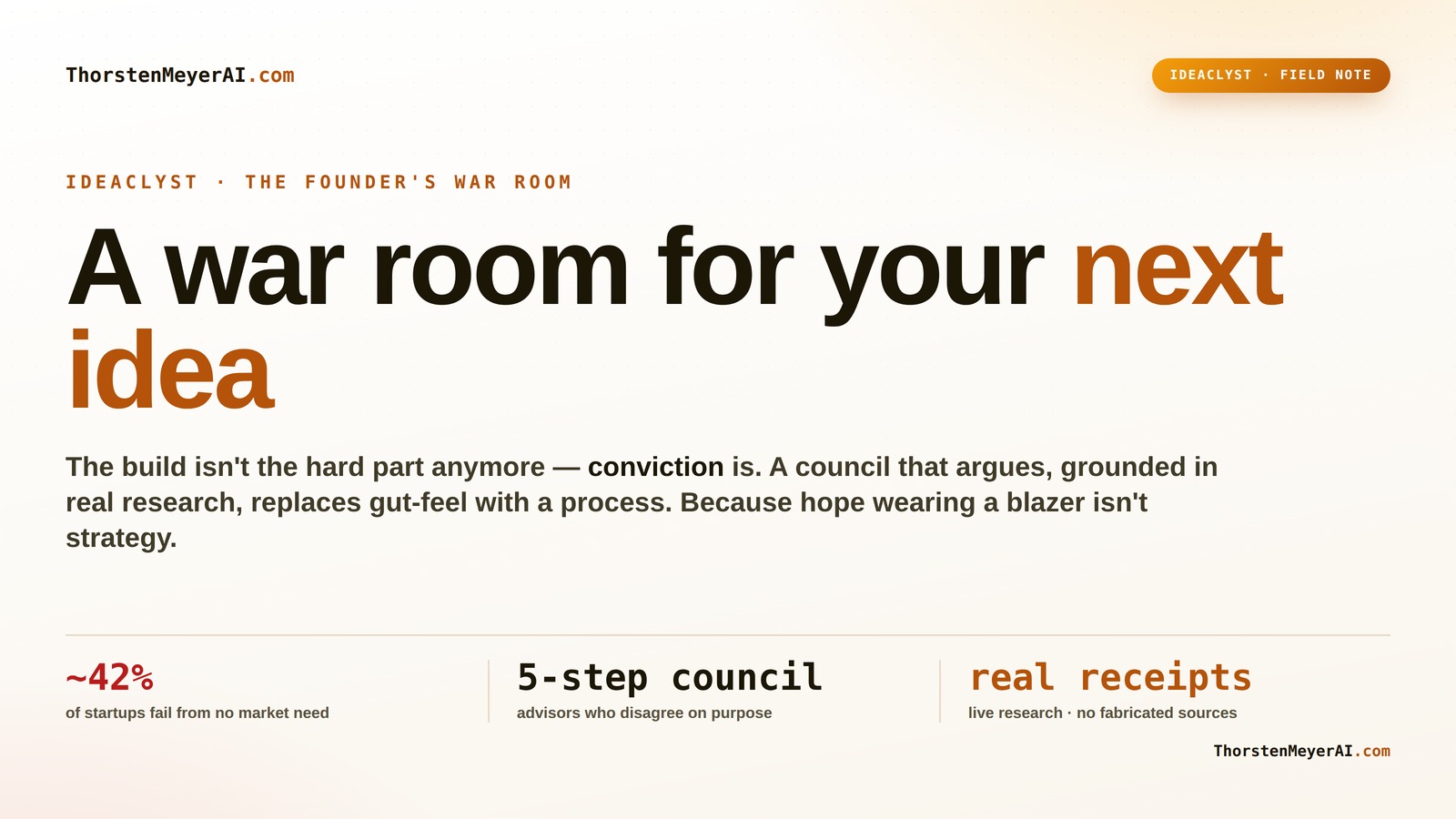
The build isn’t the hard part anymore — conviction is. Knowing which idea deserves the next six months, and being able to defend it. Most founders answer with gut feel and optimistic math. That’s hope wearing a blazer. IdeaClyst replaces it with a process.
The most expensive decision is what to build
The single most valuable thing a tool can do is talk you out of the wrong six months. The numbers make the case better than any pitch.
Three tools in one — on your own machine
Strip away the framing and IdeaClyst is three things at once, all running locally with nothing leaving your laptop.
An AI council
Pressure-tests an idea you bring it — advisors who argue on purpose.
A discovery engine
Finds ideas you didn’t know to look for by hunting real demand signals.
A founder’s workspace
Carries winners from “interesting” all the way to “ready to build.”
Advisors who disagree on purpose
Not one confident, agreeable answer — a structured five-step deliberation where models play different roles and turn on their own work. The disagreement is the feature.
The five-step deliberation
A council that leads with the bad news surfaces the objections you’d otherwise find the expensive way, on month five.
Product strategy
Who’s it for, what’s the wedge, why now, what’s the business model.
Technical architecture
What would it actually take to build — and where’s the risk.
Critique pass
The council turns on its own work. Where’s the hand-waving? What kills this?
Second, independent critique
A different voice, a different angle — so blind spots don’t survive.
Final synthesis
Everything into one coherent founder packet: strategy, architecture, validation, plan.
When IdeaClyst cites a source, it actually fetched it
The hard departure from “ask an AI what it thinks of my startup.” It runs in a strict, real-data-only mode — if it can’t gather genuine evidence, it says so plainly rather than inventing a plausible paragraph.
Confidence with receipts
No fabricated statistics, no imaginary competitors, no made-up citations. The packet survives a skeptical co-founder or a sharp investor because the reasoning has receipts.
Market research first
Scouts the landscape before the council reasons about anything.
Competitor read
Real positioning, pricing signals, feature claims — differentiation vs. reality.
Validation with links
Not “talk to customers” — concrete signals & sources you can click.
From the blank page to build-ready
Evaluation is half the problem; the blank page is the other half. And a plan is worthless if it dies in a tab you never reopen.
Bring a space, not an idea
“AI for accountants,” “tools for indie game studios” — plus your goal and real capacity. It hunts demand signals across HN, Reddit, Product Hunt, GitHub, pricing pages.
- An honest market read — leads with the bad news when a space is hard
- An opportunity map — high pain, thin competition
- Ranked candidates — wedge, who pays, effort, risk, confidence
- each with KILL CRITERIA — when to walk away
A home and a forward path
Every promising idea gets carried forward, with every artifact in plain files on your disk.
- Validation tooling — sprint board, interview list, evidence browser
- Founder profile — a personal-fit lens; same discovery, different advice
- Build workspaces — funnel, personas, landing draft, version history
- “Build this idea” → a PRD + task queue, ready for a coding agent
Key Takeaways
- A digital war room like IdeaClyst centralizes idea testing, critique, and planning, making innovation faster and more reliable.
- Grounding AI council feedback in live web research prevents false confidence and improves decision quality.
- Organize your ideas, critiques, and validation results in Markdown files stored locally—your data, your control.
- Regular updates, embracing disagreement, and staying organized turn a war room into a powerhouse for growth.
- You don’t need a physical space; a portable, structured digital setup can be just as effective—and more flexible.
As an affiliate, we earn on qualifying purchases.
Why a War Room Is the Secret Weapon for Innovation
A war room isn’t just a fancy term. It’s a strategic hub that keeps everyone aligned, focused, and moving forward, much like a war room for your next idea. For founders, it’s the place where ideas get tested in real-time, with everyone’s input visible and actionable.
Having this central space matters because it transforms scattered efforts into a cohesive strategy. When ideas are laid out visually and critiqued openly, teams can identify flaws early, pivot quickly, and avoid wasting resources on flawed concepts. The tradeoff, however, is that managing a war room requires discipline—regular updates, open critique, and organization—to prevent it from becoming cluttered or stagnant. This dynamic environment accelerates decision-making but demands consistent effort to stay effective. It’s a balancing act: the more engaged and organized your team is, the more powerful the war room becomes, turning collective insights into rapid innovation.
As an affiliate, we earn on qualifying purchases.
How Digital War Rooms Like IdeaClyst Make It Easier Than Ever
Traditional war rooms are physical—whiteboards, sticky notes, big screens, but digital war rooms like IdeaClyst take that concept online. But digital war rooms take that concept online, making collaboration seamless no matter where your team is. With IdeaClyst, the entire process lives on your laptop, not a whiteboard in a conference room.
Imagine having a dedicated space where your idea gets dissected by different AI advisors, each playing a role—strategy, tech, critique—and all the notes, critiques, and plans are stored securely on your local machine, similar to the capabilities discussed on FeatureBuddies. This setup offers significant advantages: it eliminates the risks of data leaks associated with cloud storage, provides instant access without dependency on internet connectivity, and enhances privacy—crucial for sensitive projects. The flexibility to revisit and revise your work anytime ensures continuous refinement. However, this approach also requires disciplined organization—since everything is stored locally, it’s up to you to maintain clarity and avoid clutter. The benefit is a highly secure, customizable environment that adapts to your workflow, empowering you to iterate rapidly without external dependencies.
local-first research storage device
As an affiliate, we earn on qualifying purchases.
As an affiliate, we earn on qualifying purchases.
What Goes Into a Powerful Idea War Room (And How to Set One Up)
Building an effective idea war room isn’t about throwing a bunch of tools together, but rather creating a structured space with clear purpose, much like the approach outlined on IdeaClyst. It’s about creating a structured space with clear purpose. Here’s a step-by-step process to set one up with IdeaClyst:
- Gather your core team and define what success looks like. Clarifying your goals ensures everyone’s efforts are aligned and focused on what truly matters, preventing aimless iteration.
- Import or write your initial idea into the system—be it a sentence, a paragraph, or a sketch. Starting with a clear, concise idea provides a foundation for meaningful critique and development.
- Run it through the AI council—product, tech, critique—to surface strengths and weaknesses. This step leverages diverse perspectives, highlighting blind spots and accelerating validation.
- Use the discovery engine to find related ideas or market opportunities you hadn’t considered. Exploring adjacent concepts broadens your understanding and uncovers potential pathways.
- Iterate based on feedback, then synthesize everything into a final plan or roadmap. This process turns insights into actionable steps, reducing the risk of misdirection or missed opportunities.
For example, if you’re developing a new SaaS platform, you’d start by outlining your target customer, then let the council challenge your assumptions—like pricing or feature set—and finally organize your findings into a clear path forward, similar to strategies discussed on IdeaClyst. The tradeoff here is that a well-structured war room requires upfront effort, but this investment pays off by making subsequent decisions faster and more confident.
As an affiliate, we earn on qualifying purchases.
What to Track Inside Your Idea War Room for Maximum Impact
In a digital war room like IdeaClyst, you want to keep your focus on key areas because this organization deeply influences the quality of your insights and decisions. Tracking core idea descriptions and initial hypotheses helps you stay true to your original intent, while feedback from the AI council provides diverse, unbiased perspectives that can challenge your assumptions and reveal overlooked flaws. Market research snippets and validation tests serve as concrete evidence of real-world viability, grounding your ideas in data. Related ideas or opportunities uncovered by discovery tools broaden your scope and help you identify new avenues for growth or pivot points. Lastly, action items and next steps ensure continuous momentum, turning insights into tangible progress. The implication is that disciplined tracking keeps your project aligned and adaptable, preventing chaos and enabling rapid iteration. For example, a founder working on a new health app might organize regulatory considerations, user feedback, and prototype critiques—all stored as Markdown files—so they can revisit, revise, and refine with clarity and confidence.
How a War Room Transforms Decision-Making and Creativity
When your ideas are laid out visually and critiqued from multiple angles, decision-making becomes not just clearer but also more strategic. Visual layouts help identify weak points that might be missed in verbal discussions or casual chats, giving you a comprehensive understanding of your idea’s strengths and vulnerabilities. Critique from diverse perspectives—enabled by structured discussion—forces you to justify your assumptions with evidence, reducing biases and guesswork. This process cultivates a mindset of continuous validation, where every decision is backed by data rather than intuition alone. For instance, a solo founder testing a new app concept can run it through the council, uncover critical flaws, and discover untapped market niches—all in a structured environment that compels rigorous analysis. The implication is that this disciplined approach not only enhances creativity by fostering open critique but also minimizes costly mistakes by catching issues early, leading to smarter, more confident decisions.
Common Mistakes to Avoid When Building Your Idea War Room
Don’t make these typical errors, as they can significantly undermine your war room’s effectiveness. Turning it into a static dump—where information is added but never revisited—leads to stagnation. An effective war room must be dynamic, with regular updates and active engagement to reflect new insights and pivot points. Overloading it with irrelevant info distracts from core priorities; focusing on what truly moves your idea forward keeps the space lean and actionable. Ignoring critique—especially dissenting opinions—limits growth and can reinforce blind spots, so embracing disagreement is essential for robust validation. Relying solely on AI feedback can give a false sense of certainty; human judgment and real-world testing remain critical. Lastly, neglecting organization—by failing to use clear tags, folders, and markdown—creates chaos, making it difficult to find pertinent information when needed. The tradeoff is that a well-maintained war room becomes a powerful tool for rapid iteration and learning, while neglecting these practices risks turning it into a cluttered, ineffective space. For example, a founder who updates their war room weekly, incorporates critiques, and keeps everything well-organized will make faster progress than one who lets the space gather dust.
Real-World Examples of How Founders Use IdeaClyst as Their War Room
Imagine a SaaS founder working late at night. They input their idea into IdeaClyst, run it through the council to identify technical risks, then use the discovery engine to explore new markets. Over a few days, they develop a solid plan—ready for prototypes and pitches. This process illustrates the power of a structured environment that accelerates validation and reduces guesswork, enabling founders to identify pitfalls early and pivot with confidence.
Another example: a small team uses the tool to brainstorm features, critique each other’s ideas, and track progress—all on their laptops, no cloud needed. This setup provides a portable, secure, and flexible war room that adapts seamlessly to any project or team size. The real-world impact is faster decision cycles, better risk mitigation, and a more confident path to market. These examples demonstrate that a well-organized, disciplined digital war room like IdeaClyst can be a game-changer for founders seeking to iterate quickly and avoid costly missteps.
Frequently Asked Questions
What exactly is a digital war room for ideas?
A digital war room is a centralized online workspace where you can gather, critique, and develop ideas with your team or solo. It combines tools for collaboration, research, and planning, all stored securely on your device.Can I use IdeaClyst if I work remotely or solo?
Absolutely. IdeaClyst is designed to be portable and local-first, making it perfect for remote teams or solo founders who want a private, flexible space to innovate without relying on cloud services.What do I put inside my war room to make it effective?
Keep core idea descriptions, critiques, validation data, related opportunities, and action plans. Organize everything with Markdown files on your local disk for easy access and revision.How does a war room improve decision-making?
It makes all ideas visible and open to critique. Structured disagreements surface weaknesses early, reducing costly mistakes and helping you choose the best path faster.Is a physical war room better than a digital one?
Not necessarily. A digital war room offers flexibility, ease of access, and portability. It’s especially valuable for remote teams or solo founders who need a central hub that’s always available on their laptop.Conclusion
Think of IdeaClyst as your personal command center for innovation—where ideas are challenged, refined, and ready for action. It’s a smart, portable war room that keeps every detail at your fingertips, helping you cut through doubt and move faster.
Your next big idea deserves a space that works as hard as you do. Why settle for guesswork when you can build a battle-tested plan—right on your own machine?
Halloween Picks
halloween
As an affiliate, we earn on qualifying purchases.