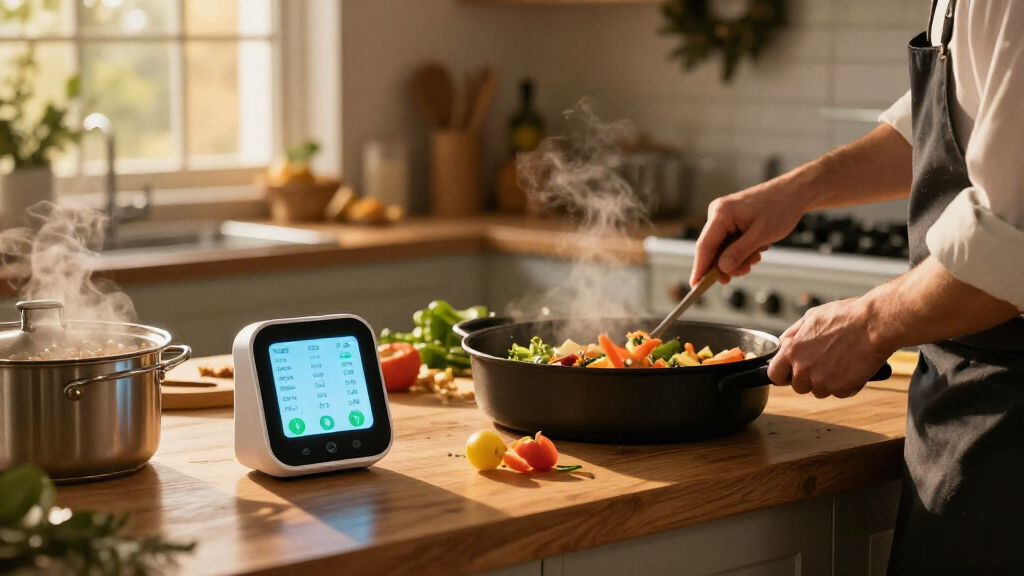
🔍 Read the full analysis: A Guide To AI-Powered Kitchen Timers For Holiday Cooking on ThorstenMeyerAI.com

Get the latest gadgets delivered free with Prime
- Fast, free delivery on millions of items
- Prime Video, Amazon Music and more included
- Member-only deals all year
TL;DR
AI-powered kitchen timers can interpret spoken requests, set multiple labeled reminders and, in some products, suggest timers from recipe steps. Their features vary, and speech or connection failures remain possible; they also cannot determine whether food is safely cooked. Holiday cooks should check timer controls, alert reliability, offline operation, privacy and cost before buying.
AI-powered kitchen timers can interpret spoken cooking requests, organize multiple labeled countdowns and, in some products, suggest reminders from recipes, according to the original guide published by ThorstenMeyerAI.com. The guide says the features may help holiday cooks manage several dishes, but speech errors, internet outages and recipe misreadings remain possible, and a timer cannot verify that food is safely cooked.
The term “AI-powered” covers different features, from recognizing a spoken timer command to suggesting a schedule based on recipe instructions. A connected device is not necessarily using AI: some products rely on fixed voice commands, preset automations or conventional timers. The guide advises shoppers to check manufacturers’ current feature descriptions rather than treating the label as a measure of capability.
For a cook preparing several dishes, a system that can set and label separate timers could reduce the need to handle a phone with messy hands. A request such as setting a nine-minute pasta timer and a five-minute sauce reminder is useful only if the device records both tasks correctly and makes their labels easy to review. The guide recommends checking the display or spoken confirmation, particularly when a misheard duration could affect the meal, and using a precise kitchen scale for measured ingredients.
Some systems can also turn recipe instructions into proposed alerts. Those suggestions should be reviewed before they are used: a recipe timer is a planning aid, not a cooking script. Cooks may need to adjust the schedule for their equipment, quantities or pace. A timer also tracks elapsed time; it does not inspect food or establish that it has reached a safe temperature.
Check what a product actually does: voice control and Wi-Fi alone do not prove it uses AI.
Use clear timer names, review spoken commands, and confirm recipe-generated alerts before cooking.
Compare alert options, timer adjustments, offline use, privacy controls, and total cost.
Treat recipe timers as reminders to check; use a food thermometer when safe temperature matters.
Keeping Holiday Dishes on Schedule
Holiday meals often involve several dishes that need attention at different times. Named, separate alerts could make it easier to tell which task a beep refers to, while voice control may reduce taps when a cook’s hands are occupied. These benefits depend on the system hearing the request correctly and presenting a clear way to check or correct it.
The practical test is not how natural a product sounds in a demonstration, but whether it can manage ordinary changes during cooking. A user should be able to pause, adjust or dismiss one timer without losing other countdowns. If a timer requires repeated commands or is difficult to correct, it may add distraction rather than remove it.
Reliability matters most when timing affects several dishes at once. The guide recommends keeping a basic phone or manual timer available as a backup, and checking whether the device can still run timers without an internet connection. That preparation can help limit disruption if a cloud service or home network is unavailable.
Popular right now

Bose QuietComfort Headphones (2nd Gen), Wireless Over-Ear Noise-Cancelling Headphones, Black

eufy C30 Robot Vacuum and Mop

KitchenAid Artisan 5-Quart Tilt-Head Stand Mixer, White
As an affiliate, we earn on qualifying purchases.
From Voice Commands to Recipes
Kitchen timers have expanded from simple countdowns to connected devices and voice assistants that can accept spoken commands. More flexible language interpretation may let users phrase requests conversationally, while recipe services can use cooking instructions to propose alerts. But connectivity alone does not establish AI capability, and product functions can differ by model, region, subscription and software version.
The source guide describes a broader move, as of information available through mid-2024, to add conversational and generative AI features to existing assistants, recipe services and smart displays. That is background rather than a claim about a particular product or a newly announced launch. Shoppers should consult current product documentation because cloud-dependent features and paid offerings can change after hardware is purchased.
For multiple timers, useful controls may matter more than the technology label. The guide recommends using clear task names, confirming durations and changing one timer at a time. In a noisy kitchen—with a fan, running tap or conversation—a spoken request may be misheard, so visible labels and easy corrections are practical safeguards.
Limits and Features Still Vary
The guide does not identify a specific product, independent test results or a newly released device. It therefore does not establish how accurately any particular timer understands speech, how dependable its alerts are or whether its recipe suggestions work well in practice. Capabilities vary by product and software version, and current availability should be checked with manufacturers.
It is also not clear whether a given timer will function fully during an internet outage, what data its voice or recipe features collect, or which functions require a subscription. Buyers should review offline behavior, privacy terms and ongoing costs before relying on a device. No timer can confirm that food is safe to eat; users still need to follow appropriate cooking guidance and assess doneness separately.
Check Before the Holiday Meal
There is no specific launch date or next product milestone in the source material. The practical next step for shoppers is to compare current product documentation for timer labels, voice corrections, alert options and offline use, then check privacy policies and subscription costs. Features advertised for a product may depend on its software, region or connected services.
Before using a timer for a holiday meal, test it with a low-stakes request: set two named timers, check that both durations appear correctly, and adjust one without disturbing the other. Confirm whether alerts remain available without Wi-Fi and keep a simple backup timer within reach. Treat any recipe-generated schedule as a draft to review, not confirmation that a dish is cooked.
Key Questions
What does an AI-powered kitchen timer do?
It uses software to interpret a cooking request and create, label or suggest one or more timers. Some products also connect timer suggestions to recipe instructions. Features vary, so check the specific product description.
Can a kitchen timer tell me when food is safe to eat?
No. A timer tracks elapsed time or reminds you to check a dish; it does not inspect the food or verify that it has reached a safe temperature.
Will an AI timer work without internet access?
That depends on the product and feature. Check the manufacturer’s information about offline operation, and keep a basic phone or manual timer available in case a connection-dependent function fails.
What should I check before buying one for holiday cooking?
Look for clear labels, easy ways to pause or change individual timers, audible or visible confirmations, offline behavior, privacy details and any subscription costs. Test multiple timers before depending on the device for a meal.
Source: ThorstenMeyerAI.com