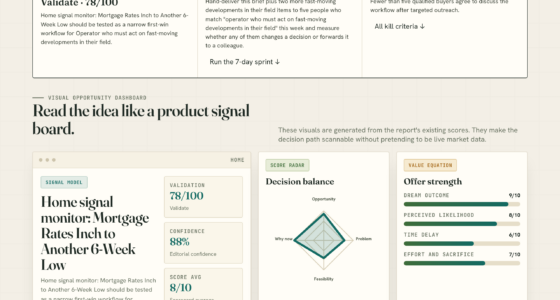

📊 Full opportunity report: World Model Readiness: Are You Ready for AI That Acts? on ThorstenMeyerAI.com — validation score, market gap, and execution plan.

Get the latest gadgets delivered free with Prime
- Fast, free delivery on millions of items
- Prime Video, Amazon Music and more included
- Member-only deals all year
TL;DR
A new diagnostic tool evaluates how prepared organizations are for the shift from AI that describes to AI that predicts and acts. Major AI labs are rapidly developing world models, but readiness varies widely. The assessment helps distinguish between hype and practical capability.
Organizations are now being offered a new diagnostic tool to evaluate their readiness for the emerging era of AI systems that predict and act, moving beyond traditional language models. This tool aims to identify gaps in data, processes, and oversight needed to effectively deploy world models, which are rapidly becoming a central focus in AI development.
The diagnostic, developed by Thorsten Meyer AI, is designed to assess whether an organization has the necessary data, processes, and oversight mechanisms to adopt AI systems capable of understanding and predicting environmental changes. Major players like Meta, Google DeepMind, Nvidia, and Waymo have announced significant progress in developing world models, with applications ranging from photorealistic 3D environments to robotics. These models aim to internalize an understanding of how environments evolve, enabling AI to predict consequences of actions—an essential step toward autonomous decision-making systems.
While research momentum is high, experts caution that current systems are still limited by the ‘reality gap’—the difference between controlled simulations and the messy real world. Many models require vast data and compute resources, and their performance on physical reasoning tasks remains inconsistent. The diagnostic tool emphasizes calibration, oversight, and data readiness as key factors in transitioning from research to operational deployment. It does not promise to build world models but instead provides organizations with a clear picture of their current preparedness and what gaps need addressing.
World Model Readiness — are you ready for AI that acts?
LLMs describe. World models predict and act. The next AI shift isn’t “have we adopted a chatbot” — it’s whether you’d know what to do with a model that anticipates consequences.
Independent commentary, produced with AI assistance under human editorial oversight. The views are the author’s own and may change. World Model Readiness is an early, positioning-stage diagnostic — an assessment framework, not a prediction, guarantee, or technical advice; its conclusions depend on the framework’s assumptions. “World models” are an emerging, rapidly-evolving area of AI; statements about the field reflect publicly reported developments as of mid-2026 and may quickly date. References to companies, labs, and products describe public reporting and imply no affiliation, endorsement, or verification. Product, model, and company names are trademarks of their respective owners.
Implications of Transitioning to Action-Oriented AI
This development matters because the shift from descriptive AI to predictive, action-capable systems could transform industries such as robotics, logistics, and autonomous vehicles. Organizations unprepared for this transition risk deploying systems that act without sufficient understanding, leading to potential failures or safety issues. The diagnostic helps organizations avoid rushing into adoption prematurely, ensuring they understand their capabilities and limitations before integrating world models into critical operations.
AI diagnostic tools for organizations
As an affiliate, we earn on qualifying purchases.
As an affiliate, we earn on qualifying purchases.
Rapid Advances in World Model Research and Industry Adoption
Over the past three years, AI research has shifted focus from language models that generate text to systems that understand and predict the environment. Notable developments include Yann LeCun’s startup, AMI Labs, raising significant funding to build world models, and Google DeepMind’s Genie 3 generating real-time 3D worlds. Major tech companies like Meta, Nvidia, and Waymo have launched projects aimed at applying world models to robotics, simulation, and autonomous driving. Despite these advances, most current models are still experimental, with performance limitations and a significant ‘reality gap’ that must be bridged before widespread deployment.
“The diagnostic is a mirror, not a builder. It helps you honestly assess whether you are ready for the next phase of AI—systems that predict and act, not just describe.”
— Thorsten Meyer, AI researcher
world model readiness assessment software
As an affiliate, we earn on qualifying purchases.
As an affiliate, we earn on qualifying purchases.
Current Limitations and Challenges in Real-World Deployment
It remains unclear how soon these world models will overcome the ‘reality gap’ sufficiently for reliable deployment in complex, unpredictable environments. The performance of current systems on physical reasoning tasks is inconsistent, and the calibration of models to real-world data is still a significant challenge. The diagnostic tool cannot predict exactly when these hurdles will be fully addressed, only indicating current gaps.
As an affiliate, we earn on qualifying purchases.
Next Steps for Organizations and Developers
Organizations should begin evaluating their data infrastructure, process modeling, and oversight capabilities using the new diagnostic tool. Developers and researchers will likely continue refining world models, with upcoming benchmarks and pilot projects testing their real-world applicability. Stakeholders should monitor industry advances and gradually prepare for phased adoption, prioritizing safety, calibration, and oversight mechanisms.
enterprise AI readiness evaluation
As an affiliate, we earn on qualifying purchases.
As an affiliate, we earn on qualifying purchases.
Key Questions
What exactly does the diagnostic assess?
The diagnostic evaluates an organization’s data readiness, process representation, oversight capabilities, and understanding of the limitations of current world models.
Is this diagnostic a guarantee that AI will be safe and reliable?
No, it is a readiness assessment that highlights gaps and risks; it does not guarantee safety or performance in deployment.
When will AI systems with reliable world models be widely available?
It is uncertain; current research is progressing, but practical, robust deployment in complex environments may still be several years away.
How should organizations prepare for this shift?
Start by assessing data, processes, and oversight capabilities, and gradually integrate testing of predictive and action-based AI systems in controlled environments.
Source: ThorstenMeyerAI.com
Halloween Picks
halloween
As an affiliate, we earn on qualifying purchases.