🔍 Read the full analysis: 14 AI Workflow Automation Software Options, Explained on ThorstenMeyerAI.com

Get the latest gadgets delivered free with Prime
- Fast, free delivery on millions of items
- Prime Video, Amazon Music and more included
- Member-only deals all year
TL;DR
A guide from ThorstenMeyerAI.com groups 14 AI workflow automation options by audience and technical needs, from no-code playbooks to developer and enterprise resources. It recommends matching a choice to a team’s skills, integrations, security requirements and expected workload; its recommendations are editorial judgments, not independently verified product rankings.
ThorstenMeyerAI.com has published a guide to 14 AI workflow automation options, sorting resources by technical skill and operational needs, from no-code approaches for business users to developer-focused and enterprise materials. The article argues that buyers must balance quick setup against the flexibility and scale needed for more complex workflows.
In its guide, ThorstenMeyerAI.com presents The No-Code AI Automation Playbook as its best overall choice for business users who want to automate without coding, saying it connects concepts associated with Zapier, Make and n8n. The publisher recommends n8n AI Automation to developers seeking more control and Python integration. These are the guide’s assessments; the supplied source text does not provide comparative test results or independent validation. For more on preparing workflows, see a guide to checking workflow readiness.
The guide also names Agentic Coding with Claude Code, Agentic AI for DevOps, AI-Powered Automation for Small Business and Microsoft Power Automate. ThorstenMeyerAI.com frames the first two around autonomous agents and software or operations work, the small-business resource around simpler, high-impact tasks, and Power Automate around organizations already using Microsoft’s ecosystem. Compare additional options in this look at AI automation software guides.
Although the guide’s title promises 14 options, the supplied source text names only six resources. It does not provide the remaining eight names or a complete list of the 14, so they cannot be summarized here without adding unsupported information.
The 14 picks
- 1
 Agentic AI for DevOps Engineers: Building Autonomous CI/CD, Infrastructure, a…View on Amazon →
- 2
 Workflow Automation with Microsoft Power AutomateView on Amazon →
- 3
 Claude AI for Smart Automation: No-Code Strategies to Build Intelligent Workf…View on Amazon →
- 4
 The No-BS Guide to AI Agents & Automation: Build AI Workflows, Automate Your…View on Amazon →
- 5
 AI Agents: From Theory to Operations — A Practical Guide to Business Automati…View on Amazon →
- 6
 50 AI Workflows for Engineers: From Debugging to System Design, Code Review &…View on Amazon →
- 7
 AI-Powered Automation and Workflows for Small Business OwnersView on Amazon →
- 8
 Practical Autonomous Workflow Automation: Build AI Agents and Automate Real-W…View on Amazon →
- 9
 Hands-On AI Workflow Automation: A Beginner-Friendly Roadmap to Eliminating R…View on Amazon →
- 10
 The No-Code AI Automation Playbook: Build Practical AI Workflows with Zapier,…View on Amazon →
- 11
 AI for Everyday Automation: 7 AI Workflows to Save Hours at Work Every WeekView on Amazon →
- 12
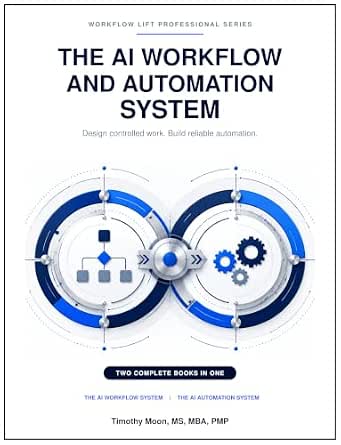 AI Workflow and Automation System – Workflow Lift Professional SeriesView on Amazon →
- 13
 n8n AI Automation: Build Smarter Workflows, Agents, and Intelligent Systems w…View on Amazon →
- 14
 Agentic Coding with Claude Code (5-in-1): A Practical Developer’s Handbook fo…View on Amazon →
Choosing Between Speed and Control
The choice can shape how quickly a team gets a working process and how well it can handle exceptions as that process grows. No-code tools can lower the barrier to entry, while code-first approaches may suit teams that need custom logic and have the skills to maintain it. Neither is automatically the right fit for every organization.
The guide also points to practical risks that can determine whether an automation remains useful: integration reliability, operating costs, data handling and ongoing maintenance. A workflow can fail or become expensive if a connector breaks, usage charges rise, or sensitive information passes through services that do not meet an organization’s requirements.
Popular right now

TCL 65-Inch T7 Series 4K QLED Smart Google TV, 144Hz (65T7)

Roborock Robot Vacuum and Mop Combo with Self-Empty Dock

TCL 65-Inch QM6K QLED Mini-LED 4K HDR Smart Google TV, 144Hz
As an affiliate, we earn on qualifying purchases.
How the Guide Groups Its Picks
ThorstenMeyerAI.com says it evaluated resources for practical applicability—whether instructions can lead to a working workflow—and technical accessibility. The guide separates material intended for nontechnical business users from developer-oriented frameworks and enterprise environments. The supplied article describes this selection method but does not include scores, a full methodology dataset or evidence of testing.
The guide’s broader framing is that automation choices span a range from linear, prebuilt connections to workflows with branching logic or agents that can make decisions. It cautions that simple tools may become awkward as logic grows, while code-first systems demand programming expertise. That tradeoff underlies its recommendations for small businesses, developers and organizations using Microsoft’s cloud and productivity services.
The Full Fourteen Are Not Listed
The supplied ThorstenMeyerAI.com source text does not identify all 14 options, despite the title, and gives no publication date. It also does not supply prices, feature-by-feature comparisons, benchmark results, or details supporting its rankings. The guide’s judgments should be read as editorial recommendations rather than independently established findings.
Specific claims in the guide about Python integration, platform flexibility and Microsoft ecosystem fit are not accompanied in the supplied text by product documentation or test results. Readers would need to check current vendor materials for available connectors, pricing, security controls and feature changes before making a purchase or deployment decision.
Verify Fit Before Deployment
Teams considering these approaches should first map the workflow they want to automate, identify the applications and APIs it depends on, and confirm who will build and maintain it. They should also compare costs at higher usage levels and review data retention, access controls and compliance terms before routing sensitive information through third-party services.
The supplied source does not announce a forthcoming update or next milestone. A more complete comparison would require ThorstenMeyerAI.com to provide the other eight options and the evidence behind its evaluations; meanwhile, buyers can verify current capabilities directly with the relevant vendors.
Key Questions
Which option does the guide recommend for nontechnical users?
ThorstenMeyerAI.com names The No-Code AI Automation Playbook as its best overall choice for business users seeking automation without coding. This is the guide’s assessment, not an independently verified ranking.
What does it recommend for developers?
The guide points developers seeking custom control toward n8n AI Automation and cites Python integration. The supplied material does not include technical test results to independently assess that claim.
Does the source list all 14 options?
No. The supplied ThorstenMeyerAI.com text names six resources and does not identify the other eight, so a complete 14-item comparison cannot be reconstructed from it.
What should teams check before choosing an automation platform?
Check whether it supports required integrations, fits the team’s coding skills, can handle expected volume and has suitable security, privacy and maintenance controls. Compare costs at projected usage, not only at today’s volume.
Source: ThorstenMeyerAI.com