
📊 Full opportunity report: The Heir’s Scorecard: Reviewing Your Wealth Advisor on IdeaNavigator AI — validation score, market gap, and execution plan.

Get the latest gadgets delivered free with Prime
- Fast, free delivery on millions of items
- Prime Video, Amazon Music and more included
- Member-only deals all year
TL;DR
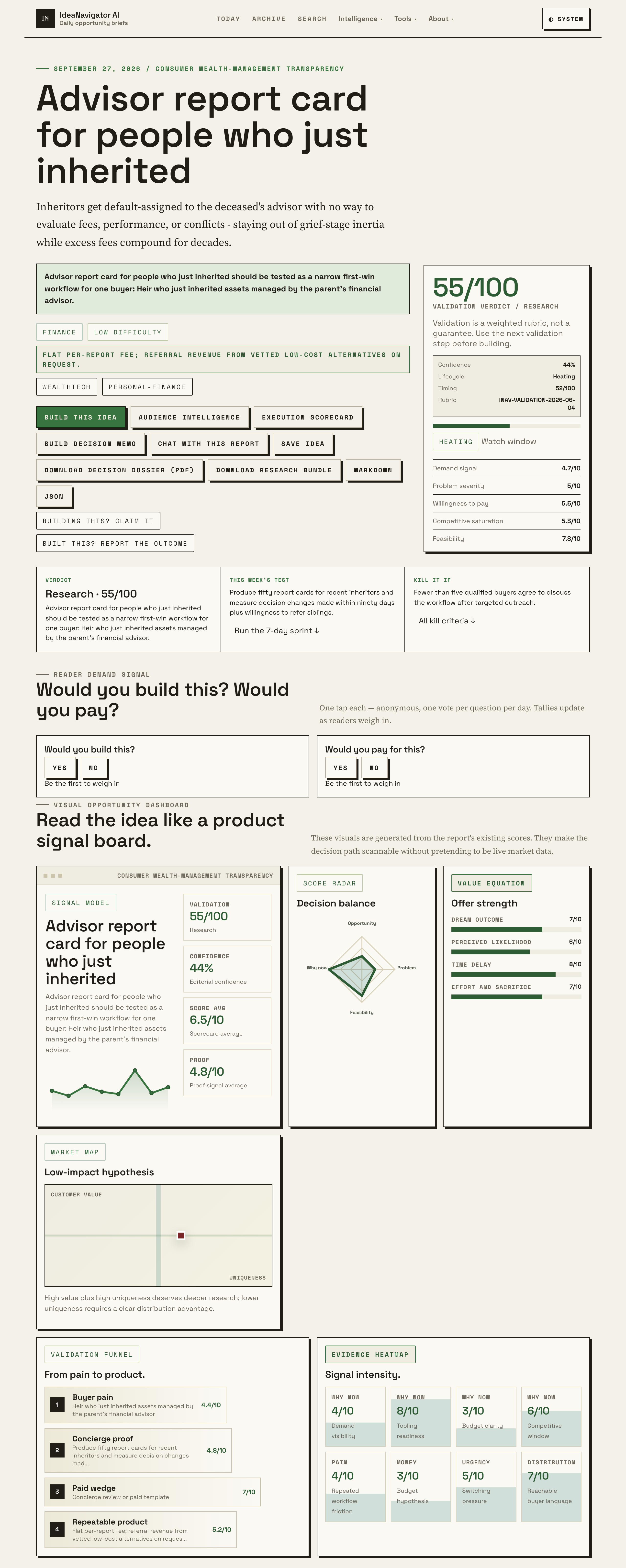
IdeaNavigator AI has outlined a proposed report card for people who inherit assets managed by a parent’s financial advisor. The concept would analyze statements, disclosed fees and regulatory records, then offer options to stay, negotiate or switch; no launch, test results or user outcomes are provided.
IdeaNavigator AI has proposed a report card to help people who have recently inherited assets evaluate the financial advisor who managed them for a parent. The concept would use account statements and public disclosures to estimate fees, review regulatory history and conflicts, and present options to stay, negotiate or switch; the proposal does not establish that a product has launched or been tested.
The proposed first version is aimed at a specific situation: an heir receives assets that remain with the parent’s financial advisor. IdeaNavigator AI says inheritors may remain with that advisor by default, without a clear way to judge fees, performance or conflicts. The proposal links this inertia to grief, but provides no research or user data measuring how often it occurs or what it costs.
Under the suggested workflow, a user would enter the advisor’s name and upload financial statements. The report would draw on regulatory history and disclosed conflicts, interpret the account’s stated charges to estimate all-in fees, and compare those costs with alternatives. It would then offer stay, negotiate or switch guidance, along with scripts for conversations with the advisor. The materials do not specify how the product would verify its calculations or tailor recommendations to an heir’s financial circumstances.
The proposed business model combines a flat fee per report with referral revenue if users request introductions to vetted lower-cost alternatives. To test demand, IdeaNavigator AI suggests preparing 50 reports for recent inheritors and measuring whether they make a decision within 90 days, as well as whether they would refer siblings. Those are proposed measures; no completed test, pricing, referral partners or results are reported.
A Review at the Point of Inheritance
The concept targets a consequential financial handoff. Someone inheriting an account may need to decide whether to retain the existing advisor while also managing paperwork and personal loss. A clear explanation of fees and disclosures could help make that decision more informed. The proposal’s concern is that ongoing charges can accumulate if an heir stays without reviewing the arrangement, but it gives no fee examples or estimates of potential savings.
The idea also puts trust and incentives at the center of its business model. A report that recommends alternatives while earning referral revenue would need to explain how those referrals are selected and whether payments affect what appears in the comparison. For readers, the distinction between a document-based review and personalized financial advice would also matter. The proposed outline does not define that boundary or explain who would be responsible for recommendations.
Top picks for "heir scorecard wealth"
As an affiliate, we earn on qualifying purchases.
The Proposed First Customer
IdeaNavigator AI frames the opportunity within the transfer of wealth to heirs, describing trillions of dollars moving over the decade. It does not provide a specific estimate, time period beyond that broad description, or supporting data in the proposal. Its narrower starting point is an heir whose inherited assets are already under the care of the deceased parent’s advisor.
The proposed service depends on two inputs: public information, such as regulatory filings and fee disclosures, and the heir’s own account statements. IdeaNavigator AI argues that public records and large language model document parsing could make parts of the review automatable. That is a product rationale, not evidence that the process can reliably extract every charge or identify all relevant conflicts. The outline does not name a regulator or filing, describe a data source, or report accuracy checks.
Evidence Still to Be Established
No product launch, pilot or user results are described. It is unclear whether the proposed 50-report test has begun, who would prepare or review the reports, or how the service would handle missing or inconsistent statements. No methodology is given for benchmarking performance or comparing advisors, and the proposal does not explain whether comparisons would account for differences in services, investment risk or tax circumstances.
The suggested regulatory review also raises practical questions that remain unanswered: how current records would be, how disclosures would be matched to the named advisor, and how the report would distinguish an allegation from a finding. The outline provides no sample report, fee schedule, privacy or data-retention terms, or details about the alternatives that might receive referrals. Its claim that costs can compound over decades is presented as the problem the product aims to address, not as a measured outcome of a study.
Testing Demand and Decision Changes
The next step proposed by IdeaNavigator AI is to produce 50 reports for recent inheritors and track decisions over 90 days, along with willingness to refer siblings. Such a test could indicate whether users act on the information and find the report useful. The proposal does not state when recruitment would start, what would count as a decision change, or how the team would separate the report’s effect from other advice or family circumstances.
Until results or a product release are reported, the scorecard remains a proposed consumer-finance workflow. Its central promise is to make an inherited advisor relationship easier to examine; whether it can provide accurate, understandable comparisons at a price users will pay has yet to be shown.
Source: IdeaNavigator AI
Key Questions
Has the advisor report card launched?
No launch is reported. IdeaNavigator AI describes a proposed product and a possible validation test, without giving a release date or saying that testing has taken place.
Who is the proposed service for?
It is aimed at someone who has recently inherited assets that were managed by the deceased parent’s financial advisor.
What would the report review?
The proposed report would use account statements and public disclosures to examine estimated all-in fees, regulatory history and disclosed conflicts, then offer stay, negotiate or switch options.
How would the idea be tested?
IdeaNavigator AI proposes producing 50 reports for recent inheritors and measuring decision changes within 90 days and willingness to refer siblings. No test results are provided.
Source: IdeaNavigator AI
Halloween Picks
halloween
As an affiliate, we earn on qualifying purchases.