
📊 Full opportunity report: How IEP Negotiation Simulators Fit Into Special-Education Advocacy on IdeaNavigator AI — validation score, market gap, and execution plan.
TL;DR
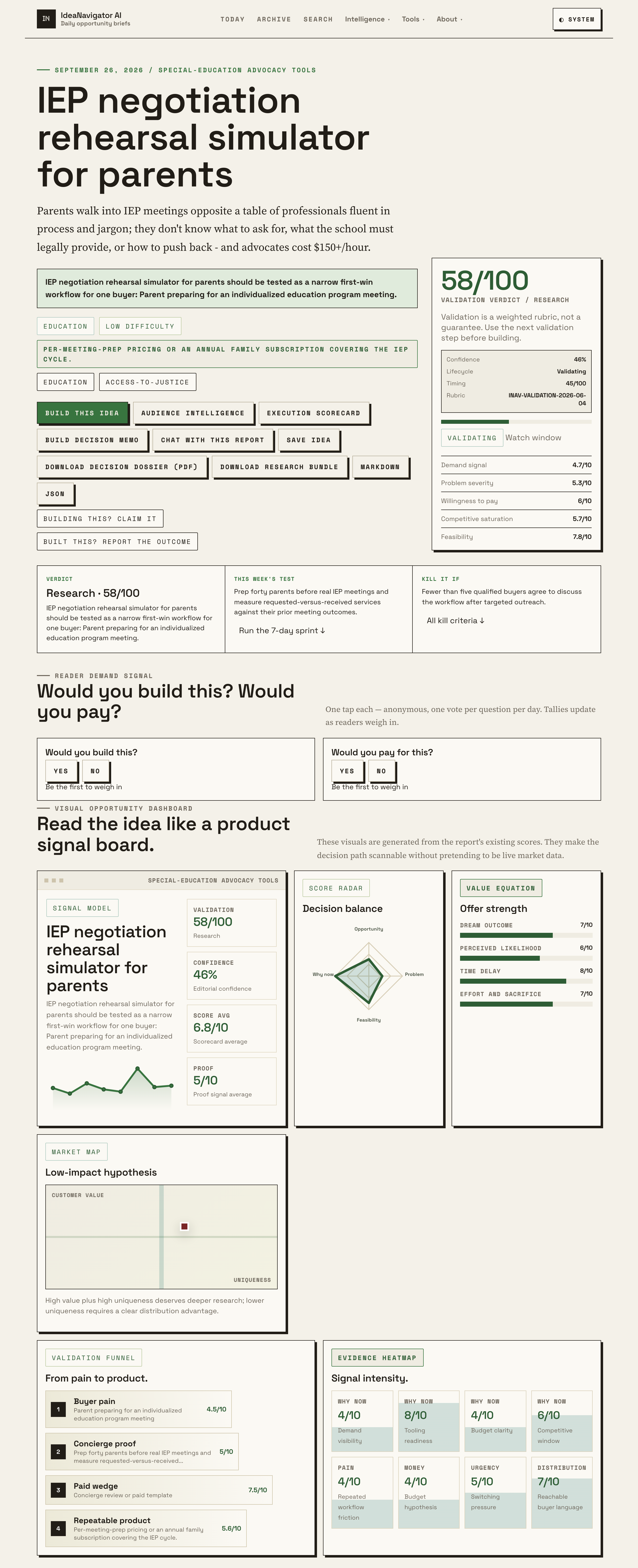
A new product concept from IdeaNavigator AI proposes an AI-driven rehearsal simulator that prepares parents for individualized education program (IEP) meetings by explaining entitlements, drafting legally grounded requests, and role-playing realistic pushback. The concept reflects growing interest in affordable alternatives to paid special-education advocates, whose rates often exceed $150 per hour. No such tool has been validated yet; the proposal calls for testing with forty parents before real meetings.
A newly published product concept proposes using large-language-model role-play to train parents for individualized education program (IEP) meetings, the legally required sessions where schools and families agree on services for students with disabilities. The concept, outlined by IdeaNavigator AI, calls for a simulator that reads a family’s current IEP and evaluation reports, explains entitlements in plain language, and then role-plays the meeting — including realistic pushback from school staff — until the parent can hold their positions. No working product has been built or tested; the proposal is currently at the idea-validation stage.
The concept targets a single, narrow buyer: a parent preparing for an upcoming IEP meeting. According to IdeaNavigator AI, the core problem is asymmetry at the negotiating table. Parents typically sit opposite a team of professionals fluent in special-education process and jargon, and often do not know what to ask for, what the school must legally provide, or how to push back when services are declined. Professional advocates who can fill that gap commonly charge more than $150 per hour, a cost the proposal identifies as prohibitive for many families.
The proposed minimum viable product works in three stages. First, the parent uploads their child’s current IEP and evaluation reports. The tool then explains the family’s entitlements in plain language and generates a request list with legal grounding for each item. Finally, it role-plays the meeting itself, simulating a school team that pushes back on requests, and repeats the exercise until the parent can maintain their positions under pressure. Pricing, per the concept, could follow either a per-meeting-preparation fee or an annual family subscription covering the full IEP cycle — the yearly sequence of evaluation, planning, and review meetings.
The proposed validation method is specific: prepare forty parents before their real IEP meetings and measure the services they request versus the services they receive, compared against outcomes from each family’s prior meeting. IdeaNavigator AI positions the simulator within the broader market for special-education advocacy tools, describing it as a deliberately narrow “first-win” workflow rather than a general-purpose assistant.
The Advocacy Gap the Tool Targets
IEP meetings carry high stakes: they determine the services, accommodations, and placement a child with a disability receives, and outcomes are difficult to reopen between annual cycles. Parents who arrive without command of the process — the jargon, the legal baseline of what districts must provide, and common deferral tactics — can leave with fewer services than their child is entitled to. Paid advocates and special-education attorneys exist to correct that imbalance, but at $150 or more per hour, they are out of reach for many families, particularly those in districts where meetings are already adversarial.
The concept’s timing argument rests on two converging trends, as stated by IdeaNavigator AI: LLM role-play has improved enough to simulate a realistic multi-party meeting, and special-education identification rates keep climbing while district resources tighten — a combination that tends to make negotiations more contentious. If a simulator could deliver even part of what a paid advocate provides at subscription pricing, it would lower the cost of preparation substantially. The proposal also argues that narrow scope matters: by serving one buyer with one job — preparing for one meeting — the tool can be tested and improved quickly rather than attempting to cover the entire special-education landscape at once.
Top picks for "negotiation simulator special"
As an affiliate, we earn on qualifying purchases.
How the Concept Fits Existing Advocacy Tools
The idea sits within an established market of special-education advocacy resources. Families currently draw on paid advocates, parent training centers, published guides on IEP rights under the Individuals with Disabilities Education Act (IDEA), and more recent AI chatbots used informally to draft requests or decode evaluation reports. What distinguishes the proposed simulator is rehearsal: rather than only informing the parent, it practices the live negotiation, including the pressure of professional pushback, before the real meeting occurs.
The concept also reflects a broader pattern in AI product development — using conversational models for role-play training in high-stakes interpersonal situations, a technique already applied in interview preparation and difficult-conversation coaching. Applying it to IEP meetings extends that approach to a legal-adjacent domain where the counterparty is an institution with more information and process fluency than the family.
What Has Not Been Tested Yet
No product has been built, and no parents have used the proposed simulator — the concept exists only as a published idea with a validation plan. Several material questions remain open. It is not yet clear whether an AI role-play can faithfully reproduce the dynamics of a real IEP meeting, where the pushback a parent faces may be institutional and procedural rather than purely conversational. The accuracy of the tool’s legal grounding is unverified: IEP entitlements depend on jurisdiction, district practice, and the specifics of a child’s evaluation, and an error in the generated request list could mislead a parent. Privacy is also unresolved — the workflow requires uploading sensitive educational and evaluation records, and no data-handling framework has been specified. Finally, the causal claim at the heart of the validation plan — that rehearsal improves requested-versus-received service outcomes — is a hypothesis, not a finding, and the proposed forty-parent study has not been run.
Path From Concept to Validated Tool
The immediate next step laid out in the concept is the validation study: recruiting forty parents ahead of real IEP meetings, preparing them with the simulator, and tracking whether the services they request and receive improve relative to their prior meetings. Before that, an MVP would need to be built — the document-upload pipeline, the plain-language entitlement explainer, the legally grounded request generator, and the role-play engine with simulated pushback. If validation succeeds, the concept anticipates pricing around per-meeting preparation or an annual family subscription, with expansion potentially following across the full IEP cycle. Until results from real meetings exist, the simulator remains an untested proposition in the special-education advocacy market.
Source: IdeaNavigator AI
Key Questions
Does an IEP meeting simulator actually exist today?
No. What has been published is a product concept by IdeaNavigator AI describing how such a tool would work and how it should be tested. No working product, pilot, or published results exist yet.
How would the simulator prepare a parent for an IEP meeting?
Per the concept, the parent uploads the current IEP and evaluation reports; the tool explains entitlements in plain language, generates a request list with legal grounding, and then role-plays the meeting with simulated pushback until the parent can hold their positions.
Could an AI simulator replace a paid special-education advocate?
That is untested. Advocates and attorneys charge $150 or more per hour and provide in-person representation and legal judgment that a rehearsal tool does not. The concept positions the simulator as an affordable preparation aid, not a replacement, and its effectiveness has not been measured.
What evidence would show the simulator works?
The proposed validation would prepare forty parents before real IEP meetings and compare the services they request and receive against their own prior meeting outcomes. A measurable improvement in requested-versus-received services would be the key signal. This study has not been conducted.
What are the privacy concerns with uploading IEP documents?
The workflow requires uploading sensitive educational and evaluation records. The concept does not specify how that data would be stored, protected, or shared, and any real product would need to address student-privacy obligations before handling such documents.
Source: IdeaNavigator AI