
🔍 Read the full analysis: What Makes A Factory Robot AI-Enabled? on ThorstenMeyerAI.com

Get the latest gadgets delivered free with Prime
- Fast, free delivery on millions of items
- Prime Video, Amazon Music and more included
- Member-only deals all year
TL;DR
Industrial robots have moved from repetitive hot-metal handling to widespread use across factory production, with 5 million operating worldwide in 2025, according to the International Federation of Robotics. The source account focuses on industrial automation and employment; it does not establish that the robots described are AI-enabled. Whether a factory robot uses AI depends on its capabilities and control system, not simply on being a robot.
A November 24 report on factory automation traces industrial robots from Unimate’s 1961 deployment at a General Motors plant to a global installed stock of 5 million robots in 2025, according to the International Federation of Robotics (IFR). The account documents the growth of industrial automation, but does not show that these machines are AI-enabled: a robot’s ability to perform programmed work is not, by itself, evidence that it uses artificial intelligence.
Unimate was installed at GM’s Ternstedt plant in Trenton, New Jersey, to unload a die-casting press, the IFR and The Henry Ford museum say. The machine handled hot metal parts and stacked them, taking on work described in the report as hot, heavy and dangerous. The account says its instructions came step by step from a magnetic drum—a form of programmed operation, not evidence of AI.
Robots later took on welding. At GM’s Lordstown, Ohio, plant in 1969, Unimate spot-welding robots helped automate more than 90% of body welding, compared with 20% to 40% at traditional plants, according to the IFR. Japan’s Kawasaki began producing licensed Unimate robots around the same time, as manufacturers faced labor shortages in hard, dirty and dangerous work.
The IFR’s 2026 report counted more than 600,000 new installations in 2025, including 354,000 in China—59% of the world total. The United States installed almost 38,500, while Japan installed 36,219. These figures describe industrial robot installations; they do not identify what share used AI. The source account likewise provides no technical survey of AI adoption.
Infographic 01 · Five million robots
Where the robots work
Sixty-five years after the first Unimate, five million industrial robots work in the world's factories. South Korea has by far the most per worker.
Robots per 10,000 employees in manufacturing · 2024
Where the new robots went · 2025
- China: 354,000 installed, 59% of the world total.
- United States: almost 38,500 (+12%), again the second-largest market.
- Japan 36,219 (−19%) · South Korea 30,000 · Germany fewer than 25,000 (−8%), Europe’s largest market.
Robot density = operational industrial robots per 10,000 employees in manufacturing. China (166 in 2024) is not compared here: the IFR switched to updated Chinese labour data in 2026, which changed the denominator.
Sources: IFR, robot density press release, 8 Apr 2026 (data 2024); IFR, World Robotics 2026 press release, 24 Sep 2026.
Powered by Thorsten Meyer AI
Automation Is Not the Same as AI
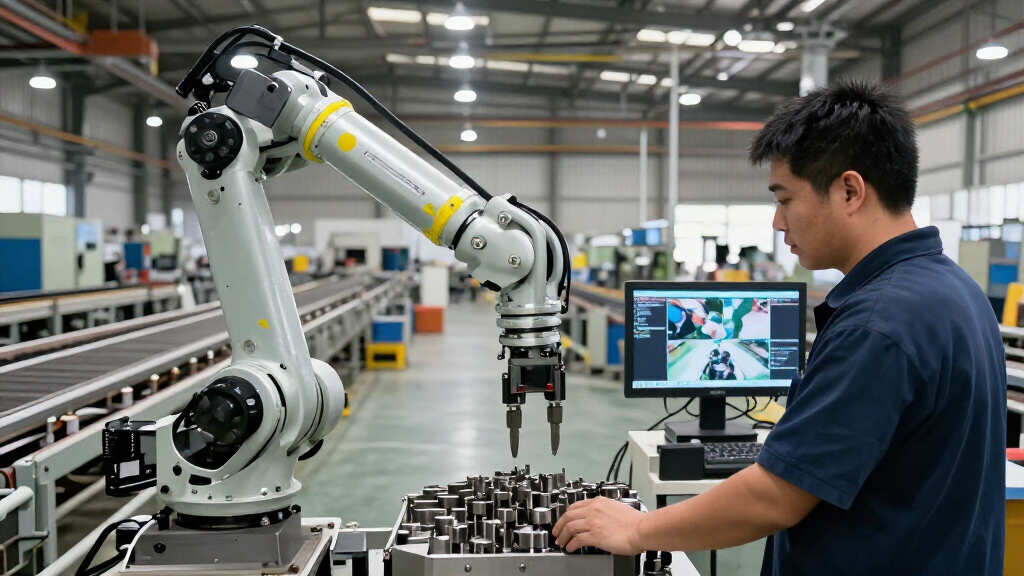
The distinction matters because factory robotics and AI are often discussed as if they were interchangeable. A robot may repeat precise movements from a fixed program without independently interpreting its surroundings or adapting its actions. Calling a machine AI-enabled requires evidence about its software and capabilities, not merely its presence on a production line.
The employment stakes are also real, but the research summarized in the source does not support a single universal outcome. Economists Daron Acemoglu and Pascual Restrepo estimated that each additional industrial robot in the United States from 1990 to 2007 displaced about 3.3 workers across the economy, with an estimated 400,000 jobs lost overall. The report contrasts this with Germany, where factory job losses were offset by service-sector gains in the estimate it cites. Those findings concern industrial robots and employment, not AI specifically.
Popular right now

iRobot Roomba Max 875 Robot Vacuum and Mop

KitchenAid Artisan 5-Qt Tilt-Head Stand Mixer, Almond Cream

Apple AirPods Pro (2nd Generation) Wireless Earbuds with USB-C MagSafe Charging Case
As an affiliate, we earn on qualifying purchases.
From Unimate to Global Deployment
The early machines were built to handle work that was dangerous, physically demanding or repetitive. George C. Devol filed a patent for a programmed article-transfer machine in 1954; the patent was granted in 1961. With entrepreneur Joseph Engelberger, he founded Unimation, whose first robot went to GM. The early industrial robot’s job was specific: lift and move parts according to instructions.
Robot designs and uses expanded over subsequent decades. The source says GM introduced spot-welding robots at Lordstown in 1969; European manufacturers developed new models in 1973. By the IFR’s 2024 density figures, South Korea had 1,220 industrial robots per 10,000 manufacturing employees, Germany 449 and the United States 307. Robot density measures machines per manufacturing workforce; it does not measure AI use, autonomy or how many workers a machine replaces.
AI Use Is Not Quantified
The figures cited cover industrial robots, but the account does not specify how many use AI, what definition of “AI-enabled” applies, or whether any reported systems learn or adapt after deployment. It also does not provide plant-level evidence to distinguish fixed programming from AI-assisted perception, planning or control. The job estimates cited concern earlier periods and cannot establish the employment effect of current AI-enabled systems.
The employment comparison also depends on which workers and outcomes are counted. The source notes that people who never secured factory jobs may experience automation differently from workers who remain employed. The figures and summaries provided do not resolve those differences or establish a single effect for every country or industry.
Evidence Needed on Factory AI
The immediate next step is to separate three questions that are often bundled together: how many industrial robots are installed, how many use AI, and how their use affects employment. The IFR figures cited here address the first question. A measured answer to the second would require a clear definition and comparable data on robot software and functions; evaluating the third would require research that tracks workers, firms and job changes over time.
For readers evaluating a claim that a factory robot is AI-enabled, the relevant details are the system’s documented capabilities, how it receives and uses information, and whether it can adapt its actions rather than simply follow a fixed sequence. The source account offers a history of industrial robots and a review of selected employment research, but does not provide that technical evidence for today’s factory fleet.
Key Questions
Does every factory robot use artificial intelligence?
No. A robot can carry out programmed movements without using AI. The source account does not quantify how many of the 5 million industrial robots counted in 2025 were AI-enabled.
What was Unimate’s job at GM?
Unimate unloaded a die-casting press at GM’s Ternstedt plant in Trenton, New Jersey, handling hot metal parts. The IFR and The Henry Ford museum identify the plant and task.
How many industrial robots were operating worldwide in 2025?
The International Federation of Robotics counted an operational stock of 5 million industrial robots in 2025, 9% more than a year earlier, according to the source account.
Do industrial robots always reduce employment?
No single outcome is established for all places and periods. The source cites research estimating job losses in the United States from 1990 to 2007 and a different balance of factory and service employment in Germany.
Source: ThorstenMeyerAI.com