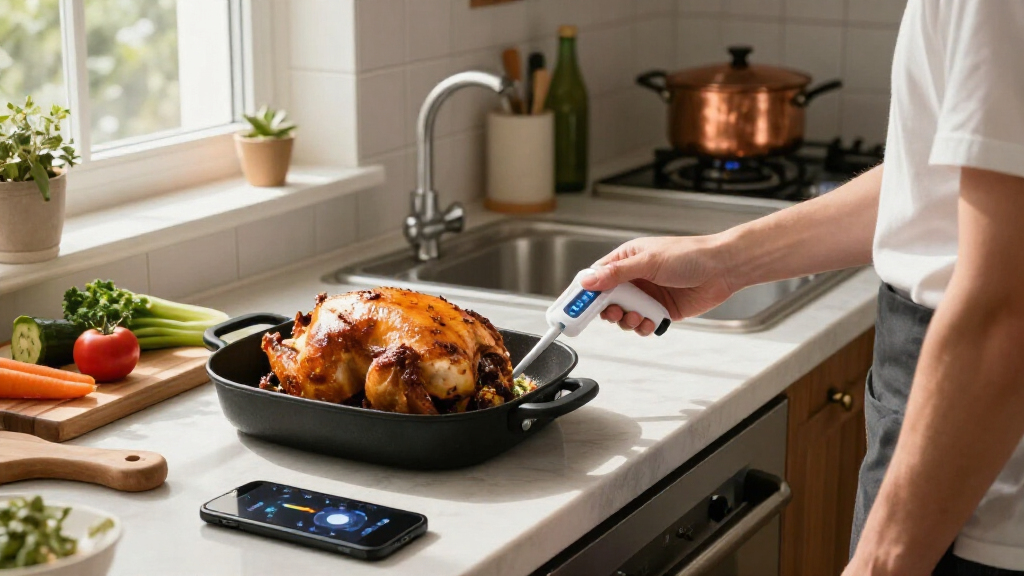
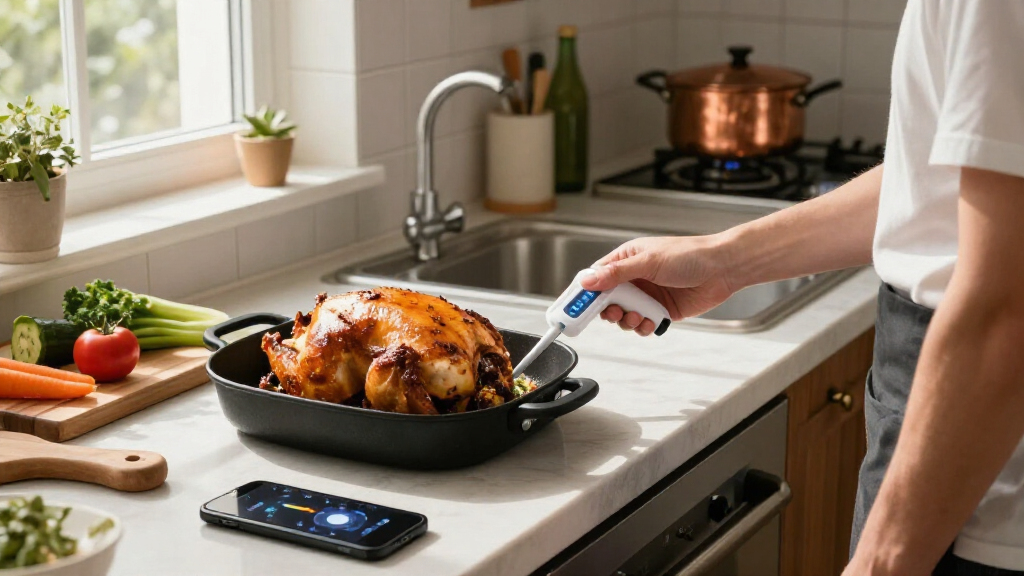
For roasting, I’d start with the ThermoMaven G1 for its smart display base, which keeps temperature information available without relying on a phone. The ThermoMaven P2 is a strong alternative for cooks who want Wi-Fi, two probes, and a base, while the CHEF iQ Sense with two probes suits cooks who value slim probes and app-guided cooking. The main tradeoffs are connection range, probe count, display convenience, and how much you want to depend on an app. A long-range or multi-probe setup can help with larger roasts or several cuts, but may add complexity you won’t use for a single joint. Read on for the full breakdown and help matching a thermometer to your roasting routine.

Get the latest gadgets delivered free with Prime
- Fast, free delivery on millions of items
- Prime Video, Amazon Music and more included
- Member-only deals all year
Complete the kit



Key Takeaways
- A display base changes the cooking routine: The ThermoMaven G1, ThermoMaven P2, and JoyBear provide at-base readouts, unlike options that lean more heavily on a phone.
- Connection claims are not interchangeable: Wi-Fi models such as the ThermoMaven Wi-Fi options and Meatmeet X Pro may suit remote monitoring, while Bluetooth-focused picks are more dependent on proximity and setup.
- Two probes cover most single-roast needs: They let you monitor two parts of a roast or track the meat and cooking environment, while four-probe models like the TempPro TP829 and CHEF iQ Sense 4-probe version favor multi-item cooking.
- Probe shape and count solve different problems: CHEF iQ Sense’s ultra-thin probes prioritize a smaller insertion point; additional probes prioritize monitoring more food at once.
- Range and extra features should match the kitchen: A 3000-foot or 360-foot range claim may matter for monitoring from farther away, but probe placement, oven layout, and the connection path still affect usefulness.
| SMNQIUA Wireless Smart Meat Thermometer with Bluetooth and Digital Display |  | Best for Long Roasts with On-Base Controls | Connectivity: Bluetooth 5.4 | Sensors: 6 | Listed accuracy: Up to ±1°F in description; ±0.5°F in listing title | VIEW LATEST PRICE | See Our Full Breakdown |
| ThermoMaven Smart Wireless Meat Thermometer with Wi-Fi and Bluetooth |  | Best for Precision and Remote App Monitoring | Connectivity: 2.4 GHz Wi-Fi and Bluetooth | Sensors: 6 (5 internal and 1 external) | Accuracy: NIST-certified ±0.5°F | VIEW LATEST PRICE | See Our Full Breakdown |
| Bluetooth Meat Thermometer with Dual Probes and 360 ft Range |  | Best for Roasting Two Foods at Once | Probe count: 2 | Connectivity: 2.4 GHz Wi-Fi and Bluetooth | Maximum range: Up to 360 ft via Wi-Fi; up to 200 ft via Bluetooth | VIEW LATEST PRICE | See Our Full Breakdown |
| MEATER Plus Wireless Smart Meat Thermometer with Bluetooth and Walnut Charger |  | Best for Guided Roasting | Connectivity: Bluetooth | Wireless range: Up to 165 ft | Sensors: Dual food and ambient sensors | VIEW LATEST PRICE | See Our Full Breakdown |
| ThermoMaven 3000-Foot Wireless Meat Thermometer with 2 Probes |  | Best for App-Free Long-Range Monitoring | Connectivity: Sub-1G wireless | Wireless range: Up to 3,000 ft | Probes and sensors: 2 probes; 6 sensors per probe | VIEW LATEST PRICE | See Our Full Breakdown |
| ThermoMaven G1 Wireless Meat Thermometer with Smart Display Base |  | Best for Long-Range Monitoring | Connectivity: Sub-1G, Bluetooth, and Wi-Fi | Wireless range: Up to 3,000 ft unobstructed; 700 ft obstructed | Sensors: 6 total: 5 internal and 1 external | VIEW LATEST PRICE | See Our Full Breakdown |
| Meatmeet X Pro Wireless Meat Thermometer with Wi-Fi, Bluetooth, and 2 Probes |  | Best for Two Roasts at Once | Probes: 2 | Sensors per probe: 6: 5 internal and 1 ambient | Accuracy: ±0.18°F | VIEW LATEST PRICE | See Our Full Breakdown |
| ThermoMaven Smart WiFi Wireless Meat Thermometer with 2 Probes |  | Best for Guided Roasting | Model: WT02 Lite | Probes: 2 | Sensors per probe: 6 | VIEW LATEST PRICE | See Our Full Breakdown |
| Smart Wireless Meat Thermometer with 2 Probes |  | Best for Magnetic-Dock Convenience | Probe count: 2 | Reading time: 1 second | Accuracy: ±1°F | VIEW LATEST PRICE | See Our Full Breakdown |
| CHEF iQ Sense Smart Wireless Meat Thermometer with 2 Ultra-Thin Probes |  | Best for Long Roasts | Model: iQ Sense CQ60-2C-Z1-E | Probes: 2 | Sensors per probe: 5: 4 internal and 1 ambient | VIEW LATEST PRICE | See Our Full Breakdown |
| TempPro TempSync TP829 Wireless Meat Thermometer with 4 Probes |  | Best for Multi-Roast Monitoring | Connectivity: RF wireless | Wireless range: Up to 1,000 feet | Probe count: 4 | VIEW LATEST PRICE | See Our Full Breakdown |
| MEATER Plus Wireless Smart Meat Thermometer with Bluetooth, Honey |  | Best for Guided Roasting | Connectivity: Bluetooth; Wi-Fi support listed | Probe count: 1 | Temperature sensors: Dual | VIEW LATEST PRICE | See Our Full Breakdown |
| JoyBear Wireless Meat Thermometer with 2 Probes and Smart Display Base |  | Best for Phone-Free Control | Probe count: 2 | Sensors: 6 | Accuracy: ±0.5°F | VIEW LATEST PRICE | See Our Full Breakdown |
| CHEF iQ Sense Smart Wireless Meat Thermometer with 4 Probes |  | Best Premium Multi-Probe System | Probe count: 4 | Temperature sensors: 5 total: 4 internal and 1 ambient | Maximum temperature: 1,000°F | VIEW LATEST PRICE | See Our Full Breakdown |
| ThermoMaven P2 Wi-Fi Wireless Meat Thermometer with 2 Probes and Smart Display Base |  | Best for Remote Two-Roast Monitoring | Probe count: 2 | Sensors: 6: 5 internal and 1 external | Connectivity: 2.4 GHz Wi-Fi and Bluetooth | VIEW LATEST PRICE | See Our Full Breakdown |
| smart meat thermometers for roasting | Connectivity | Probe care | Accuracy |
|---|---|---|---|
| SMNQIUA Wireless Smart Meat Th | Bluetooth 5.4 | IPX7 waterproof; dishwasher safe | — |
| ThermoMaven Smart Wireless Mea | 2.4 GHz Wi-Fi and Bluetooth | IPX8 waterproof; dishwasher safe | NIST-certified ±0.5°F |
| Bluetooth Meat Thermometer wit | 2.4 GHz Wi-Fi and Bluetooth | IP67 waterproof; dishwasher safe | ±1°F |
| MEATER Plus Wireless Smart Mea | Bluetooth | Dishwasher safe | — |
| ThermoMaven 3000-Foot Wireless | Sub-1G wireless | IPX8 waterproof; dishwasher safe | NIST-certified ±0.5°F |
| ThermoMaven G1 Wireless Meat T | Sub-1G, Bluetooth, and Wi-Fi | IPX8 waterproof and dishwasher-safe | ±0.5°F, NIST-certified |
| Meatmeet X Pro Wireless Meat T | Wi-Fi and Bluetooth | — | ±0.18°F |
| ThermoMaven Smart WiFi Wireles | Wi-Fi, Bluetooth, and RF | — | — |
| Smart Wireless Meat Thermomete | — | — | ±1°F |
| CHEF iQ Sense Smart Wireless M | Wi-Fi and Bluetooth | Waterproof and dishwasher-safe | — |
| TempPro TempSync TP829 Wireles | RF wireless | — | — |
| MEATER Plus Wireless Smart Mea | Bluetooth; Wi-Fi support listed | — | — |
| JoyBear Wireless Meat Thermome | Bluetooth | IP67-rated and dishwasher-safe; dry thoroughly before charging | ±0.5°F |
| CHEF iQ Sense Smart Wireless M | Wi-Fi and Bluetooth | Waterproof and dishwasher-safe | — |
| ThermoMaven P2 Wi-Fi Wireless | 2.4 GHz Wi-Fi and Bluetooth | IPX8 waterproof and dishwasher-safe | ±0.5°F |
More Details on Our Top Picks
SMNQIUA Wireless Smart Meat Thermometer with Bluetooth and Digital Display
For a roast that needs steady monitoring without frequent app checks, the SMNQIUA’s display base is its clearest advantage: it shows live readings and supports basic adjustments at the unit. Six sensors and a stated accuracy of up to ±1°F provide useful tracking as the center warms, while the probe’s 24-hour runtime suits extended cooks. Its stated Bluetooth reach is generous in open areas, though walls and other obstructions can reduce that distance. Compared with the ThermoMaven Wi-Fi and Bluetooth model, this one offers longer listed probe runtime but lacks Wi-Fi and has a lower internal temperature limit of 212°F. One data caveat matters: its listing gives conflicting accuracy claims, ±1°F and ±0.5°F. I’d choose it for a straightforward roast setup, not for buyers who need a clearly documented precision figure or remote Wi-Fi access.
Pros:- Display base shows live temperatures and supports basic adjustments without opening the app.
- Six sensors track cooking temperature, with accuracy stated as up to ±1°F in the description.
- Probe is IPX7 waterproof and dishwasher safe.
- Probe and base runtimes are listed at up to 24 and 48 hours.
Cons:- The probe’s internal temperature limit is 212°F.
- Accuracy is listed inconsistently as ±1°F and ±0.5°F.
- The base is splash resistant, not described as waterproof.
Best for: Roast cooks who want a rechargeable probe, a readout at the counter, and enough battery life for an all-day cook.
Not ideal for: Buyers who need Wi-Fi monitoring away from home or a high internal-temperature ceiling; the probe is rated to 212°F and the accuracy claims conflict.
- Connectivity:Bluetooth 5.4
- Sensors:6
- Listed accuracy:Up to ±1°F in description; ±0.5°F in listing title
- Wireless range:Up to 1,000 ft in open areas; 500 ft in obstructed spaces
- Temperature limits:212°F internal; 572°F ambient
- Probe care:IPX7 waterproof; dishwasher safe
- Battery life:Probe up to 24 hours; base up to 48 hours of monitoring
- Display:Digital display base
Our verdict“Choose the SMNQIUA if you want long-running monitoring with an on-base display and can accept Bluetooth-only connectivity and unclear accuracy claims.”
ThermoMaven Smart Wireless Meat Thermometer with Wi-Fi and Bluetooth
The ThermoMaven Wi-Fi and Bluetooth is the strongest fit here for cooks who want precise readings plus the option to check a roast remotely. Its six sensors carry a NIST-certified ±0.5°F accuracy claim, and the standalone base keeps temperature checks available without relying on the app. Wi-Fi adds a kind of off-site access the Bluetooth-only SMNQIUA does not offer, while Bluetooth serves nearby monitoring. That precision and connectivity come with a notable battery tradeoff: the probe runs for only up to two hours, even though a two-minute charge is listed to provide up to two hours of use. That may be ample for many roasts, but it leaves less room for long, unattended cooks than the SMNQIUA’s listed 24-hour probe runtime. I’d pick this for measurement confidence and flexible monitoring, not for an especially long cook without access to charging.
Pros:- Six sensors with NIST-certified ±0.5°F accuracy.
- Wi-Fi and Bluetooth support both remote and nearby monitoring.
- Standalone display base allows temperature checks and target setting without the app.
- IPX8 waterproof probe is dishwasher safe.
Cons:- Probe runtime is listed at up to two hours, making it less suited to extended cooks than the SMNQIUA.
- Internal temperature limit is 221°F.
- The base needs a two-hour charge and one included C battery is also required.
Best for: Roast cooks who want NIST-certified accuracy, a local display, and Wi-Fi access to temperature readings when away from the kitchen.
Not ideal for: People who regularly cook long roasts without pausing near the base; the probe runtime is listed at up to two hours.
- Connectivity:2.4 GHz Wi-Fi and Bluetooth
- Sensors:6 (5 internal and 1 external)
- Accuracy:NIST-certified ±0.5°F
- Resolution:0.01°F
- Temperature limits:221°F internal; 572°F ambient
- Probe runtime:Up to 2 hours from a 2-minute charge
- Base runtime:Over 24 hours
- Probe care:IPX8 waterproof; dishwasher safe
Our verdict“Choose this ThermoMaven for certified precision and Wi-Fi access, provided its short probe runtime fits your roasting routine.”
Bluetooth Meat Thermometer with Dual Probes and 360 ft Range
With two probes, this thermometer is more useful than a single-probe design when a roast shares oven space with another cut or when you want to compare food temperature with the oven’s ambient reading. Its app adds presets, graphs, cook-time estimates, and alerts; the backlit repeater display also makes readings available without keeping a phone in hand. That is a different emphasis from the MEATER Plus, which centers on one wire-free probe and guided app cooking. Here, the extra probe brings flexibility, but the stated accuracy is ±1°F rather than the ThermoMaven Wi-Fi model’s NIST-certified ±0.5°F. Range also depends on connection type: the listing gives up to 360 feet via Wi-Fi and 200 feet via Bluetooth. I’d favor it for multi-item roasting and at-a-glance checks, while noting that the transmitter must stay out of water.
Pros:- Two probes support simultaneous monitoring of multiple foods or food and ambient temperatures.
- App includes doneness presets, temperature graphs, cook-time estimates, and alerts.
- Backlit LCD repeater has a magnet and folding kickstand.
- IP67 probes are dishwasher safe.
Cons:- The ±1°F accuracy claim is less precise than the ThermoMaven Wi-Fi model’s NIST-certified ±0.5°F.
- The transmitter must not be immersed in water.
- Bluetooth range is listed at up to 200 ft, shorter than the stated Wi-Fi range.
Best for: Cooks who roast two foods at once or want separate food and ambient readings displayed on a local repeater.
Not ideal for: Buyers prioritizing certified high precision, app-free operation, or a fully water-safe system; its accuracy is ±1°F and the transmitter cannot be immersed.
- Probe count:2
- Connectivity:2.4 GHz Wi-Fi and Bluetooth
- Maximum range:Up to 360 ft via Wi-Fi; up to 200 ft via Bluetooth
- Accuracy:±1°F
- Temperature limits:212°F food range maximum; 572°F ambient maximum
- Probe runtime:20–25+ hours
- Display:Backlit digital LCD repeater dock
- Probe care:IP67 waterproof; dishwasher safe
Our verdict“Pick this model when two-probe flexibility and a local display matter more than certified precision or a fully water-resistant transmitter.”
MEATER Plus Wireless Smart Meat Thermometer with Bluetooth and Walnut Charger
The MEATER Plus is the pick for cooks who want the app to guide the roast rather than simply report a number. Its dual sensors track food and ambient temperatures, while the app supplies guided instructions, alerts, and estimated finish times—helpful when timing a roast around side dishes. The charger doubles as a Bluetooth repeater, extending the connection beyond the probe alone, though the listed reach is up to 165 feet. Compared with the two-probe thermometer in this roundup, MEATER offers only one probe, so it is less suited to checking multiple cuts at once. Its 212°F internal limit is also shared with the SMNQIUA, making it a poor match for cooks who need a higher probe ceiling. This is a focused, app-led choice, but buyers who prefer on-device controls should look elsewhere.
Pros:- Wire-free probe allows flexible placement in a roast.
- Dual sensors monitor internal food and ambient temperatures.
- App provides guided cooking, alerts, and estimated finish times.
- Charger acts as a Bluetooth repeater.
Cons:- Guided cooking features depend on the companion app.
- One probe cannot monitor two cuts at once like the Bluetooth thermometer with dual probes.
- Internal temperature monitoring is limited to 212°F.
Best for: Roast cooks who want step-by-step app guidance, finish-time estimates, and a simple wire-free probe for one cut.
Not ideal for: Cooks who want to monitor multiple foods simultaneously, avoid app dependence, or need an internal limit above 212°F.
- Connectivity:Bluetooth
- Wireless range:Up to 165 ft
- Sensors:Dual food and ambient sensors
- Temperature limits:212°F internal; 527°F ambient
- Probe charging:5-minute charge provides 2 hours of cook time
- Included components:Probe, charger/repeater, and one AAA battery
- Probe care:Dishwasher safe
- Length:6.18 inches
Our verdict“Choose the MEATER Plus for app-led guidance on a single roast, not for multi-food monitoring or app-free control.”
ThermoMaven 3000-Foot Wireless Meat Thermometer with 2 Probes
For a roast that needs watching while you work elsewhere, the ThermoMaven 3000-Foot puts range and independence from a phone first. Its Sub-1G link is rated for up to 3,000 feet, and the standalone LCD base means you do not need an app or account to check readings. Two probes, each with six NIST-certified sensors, make it easier to monitor separate foods at once than with the single-probe MEATER Plus. The tradeoff is a simpler connected experience: unlike the Bluetooth dual-probe model, this one does not list app graphs, presets, or cook-time estimates. It also runs from an included AAA battery rather than a rechargeable base. For buyers who want a clear readout and long-range monitoring without phone setup, those compromises may be worthwhile; app-focused cooks should choose another option.
Pros:- Sub-1G wireless range is listed at up to 3,000 feet.
- Two probes support simultaneous monitoring of multiple foods.
- Standalone LCD base works without an app or account.
- Each probe has six NIST-certified sensors and is IPX8 waterproof and dishwasher safe.
Cons:- Sub-1G connectivity does not provide the app-based graphs and guidance listed for the Bluetooth dual-probe model.
- The base requires an AAA battery rather than a rechargeable power source.
- The base’s listed temperature range extends to 752°F, but the product data does not specify separate probe internal and ambient limits.
Best for: Roast cooks who want to monitor two foods from a distance using a standalone display, without an app or account.
Not ideal for: Buyers who want guided app cooking, graphs, or rechargeable operation; this model uses Sub-1G connectivity and an AAA-powered base.
- Connectivity:Sub-1G wireless
- Wireless range:Up to 3,000 ft
- Probes and sensors:2 probes; 6 sensors per probe
- Accuracy:NIST-certified ±0.5°F
- Temperature range:14°F to 752°F
- Response time:0.5 seconds
- Display and power:Digital LCD base; one included AAA battery
- Probe care:IPX8 waterproof; dishwasher safe
Our verdict“Choose this ThermoMaven for app-free, long-range monitoring of two foods, but skip it if you want phone-based cooking guidance.”
ThermoMaven G1 Wireless Meat Thermometer with Smart Display Base
The ThermoMaven G1 suits roasting cooks who want to check a large bird without staying beside the oven or relying on a phone. Its standalone display base shows and controls the cook locally, while Sub-1G wireless reaches up to 3,000 feet unobstructed—farther than the 1,000-foot claim for the ThermoMaven WT02 Lite. Six sensors and stated NIST-certified ±0.5°F accuracy support close tracking of the meat’s center and surrounding heat. The probe is also dishwasher-safe, which makes cleanup simpler after a long roast. The tradeoff is that this is a single-probe setup, unlike the two-probe Meatmeet X Pro, so it cannot track two dishes independently. The base is splash-resistant, not waterproof, and the listed resolution differs across the product information.
Pros:- Standalone base supports monitoring and control without an app.
- Sub-1G connection is rated for up to 3,000 feet unobstructed.
- Six sensors and NIST-certified ±0.5°F accuracy provide detailed temperature readings.
- IPX8 probe is dishwasher-safe.
Cons:- One probe cannot track two foods independently.
- The base is splash-resistant rather than waterproof.
- Resolution is listed differently in the description and product information.
Best for: Roast cooks who want a standalone readout and long-range monitoring while moving around a large home or outdoor cooking area.
Not ideal for: People roasting two meats at once or anyone who needs a base that can be rinsed or washed.
- Connectivity:Sub-1G, Bluetooth, and Wi-Fi
- Wireless range:Up to 3,000 ft unobstructed; 700 ft obstructed
- Sensors:6 total: 5 internal and 1 external
- Accuracy:±0.5°F, NIST-certified
- Maximum internal temperature:221°F
- Maximum ambient temperature:752°F
- Probe care:IPX8 waterproof and dishwasher-safe
- App compatibility:iOS and Android
Our verdict“Choose the G1 if long-range, app-optional monitoring for one roast matters more than tracking multiple dishes.”
Meatmeet X Pro Wireless Meat Thermometer with Wi-Fi, Bluetooth, and 2 Probes
For a meal with a roast and a second dish that needs its own timing, the Meatmeet X Pro makes the most sense in this group. Its two independent probes let cooks follow separate temperatures and alerts, while the standalone base keeps readings visible without opening the app. Each probe has six sensors and a stated ±0.18°F accuracy, tighter than the ThermoMaven WT02 Lite’s stated ±0.5°F. The stainless-steel probes are IP69-rated and dishwasher-safe, a practical advantage after cooking. Charging is the main compromise: a five-minute charge is specified for up to 10 hours, while a 30-minute charge provides up to 30 hours, so this is not the set-and-forget choice for exceptionally long cooks. Remote app monitoring also depends on a compatible phone and the Meatmeet app.
Pros:- Two probes provide independent readings and alerts for separate foods.
- Six sensors per probe and stated ±0.18°F accuracy.
- IP69-rated stainless-steel probes are dishwasher-safe.
- Standalone base displays readings alongside Wi-Fi and Bluetooth connectivity.
Cons:- Probe runtime is listed as up to 30 hours after a 30-minute charge.
- Remote app monitoring requires a compatible phone and the Meatmeet app.
Best for: Hosts cooking two roasts or a roast and another dish that need separate temperature tracking and alerts.
Not ideal for: Cooks who want a probe to run through especially long sessions without planning around recharge time, or who avoid app-dependent remote monitoring.
- Probes:2
- Sensors per probe:6: 5 internal and 1 ambient
- Accuracy:±0.18°F
- Connectivity:Wi-Fi and Bluetooth
- Probe temperature range:14°F to 1080°F
- Probe runtime:Up to 10 hours after 5-minute charge; up to 30 hours after 30-minute charge
- Base runtime:Up to 36 hours
- Probe material and care:Stainless steel; IP69-rated and dishwasher-safe
Our verdict“Pick the X Pro when independent monitoring of two dishes matters more than longer probe runtime between charges.”
ThermoMaven Smart WiFi Wireless Meat Thermometer with 2 Probes
The ThermoMaven WT02 Lite is a good fit for cooks who want help deciding when to check, baste, or pull a roast. Its app offers temperature graphs, alerts, and AI-guided cooking, while the smart base supplies a local readout when a phone is not in hand. Two waterproof probes make it possible to monitor separate foods, and the stated 1,000-foot range gives more room to move than the Smart Wireless Meat Thermometer’s 200-foot probe-to-dock Bluetooth range. This model is less compelling if the app is not part of the plan: remote features require Wi-Fi setup, and the listed upper temperature range is 752°F. Compared with the G1, it trades the G1’s longer stated reach for a second probe and more guided-app features.
Pros:- Two waterproof probes can track separate foods.
- Standalone smart base provides an on-device readout.
- Up to 1,000 feet of wireless range is specified.
- App includes graphs, alerts, and AI-powered guided cooking.
Cons:- Remote monitoring and app features require the base to connect to Wi-Fi.
- The listed upper temperature range is 752°F.
Best for: Roast cooks who want two-probe monitoring plus app guidance, temperature graphs, and alerts while preparing a meal.
Not ideal for: Buyers who prefer a simple, app-free setup or need a listed temperature range above 752°F.
- Model:WT02 Lite
- Probes:2
- Sensors per probe:6
- Wireless range:Up to 1,000 ft
- Connectivity:Wi-Fi, Bluetooth, and RF
- Temperature accuracy:±0.5°F, NIST certified
- Upper temperature range:752°F
- App features:Temperature graphs, alerts, and AI-guided cooking
Our verdict“Choose the WT02 Lite for two-probe roasting with guided app support, but skip it if you want the G1’s longer stated range or minimal app setup.”
Smart Wireless Meat Thermometer with 2 Probes
This two-probe set stands out for its magnetic charging dock, which can attach to a metal surface and keep the probes and display close at hand during prep. For roasting, the probes can follow two foods or track food and cooking conditions, with a digital repeater base and app alerts available. Its 1-second readings and ±1°F accuracy are more modest than the Meatmeet X Pro’s stated ±0.18°F, but the 30-minute charge provides over 25 hours of cooking use. The main limitation is range: the probe-to-dock Bluetooth link reaches 200 feet, shorter than the ThermoMaven WT02 Lite’s stated 1,000 feet. The probe’s listed food-temperature range ends at 212°F, so buyers should distinguish that figure from its separate 572°F ambient rating.
Pros:- Two probes support simultaneous monitoring of separate foods or food and ambient temperature.
- Magnetic dock can attach to metal surfaces for convenient access.
- A 30-minute charge provides over 25 hours of cooking use.
- IP67-rated 304 stainless-steel probes are dishwasher-safe.
Cons:- Probe-to-dock Bluetooth range is limited to 200 feet.
- The listed probe temperature range is 14°F to 212°F, below the separate 572°F ambient maximum.
Best for: Home cooks who want two probes, a nearby repeater display, and a dock that can attach to a metal oven or grill surface.
Not ideal for: People who need long probe-to-base range or want a higher stated food-temperature limit than 212°F.
- Probe count:2
- Reading time:1 second
- Accuracy:±1°F
- Probe-to-dock range:200 ft Bluetooth
- Dock-to-phone range:360 ft over 2.4 GHz Wi-Fi
- Probe temperature range:14°F to 212°F
- Maximum ambient temperature:572°F
- Charging and runtime:30-minute charge; over 25 hours of cooking use
Our verdict“Choose this set for convenient magnetic storage and long runtime near the cooker, not for long-distance monitoring.”
CHEF iQ Sense Smart Wireless Meat Thermometer with 2 Ultra-Thin Probes
The CHEF iQ Sense is the strongest fit here when a roast may stay in the oven for an extended session: its probes are rated for up to 50 hours per charge, longer than the stated runtimes for the Meatmeet X Pro and the magnetic-dock two-probe thermometer. Two probes also let cooks follow separate foods or compare doneness across cuts. The app adds cooking estimates, flip reminders, rest timers, presets, and guided recipes, with Wi-Fi and Bluetooth for remote updates. Its 1,000°F maximum rating gives it a broad stated heat ceiling, while dishwasher-safe probes reduce cleanup. The tradeoff is reliance on the CHEF iQ app for remote monitoring and guided features; cooks seeking an app-optional display should favor the ThermoMaven G1. The 4.75-inch probe length may also not suit every cut or placement preference.
Pros:- Two probes allow monitoring of separate foods or different doneness targets.
- Up to 50 hours of probe use per charge suits extended cooking sessions.
- Waterproof, dishwasher-safe stainless-steel probes simplify cleanup.
- App provides estimates, reminders, timers, presets, and guided recipes.
Cons:- Remote monitoring and guided cooking features require the CHEF iQ app.
- The 4.75-inch probes may not suit every roast or preferred insertion depth.
Best for: Cooks planning long roasts who want two probes, extended probe runtime, and app reminders for cooking and resting.
Not ideal for: Buyers who want app-independent remote guidance or prefer longer probes for large cuts.
- Model:iQ Sense CQ60-2C-Z1-E
- Probes:2
- Sensors per probe:5: 4 internal and 1 ambient
- Maximum temperature:1000°F
- Connectivity:Wi-Fi and Bluetooth
- Probe runtime:Up to 50 hours per charge
- Probe length:4.75 inches
- Probe care:Waterproof and dishwasher-safe
- Warranty:3 years
Our verdict“Pick the CHEF iQ Sense for long roasts and app-led cooking support; choose the G1 instead if an app-optional local display is the priority.”
TempPro TempSync TP829 Wireless Meat Thermometer with 4 Probes
Four color-coded probes and a 1,000-foot RF range make the TempSync TP829 a practical choice when several roasts or oven temperatures need watching at once. Its receiver shows current and target temperatures for all probes, so you can check progress without relying on an app or keeping a phone nearby. USDA presets, adjustable doneness levels, and audible and visual alerts simplify temperature tracking, though the display-led setup is less guided than the MEATER Plus app, which also estimates finish times. Compared with the Wi-Fi-enabled CHEF iQ Sense, the TP829 keeps things straightforward but is designed for outdoor use rather than serving as a flexible indoor roasting system. The tradeoff is a four-AAA battery requirement and fewer app-based tools; it suits cooks who value range and multiple readings over smart guidance.
Pros:- Four color-coded probes track several foods or cooking zones at once.
- RF connectivity reaches up to 1,000 feet.
- Backlit LCD displays current and target temperatures for all probes.
- USDA presets and audible and visual alerts support straightforward temperature monitoring.
Cons:- Requires four AAA batteries, adding replacements to ongoing upkeep.
- Designed for outdoor use, making it a less natural fit for indoor roasting.
- Lacks the guided cooking and estimated finish-time tools available with the MEATER Plus app.
Best for: Cooks monitoring several roasts or cooking zones outdoors who want a standalone receiver and long-range readings.
Not ideal for: Indoor-only roasters or buyers who want app-based cooking guidance, remote Wi-Fi access, or a rechargeable probe system.
- Connectivity:RF wireless
- Wireless range:Up to 1,000 feet
- Probe count:4
- Temperature range:14°F to 572°F
- Response time:3 seconds
- Resolution:0.1°F or 0.1°C
- Display:Backlit LCD
- Power:4 included AAA batteries
Our verdict“Choose the TP829 for long-range, multi-probe monitoring outdoors, but pick an app-connected model for guided indoor roasting.”
MEATER Plus Wireless Smart Meat Thermometer with Bluetooth, Honey
Guided app cooking is the MEATER Plus’s main advantage for roasting: it tracks internal and ambient temperatures, sends alerts, and estimates when the meat may be ready. That gives less experienced cooks a clearer path than the TempPro TempSync TP829’s receiver-and-preset approach, while the single wireless probe keeps the setup simple for one roast. The Bluetooth charger extends the connection to up to 165 feet, but that is a shorter reach than the TP829’s stated RF range, and this model does not monitor several cuts at once. Its internal temperature range tops out at 212°F, a limit worth checking against the intended cooking method. Cleaning guidance is inconsistent: the product information says both dishwasher safe and hand wash only, so buyers should verify care instructions before cleaning. The quick-charge feature is useful for shorter cooks, but not a substitute for checking charge before a long roast.
Pros:- Dual sensors track internal food temperature and ambient cooking temperature.
- App provides guided cooking, alerts, and estimated finish times.
- Bluetooth charger extends the stated range to up to 165 feet.
- A five-minute charge provides up to two hours of cooking time.
Cons:- One probe cannot monitor multiple roasts or separate cuts simultaneously.
- Internal temperature range is limited to 212°F.
- Product information gives conflicting dishwasher and hand-wash care instructions.
Best for: Home cooks preparing one roast who want app-led instructions, temperature alerts, and estimated finish times.
Not ideal for: Cooks tracking multiple roasts at once, needing a long-range receiver, or unwilling to resolve conflicting cleaning instructions.
- Connectivity:Bluetooth; Wi-Fi support listed
- Probe count:1
- Temperature sensors:Dual
- Internal temperature range:Up to 212°F
- Ambient temperature range:32°F to 527°F
- Bluetooth range:Up to 165 feet
- Probe length:6.18 inches
- Charging:Five minutes for up to two hours of cooking
Our verdict“Pick the MEATER Plus for guided, app-based roasting of one cut, but choose a multi-probe thermometer for several dishes or longer-range monitoring.”
JoyBear Wireless Meat Thermometer with 2 Probes and Smart Display Base
The display base can show readings and accept target settings without a phone, a useful distinction for cooks who want wireless probes but do not want an app to be part of every roast. Two probes allow separate cuts or foods to be monitored together, unlike the single-probe MEATER Plus. For app features, JoyBear adds Bluetooth presets, custom settings, and alerts, but phone monitoring remains limited to Bluetooth range; it does not offer the Wi-Fi remote access described for the ThermoMaven P2. The listed ±0.5°F accuracy and 0.5-second response time suit close temperature tracking, while up to 30 hours of operation helps with long cooks. Dishwasher-safe, IP67-rated probes simplify cleanup, though they must be dried thoroughly before charging. This balance favors a local base and two-probe flexibility over broader remote access.
Pros:- Standalone display base shows readings and supports target setting without a phone.
- Two probes can monitor separate cuts or dishes.
- Bluetooth app includes presets, custom settings, and alerts.
- IP67-rated probes are dishwasher-safe.
Cons:- Phone-based monitoring is limited to Bluetooth range.
- Probes need to be dried thoroughly before charging.
- The base-and-probe setup is less suited to buyers seeking Wi-Fi access away from home.
Best for: Roast cooks who want two wireless probes and an at-a-glance base with direct controls, without depending on a phone.
Not ideal for: People who need to check a roast from outside Bluetooth range or want Wi-Fi remote monitoring.
- Probe count:2
- Sensors:6
- Accuracy:±0.5°F
- Response time:0.5 seconds
- Runtime:Up to 30 hours
- Charging:25-minute charge
- Connectivity:Bluetooth
- Probe care:IP67-rated and dishwasher-safe; dry thoroughly before charging
Our verdict“Choose JoyBear for two-probe roasting with useful controls on the base, but pick the ThermoMaven P2 if Wi-Fi monitoring matters.”
CHEF iQ Sense Smart Wireless Meat Thermometer with 4 Probes
Four probes plus Wi-Fi and Bluetooth make the CHEF iQ Sense the most flexible option here for monitoring several roasting proteins while moving around the house. Its app supports remote temperature updates, cooking guides, alerts, and timers, whereas the TempPro TempSync TP829 also has four probes but relies on an RF receiver and is described for outdoor use. Up to 50 hours of probe runtime suits longer cooks, and dishwasher-safe probes reduce cleanup work. The stated 1,000°F maximum and 4.75-inch immersion depth broaden its cooking range, though buyers should follow the product’s probe-use guidance for their specific roast. The main compromise is dependence on the CHEF iQ app for guides, presets, and remote monitoring, plus a hub that must be charged to replenish all four probes. This is a capable, connected system, not the simplest standalone choice.
Pros:- Four probes monitor multiple foods simultaneously.
- Wi-Fi and Bluetooth support remote monitoring and probe-to-system connectivity.
- Up to 50 hours of probe runtime supports extended cooking.
- Waterproof, dishwasher-safe probes simplify cleanup.
Cons:- Cooking guides, presets, and remote monitoring require the CHEF iQ app.
- The hub must be charged to recharge all four probes.
- Four probes and a hub create a more involved setup than the single-probe MEATER Plus.
Best for: Cooks who regularly roast several cuts at once and want app-based monitoring from elsewhere in the home.
Not ideal for: Buyers who prefer phone-free controls, do not want to manage a rechargeable hub, or need a simple one-probe setup.
- Probe count:4
- Temperature sensors:5 total: 4 internal and 1 ambient
- Maximum temperature:1,000°F
- Connectivity:Wi-Fi and Bluetooth
- Probe runtime:Up to 50 hours per charge
- Probe immersion depth:4.75 inches
- Probe material:Stainless steel
- Probe care:Waterproof and dishwasher-safe
Our verdict“Choose the CHEF iQ Sense for app-connected, long-running monitoring of several roasts, but skip it if you want a standalone receiver.”
ThermoMaven P2 Wi-Fi Wireless Meat Thermometer with 2 Probes and Smart Display Base
The P2 combines two wireless probes with a display base and 2.4 GHz Wi-Fi, so cooks can set targets at the counter and check progress remotely through the app. That makes it more flexible for home roasting than the Bluetooth-only JoyBear, especially when you step outside the room; JoyBear, by contrast, avoids requiring Wi-Fi for phone monitoring within Bluetooth range. The P2 also lists NIST-certified sensors with ±0.5°F accuracy and a 0.5-second response time, useful when judging when a roast is nearing its target. Its app adds cooking history and AI-guided cooking, while the base displays readings directly. Two probes cover two dishes, not a full multi-roast spread like the four-probe CHEF iQ Sense. The stated resolution conflicts between 0.01°F and 0.5°F, so I would not treat that detail as settled. Wi-Fi remote monitoring also requires a 2.4 GHz network.
Pros:- Display base shows readings and allows target setting without the app.
- Wi-Fi supports remote monitoring, while Bluetooth links probes to the base.
- Two probes can track two dishes at once.
- NIST-certified sensors are listed with ±0.5°F accuracy.
Cons:- Remote Wi-Fi monitoring requires a 2.4 GHz network.
- Listed resolution conflicts between 0.01°F and 0.5°F.
- Two probes provide less capacity than the four-probe CHEF iQ Sense.
Best for: Home cooks monitoring two roasts who want direct base controls plus the option to check temperatures remotely over 2.4 GHz Wi-Fi.
Not ideal for: Cooks without a compatible 2.4 GHz network, those needing more than two probes, or buyers who require consistent resolution specifications.
- Probe count:2
- Sensors:6: 5 internal and 1 external
- Connectivity:2.4 GHz Wi-Fi and Bluetooth
- Accuracy:±0.5°F
- Internal temperature range:32°F–221°F
- Ambient temperature range:Up to 752°F
- Response time:0.5 seconds
- Probe care:IPX8 waterproof and dishwasher-safe
Our verdict“Choose the P2 for two-roast monitoring with both base controls and Wi-Fi access, provided your network is compatible.”
How We Picked
I ranked these thermometers around the demands of roasting: steady monitoring through a long cook, clear temperature information, practical probe placement, and a connection setup that fits how people move around their home. I also weighed probe count, the availability of a display base, stated connectivity, and whether the design appears suited to one roast or several dishes at once. Features matter here only when they solve a real cooking problem; a larger range claim, for example, is less useful than a dependable way to check progress without repeatedly opening the oven.
The order gives priority to all-around roasting convenience, then separates models by their strongest use case. Display-base models earn attention for reducing phone dependence, while Wi-Fi and long-range options suit cooks who need to check from farther away. Multi-probe sets rank well for larger meals but are not automatically the best choice for a single roast. Since the product list provides names and stated features rather than verified performance data, I avoid treating range figures or app functions as proof of real-world accuracy; buyers should confirm compatibility, probe limits, and current specifications before purchase.
| smart meat thermometers for roasting | Accuracy |
|---|---|
| SMNQIUA Wireless Smart Meat Th | — |
| ThermoMaven Smart Wireless Mea | NIST-certified ±0.5°F |
| Bluetooth Meat Thermometer wit | ±1°F |
| MEATER Plus Wireless Smart Mea | — |
| ThermoMaven 3000-Foot Wireless | NIST-certified ±0.5°F |
| ThermoMaven G1 Wireless Meat T | ±0.5°F, NIST-certified |
| Meatmeet X Pro Wireless Meat T | ±0.18°F |
| ThermoMaven Smart WiFi Wireles | — |
| Smart Wireless Meat Thermomete | ±1°F |
| CHEF iQ Sense Smart Wireless M | — |
| TempPro TempSync TP829 Wireles | — |
| MEATER Plus Wireless Smart Mea | — |
| JoyBear Wireless Meat Thermome | ±0.5°F |
| CHEF iQ Sense Smart Wireless M | — |
| ThermoMaven P2 Wi-Fi Wireless | ±0.5°F |
Factors to Consider When Choosing Smart Meat Thermometers For Roasting
Choosing a roasting thermometer is less about collecting the most features and more about avoiding interruptions and uncertainty during a cook. I’d decide how you want to receive readings, how many pieces of food you monitor at once, and whether probe placement will suit your usual roasts before comparing connectivity claims.
Choose how you want to check temperature
A phone app is useful when you want alerts while doing other tasks, but it also makes the phone part of the cooking setup. A display base offers a more direct glance at readings and can be easier for cooks who do not want to keep an app open. Before buying, check whether the base shows live temperatures on its own or still needs a phone for setup and alerts. A common mistake is to treat “smart” as meaning every function works without an app. If you share cooking duties, a visible base may be more convenient than asking another person to install or open the same app.
Match connectivity to your home and cooking habits
Bluetooth can work well when the phone stays nearby, while Wi-Fi can help when you want to monitor a roast from farther away. Neither label alone tells you how well a signal will pass through an oven, walls, or multiple rooms. Check whether the thermometer needs a nearby base or bridge, and whether your home network meets its requirements. Long-range figures are usually stated under particular conditions, so don’t assume a headline distance will translate directly to an indoor kitchen. If you mostly stay near the oven, paying extra for remote reach may add little practical value.
Buy the number of probes you will actually use
For one roast, two probes can give you useful flexibility: monitor separate sections of a large cut, or use the additional channel for another item. Four probes make more sense when you cook several roasts or proteins at once and want separate readings for each. Extra probes also mean more parts to place, clean, store, and keep charged, so a larger set is not automatically better. Don’t assume every probe measures the same things; check whether the system tracks food temperature, ambient temperature, or both. Think about your busiest typical meal, rather than an occasional holiday spread, when deciding how many channels justify the extra setup.
Consider probe size and placement before buying
A probe must reach the center of the thickest part of the meat while leaving its handle and exposed section in a safe position. Slimmer probes can leave a smaller entry point and may be less intrusive in delicate cuts, but probe dimensions and temperature limits still matter. Bone, uneven thickness, and a roast’s shape can make placement more difficult than the product photos suggest. Insert the probe into the thickest area without touching bone or sitting in a pocket of fat, which can distort the reading. Check the manufacturer’s guidance for oven use, safe temperature limits, and whether the probe can remain in place throughout roasting.
Decide how much app guidance you want
Some systems emphasize alerts and cooking guidance, while others focus on transmitting readings. App instructions can help newer cooks follow a process, but they do not replace choosing a doneness level or checking that the probe is positioned correctly. Look at whether the app supports the foods and cooking routines you actually use, and whether basic monitoring remains available if your phone disconnects. A common buying error is choosing a thermometer for a long feature list without checking whether its app works with your device. If you prefer a simple routine, clear temperature readings may matter more than recipes, presets, or notifications.
Plan for cleaning, charging, and storage
Roasting creates grease and residue, so confirm which parts can be washed and which need careful wiping. Wireless probes and charging bases need a reliable storage spot and a charging routine; a dead probe is no help once the roast is in the oven. Read the cleaning instructions rather than assuming every component is waterproof or dishwasher-safe. Consider whether the set includes a case or another way to keep probes protected between uses. For occasional roasters, a simple two-probe set that is easy to store may be a better fit than a feature-rich system with accessories you rarely use.
Frequently Asked Questions
Is Wi-Fi worth choosing over Bluetooth for roasting?
Wi-Fi is most useful if you want to monitor a roast from a different part of the home or need alerts when you are away from the kitchen. Bluetooth may be enough if you remain nearby and mainly want readings on your phone. A Wi-Fi label does not guarantee a strong connection through every oven and wall, so check whether the model uses a separate base and how its setup works. If your phone often stays near the kitchen, prioritize ease of use and a clear display over the connection type. Think about where you will actually be during a typical roast before paying for remote access.
Do I need more than one probe for a roast?
One probe can handle a straightforward single roast if it is placed correctly in the thickest part. A second probe helps when the cut is uneven, when you want to compare two sections, or when you are cooking another item at the same time. Multiple probes are most helpful for meals where different foods finish at different temperatures. They do not remove the need for good placement, and a poorly positioned probe can still give a misleading reading. For occasional single-cut roasting, I’d choose a reliable, easy-to-use setup before buying extra channels.
Can I leave a wireless probe in the oven for the whole roast?
Many wireless roasting probes are designed to stay in the food while it cooks, but the answer depends on the specific model and its stated temperature limits. Check both the maximum ambient temperature and the probe’s oven-use instructions; the food-temperature limit alone is not enough. Keep the transmitter or display base outside the oven unless the manufacturer explicitly says otherwise. Also confirm whether the probe is suitable for the cooking method you plan to use, since searing or broiling can expose it to more heat than ordinary roasting. Follow the product’s cleaning and charging instructions after the cook.
Will a smart thermometer tell me exactly when a roast is done?
It can track temperature and alert you when a chosen target is reached, but it cannot correct for poor probe placement or guarantee the doneness of every part of an uneven roast. Temperature can vary across a large cut, so place the probe in the thickest section and avoid bone. Carryover cooking also raises the temperature after the roast leaves the oven, which means the target should reflect your recipe and resting plan. Use the thermometer as a monitoring tool alongside a dependable cooking method, not as a substitute for understanding the cut. If your roast is irregular, a second reading can help you catch variation.
Should I choose a display base if I already use a smartphone?
A display base can still be useful because it gives you a quick reading without unlocking a phone or opening an app. It may also make the thermometer easier for other people in the household to check. The phone can remain valuable for remote alerts, saved settings, or longer-range monitoring, depending on the model. Before choosing, confirm which readings and controls are available directly on the base and which require the app. If you are comfortable relying on your phone and usually stay within connection range, a base may not be worth prioritizing.
Conclusion
For the best all-around roasting setup, I’d start with the ThermoMaven G1 if a smart display base is your priority; the ThermoMaven P2 is a strong fit for cooks who want a base plus Wi-Fi and two probes. For a best-value direction, compare simpler two-probe models such as the Bluetooth Meat Thermometer with Dual Probes against your need for remote monitoring, rather than paying for features you will not use. The CHEF iQ Sense with two ultra-thin probes is the best match here for cooks focused on slim probe design, while its four-probe version suits larger multi-item meals. Beginners may prefer a model with a clear display and straightforward alerts, such as the ThermoMaven G1 or JoyBear; cooks who want more freedom to monitor from farther away can compare the Wi-Fi options, including the Meatmeet X Pro. Choose based on your usual roast, the distance you need to monitor from, and how much app or display support you will genuinely use.