
📊 Full opportunity report: Organize Estate Administration Tasks With Trust Software on IdeaNavigator AI — validation score, market gap, and execution plan.

Get the latest gadgets delivered free — and shop member deals
- Fast, free delivery on millions of items
- Access to Prime Big Deal Days deals on October 6–7
- Prime Video, Amazon Music and more included
TL;DR
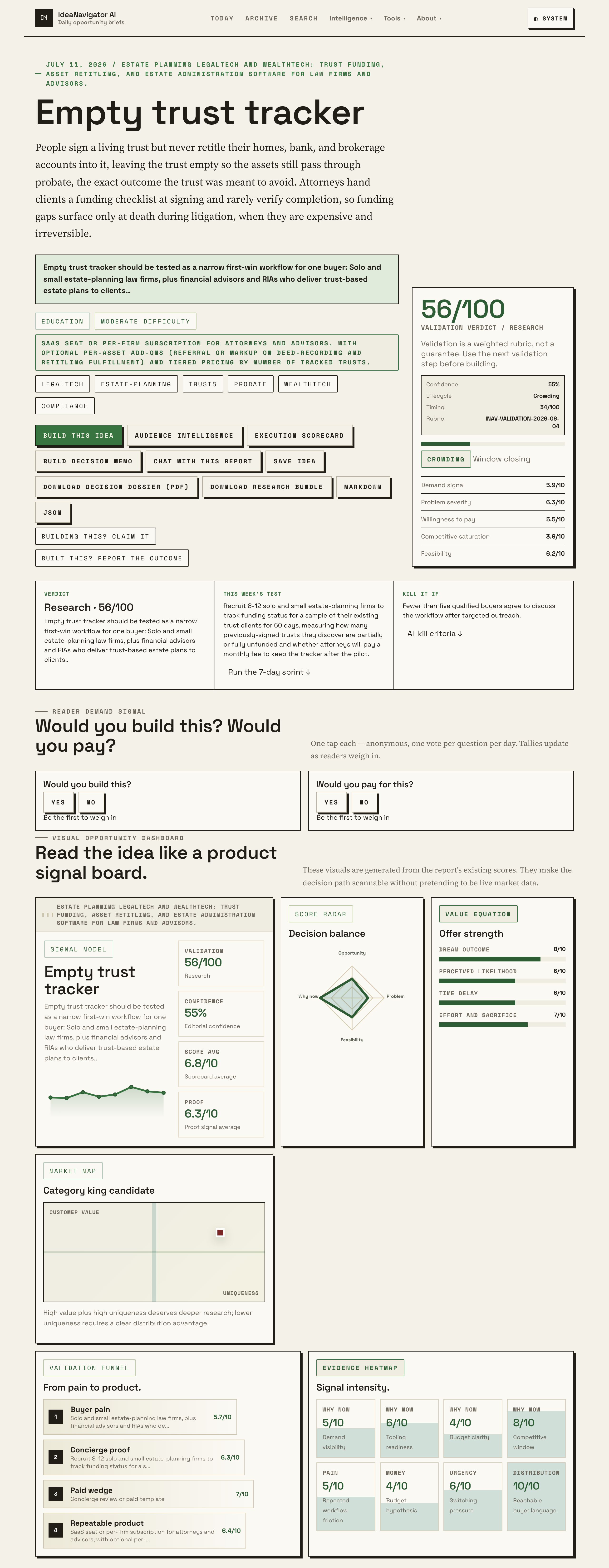
IdeaNavigator AI has proposed an “empty trust tracker,” a software concept for law firms and financial advisors to monitor whether clients transfer assets into living trusts. The proposal outlines a 60-day pilot with 8 to 12 small firms; no product launch, pilot results or customer commitments are reported.
IdeaNavigator AI’s proposal describes testing an empty trust tracker, software that would help small estate-planning law firms and financial advisors monitor whether clients transfer assets into living trusts after signing. The proposal targets a practical gap in estate planning: a signed trust may not control assets that were never retitled, but it describes a concept and pilot rather than a launched product or proven service.
According to the IdeaNavigator AI proposal, the tool would let attorneys or advisors create a funding checklist for each trust, covering assets such as real estate, bank and brokerage accounts, business interests and beneficiary designations. Staff could mark each item pending, in progress or confirmed funded, attach supporting documents such as a recorded deed or updated account statement, and send reminders to clients.
The proposal says a firm dashboard would summarize the funding status of its client trusts and show their percentage funded, allowing staff to follow up on incomplete transfers. The concept is aimed at solo and small estate-planning firms as well as financial advisors and registered investment advisers that provide trust-based plans. The proposal does not describe integrations with banks, brokerages, county recording systems or existing legal software.
The proposed business model is a subscription priced by firm or user, potentially tiered by the number of trusts tracked. Optional revenue could come from referrals or markups on deed-recording and retitling services. IdeaNavigator AI proposes recruiting 8 to 12 firms to track a sample of existing clients’ trusts for 60 days, then measuring how many are found partially or fully unfunded and whether firms would pay to continue using the tracker.
Where Trust Plans Can Fall Short
The concept focuses on the step between signing estate-planning documents and making those documents effective for particular assets. A living trust generally needs assets to be transferred or titled in a way that allows the trust to control them. If a home or account remains outside the trust, it may not receive the intended treatment under the plan; the exact outcome depends on the asset, beneficiary arrangements and applicable law.
For firms, a shared tracking system could make follow-up more visible than a paper checklist handed over at signing. The IdeaNavigator AI proposal argues that funding gaps can remain unnoticed until a client dies, when resolving ownership questions may involve costly disputes. That risk is plausible, but the proposal gives no measured rate of unfunded trusts, litigation costs or evidence that a tracker reduces either. The pilot is intended to test whether firms find enough gaps—and enough value in monitoring them—to pay for a dedicated tool.
A Manual Step After Signing
The IdeaNavigator AI proposal places the idea in the estate-planning legaltech and wealthtech markets, where document preparation and advisory tools can help create plans but may not verify that clients later retitle assets. It says trust funding often involves separate institutions and manual steps. It also cites deed-funding services priced from $250 per deed as evidence of a paid market around completing transfers; it does not identify providers or provide a broader pricing survey.
IdeaNavigator AI says only about 11% of Americans hold a trust, while describing estate-planning adoption and digital tools as growing in 2026. The proposal does not give the underlying survey, define “hold a trust,” or specify the period and comparison baseline for the claimed growth. Those figures are claims in the proposal, not independently documented findings here.
Pilot and Product Status
The proposal reports no company launch, named development team, working software, pilot enrollment or customer commitment. The proposed 60-day trial has no published start date, and the number of firms described is a recruitment target rather than confirmed participation. There are also no results showing how often existing trusts are unfunded or whether firms would subscribe.
The proposal does not explain how the system would verify documents, protect sensitive financial records, handle client consent or account for differences in state law and asset types. It is also unclear how reminders and status updates would be kept current when institutions have different transfer processes. These details would shape whether a tracker could reliably distinguish completed funding from paperwork that is still pending.
A 60-Day Firm Trial
The next step outlined in the IdeaNavigator AI proposal is to recruit 8 to 12 solo and small firms and follow a sample of their existing trust clients for 60 days. The test would count partially and fully unfunded trusts identified during the review and ask participating attorneys whether they would pay a monthly fee to keep using the system. No trial dates or recruitment updates are provided.
Evidence from that test would help establish whether the problem is common enough to support a standalone subscription and whether firms can collect and maintain funding proof without adding excessive staff work. Until such results, pricing details and product capabilities are reported, the tracker remains an early business concept.
Source: IdeaNavigator AI
Key Questions
What is an empty trust tracker?
It is a proposed tool for recording whether a client has transferred assets into a living trust, attaching proof and prompting follow-up on incomplete items.
Who is the proposed software for?
The concept targets solo and small estate-planning law firms, financial advisors and registered investment advisers that deliver trust-based plans.
Has the software launched?
No launch or working product is reported. IdeaNavigator AI describes a concept and proposes a 60-day pilot with 8 to 12 firms.
What would the pilot measure?
It would measure how many existing trusts are found partially or fully unfunded and whether participating firms would pay a monthly fee to continue using the tracker.
Source: IdeaNavigator AI
Fall Picks
fall essentials
As an affiliate, we earn on qualifying purchases.