📊 Full opportunity report: Steps To Implement Rack-by-Rack Deployment Tracking In Your Data Center on IdeaNavigator AI — validation score, market gap, and execution plan.

Get the latest gadgets delivered free with Prime
- Fast, free delivery on millions of items
- Prime Video, Amazon Music and more included
- Member-only deals all year
TL;DR
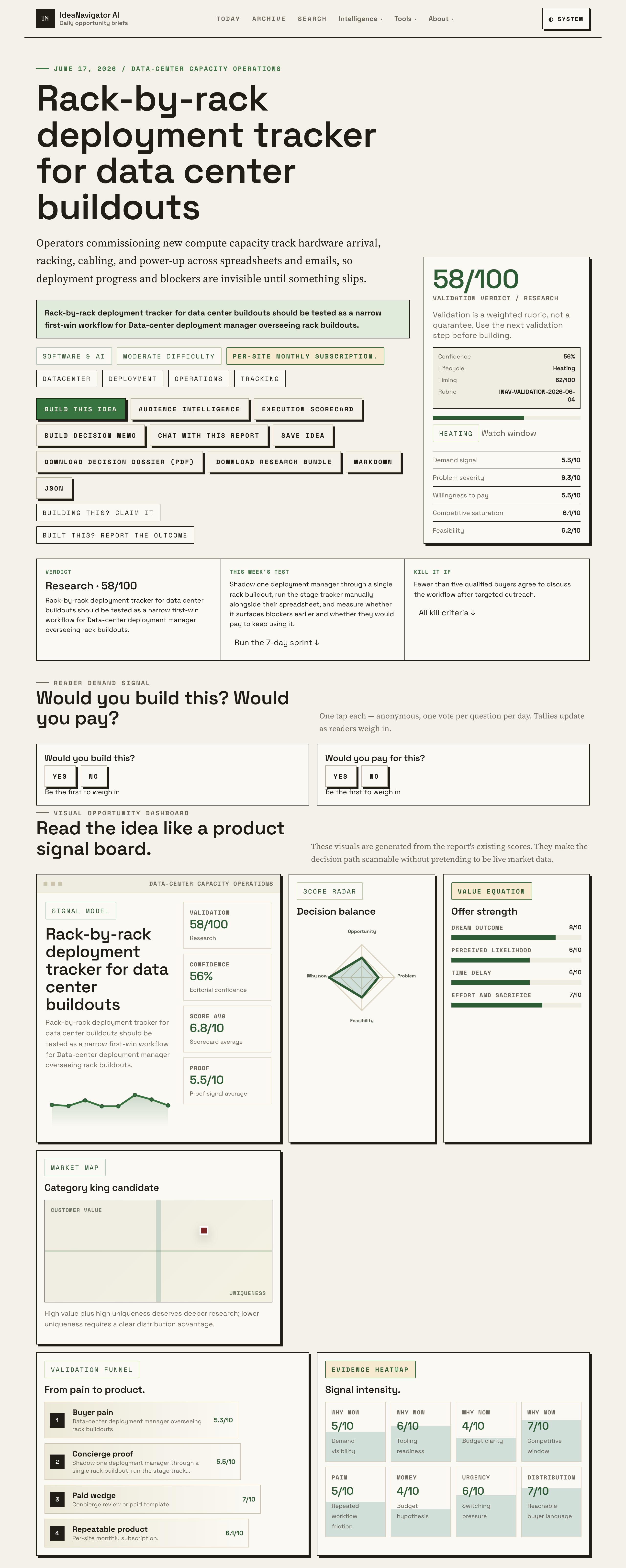
Data center operators are adopting rack-by-rack deployment trackers to improve buildout visibility amid record growth. A basic deployment board prototype is being tested to streamline progress monitoring.
Data center deployment managers are beginning to test a rack-by-rack deployment tracker designed to improve progress visibility during rapid buildouts driven by record AI demand. This approach aims to replace manual spreadsheets and emails with a simple, live tracking system.
The proposed system involves a minimal viable product (MVP): a deployment board where managers log each rack through fixed stages—delivered, racked, cabled, powered, and validated. This allows real-time monitoring of percent-complete and highlights stalled racks for a single site.
Testing involves shadowing a deployment manager during a single rack buildout, comparing the manual stage tracker with existing spreadsheet workflows. The goal is to assess whether the new system surfaces blockers earlier and if managers are willing to pay for ongoing use, with a per-site monthly subscription model as the revenue approach.
Impact of Rack-by-Rack Tracking on Data Center Efficiency
This development could significantly improve deployment visibility during rapid data center expansions, reducing delays caused by unseen blockers. It addresses a critical need as AI-driven capacity growth accelerates, enabling operators to manage thousands of racks more effectively and potentially lowering operational costs.
As an affiliate, we earn on qualifying purchases.
Current Challenges in Data Center Deployment Management
Operators currently rely on manual spreadsheets and emails to track hardware arrival, racking, cabling, and power-up processes. These methods often lead to delays and overlooked issues until failures occur, especially during fast-paced buildouts driven by AI demand. The industry is seeking purpose-built tools to improve real-time oversight.
Recent record buildouts have pushed capacity expansion timelines into compressed schedules, exposing the limitations of existing manual tracking methods. The proposed rack-by-rack tracker aims to fill this gap with a simple, scalable solution.
“A straightforward deployment board could transform how data center buildouts are managed, providing immediate visibility into progress and blockers.”
— an anonymous researcher
As an affiliate, we earn on qualifying purchases.
Uncertainties in Effectiveness and Adoption
It is not yet clear how well the simple deployment board will perform in diverse real-world scenarios or whether operators will adopt it widely. The effectiveness of early blocker detection and the willingness to pay for this tool remain under evaluation during initial testing phases.
As an affiliate, we earn on qualifying purchases.
Next Steps for Validation and Scaling
The next phase involves shadowing deployment managers during actual rack buildouts, collecting feedback, and refining the tracking system. If successful, plans include expanding testing to multiple sites and establishing a subscription-based service model. Broader industry adoption will depend on demonstrated efficiency gains and user acceptance.
data center project tracking software
As an affiliate, we earn on qualifying purchases.
As an affiliate, we earn on qualifying purchases.
Key Questions
How does the rack-by-rack deployment tracker improve over current methods?
The tracker provides real-time visibility into each stage of rack deployment, helping managers identify delays early and reduce reliance on manual spreadsheets and emails.
Will this system be suitable for all data center sizes?
The initial focus is on a simple MVP for single-site deployments, but the concept can scale to larger, multi-site operations if proven effective.
What are the costs associated with implementing this tracker?
The proposed model is a per-site monthly subscription, but exact pricing will depend on deployment scale and feature set during further development.
When will this tracking system be available for wider use?
It is currently in testing phases, with wider rollout expected after successful validation during shadow deployments, likely within the next few months.
Could this tracker replace existing manual workflows entirely?
While it aims to improve visibility, initial implementations are expected to supplement existing workflows, gradually replacing manual methods as confidence and effectiveness grow.
Source: IdeaNavigator AI
Halloween Picks
halloween
As an affiliate, we earn on qualifying purchases.