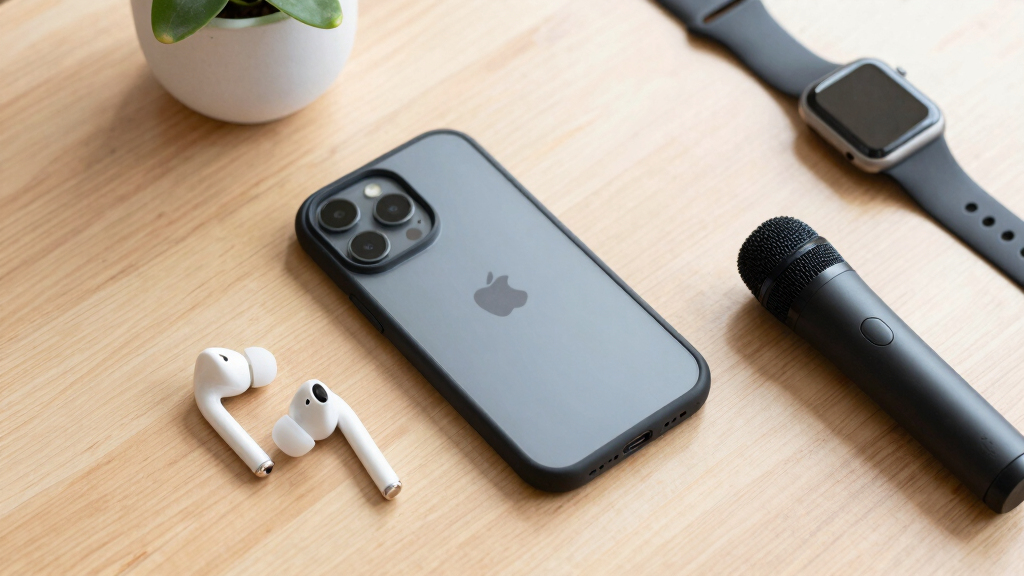

📊 Full opportunity report: Achieve Authentic Gender-Affirming Voices With Pocket Voice Lab’s Mobile Tech on IdeaNavigator AI — validation score, market gap, and execution plan.

Get the latest gadgets delivered free with Prime
- Fast, free delivery on millions of items
- Prime Video, Amazon Music and more included
- Member-only deals all year
TL;DR
Pocket Voice Lab has introduced a mobile app that provides real-time visual biofeedback for voice pitch and resonance, targeting transgender and gender-nonconforming individuals. This innovation aims to address the lack of accessible, objective feedback in voice training. The app is currently in pilot testing, with plans for a freemium model and clinician sharing features.
Pocket Voice Lab has launched a mobile app that delivers real-time acoustic biofeedback for voice pitch and resonance, specifically designed for transgender and gender-nonconforming individuals seeking voice feminization or masculinization. This development aims to make gender-affirming voice training more accessible and effective outside of traditional clinical settings.
The app is designed to help users practice voice modifications by recording short samples and receiving immediate visual feedback on their fundamental pitch and resonance relative to personal targets. It also provides a basic strain indicator based on harmonic-to-noise ratio, enabling users to monitor vocal health during practice. The initial release includes 8-12 guided exercises tailored for gender-affirming voice work, along with a session log and shareable progress summaries for users to track improvements or share with clinicians.
This tool is aimed at individuals who lack easy access to in-person speech-language pathologists (SLPs) or vocal coaches due to geographic or financial barriers. The app’s developers plan to implement a freemium subscription model, offering free daily exercises with paid tiers (~$8-15/month) that unlock unlimited sessions, detailed progress history, and clinician reports. The project is currently in a pilot phase, recruiting participants from trans voice-training and public-speaking communities to validate engagement and willingness to pay.
Impact on Accessibility and Voice Practice
This innovation could significantly improve accessibility to effective voice training for transgender and gender-nonconforming individuals, especially those who cannot regularly visit clinicians. By providing objective, real-time feedback, the app helps users practice more effectively and stay motivated, potentially reducing the gap in gender-affirming voice care. It also opens new avenues for remote coaching and longitudinal progress tracking, which are currently limited in traditional settings.
gender-affirming voice training app
As an affiliate, we earn on qualifying purchases.
As an affiliate, we earn on qualifying purchases.
Rise of Mobile Voice Biofeedback Tools
Recent advancements in smartphone microphone technology and acoustic analysis have made real-time voice biofeedback feasible outside labs. Peer-reviewed research increasingly treats voice as a clinical biomarker, with academic projects like TruVox and Attuned validating the method. The gender-affirming voice care gap is well documented, and AI-powered voice apps such as Vocal Image have demonstrated strong consumer demand, with over 4 million downloads. These trends set the stage for products like Pocket Voice Lab to enter the market and meet unmet needs in this space.
“Real-time visual biofeedback can transform how individuals practice and improve their voice, especially when access to clinicians is limited.”
— an anonymous researcher
As an affiliate, we earn on qualifying purchases.
Unconfirmed Aspects of App Effectiveness and Adoption
It remains unclear how effectively the app will translate into long-term vocal improvements or how well users will adopt and integrate it into their routines. Data on actual user outcomes and satisfaction is still being gathered during the pilot phase. Additionally, the scalability of clinician-sharing features and the app’s impact on clinical practice are yet to be determined.
As an affiliate, we earn on qualifying purchases.
Next Steps in Pilot Testing and Market Expansion
The project will continue pilot testing over the coming months, focusing on user engagement, satisfaction, and willingness to pay. Success metrics include at least 40% of users completing three or more guided sessions in the first week and a 25% conversion rate to paid subscriptions. If results are favorable, the team plans to expand features, refine the app based on user feedback, and explore licensing opportunities with clinics and speech therapy practices.
As an affiliate, we earn on qualifying purchases.
Key Questions
How does the app provide feedback on voice pitch and resonance?
The app records a voice sample and uses acoustic analysis to display real-time visual feedback on fundamental pitch and resonance, comparing it to user-set targets, along with a strain indicator based on harmonic-to-noise ratio.
Who is the target user for this technology?
The primary users are transgender and gender-nonconforming individuals seeking voice feminization or masculinization, as well as public speakers and singers who want ongoing practice outside of clinical settings.
Will the app replace in-person therapy or coaching?
No, the app is designed as a supplement to traditional therapy, providing objective practice tools between sessions and enabling progress tracking. It aims to enhance, not replace, clinician-led care.
When will the app be widely available?
The app is currently in pilot testing; a commercial release is expected after further validation and refinement, likely within the next year, depending on pilot outcomes.
Is this technology supported by scientific research?
Yes, peer-reviewed studies support the use of acoustic biofeedback for voice training, and academic prototypes like TruVox and Attuned have validated the method. The science behind voice as a clinical biomarker continues to grow.
Source: IdeaNavigator AI
Columbus Day / Indigenous Peoples' Day Picks
long weekend sales
As an affiliate, we earn on qualifying purchases.