
📊 Full opportunity report: Apple Silicon’s Quiet Memory Advantage on ThorstenMeyerAI.com — validation score, market gap, and execution plan.

Get the latest gadgets delivered free with Prime
- Fast, free delivery on millions of items
- Prime Video, Amazon Music and more included
- Member-only deals all year
TL;DR
Apple Silicon’s unified memory architecture allows it to handle larger AI models at a lower cost compared to discrete GPUs. While slower per token, it offers significant capacity and efficiency advantages for specific workloads, especially in personal use and offline scenarios.
Apple Silicon chips in 2026 provide a notable memory capacity advantage for running large AI models, despite lower memory bandwidth compared to discrete GPUs, making them a key option for personal AI workloads.
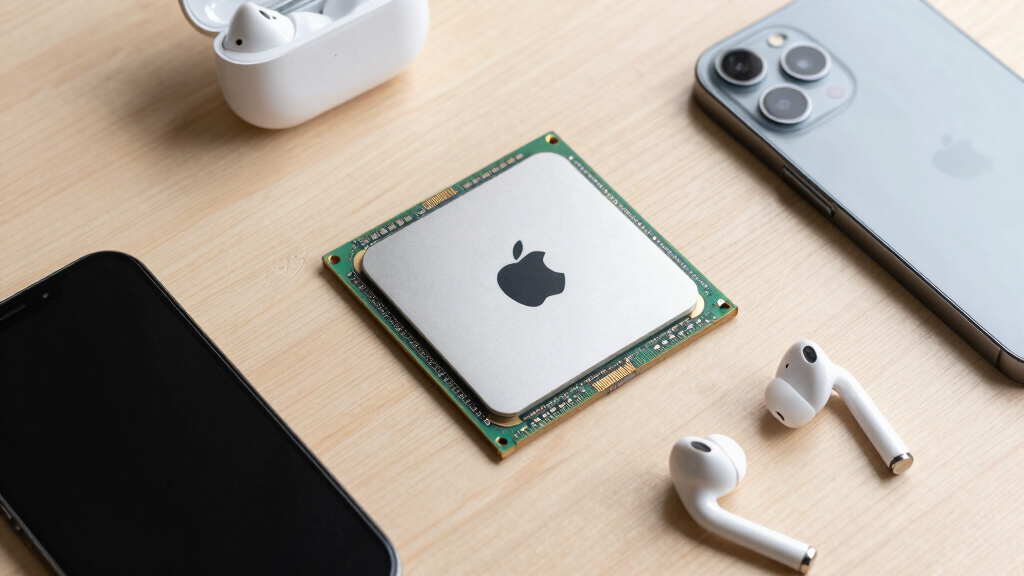
Unlike traditional PCs that have separate system RAM and GPU VRAM, Apple Silicon features a unified memory architecture where CPU and GPU share the same pool of physical memory. This design allows Macs with higher RAM configurations—such as 64GB, 128GB, or even 256GB—to run AI models larger than what a typical discrete GPU can handle without performance drops caused by data transfer bottlenecks.
For example, a Mac Studio with 256GB of RAM can manage models up to 200 billion parameters at near-lossless quality, a capacity that would require multi-GPU setups costing thousands of dollars on the NVIDIA side. This makes Apple Silicon a unique consumer solution for large model inference, offering capacity that is otherwise only available in expensive enterprise hardware.
However, this advantage comes with a trade-off: Apple Silicon’s lower memory bandwidth results in slower inference speeds. For models that fit within GPU VRAM, NVIDIA’s discrete cards outperform Apple Silicon significantly in tokens per second. Still, for large models requiring extensive memory, the slower speed is acceptable given the capacity and cost benefits.
Additionally, Apple Silicon’s power efficiency and silent operation make it attractive for continuous, always-on AI inference tasks, further reducing long-term operational costs. Nonetheless, recent industry-wide memory shortages have impacted Apple, leading to the discontinuation of certain configurations and price increases across its lineup.
Apple Silicon’s quiet memory advantage
While the discrete-GPU world fought over 24GB of brutally expensive VRAM, a Mac quietly offered to run the big model on one silent, low-watt box. Not magic — but the rare place an architecture beats the squeeze.
Mac Studio 256GB holds a 70B at near-lossless Q8, or 200B+ at Q4 — no single GPU reaches that at any price. Win zone: 32–200B models at 10–30 tok/s for personal/dev use.
M5 Max ~614 GB/s vs RTX 4090’s 1,008. A 70B runs ~12–18 tok/s on M5 Max vs 40–50 on a 5090. You buy capacity, not raw throughput. Bandwidth & capacity matter — not FLOPs.
Apple turned a laptop-efficiency design — one shared memory pool — into the most elegant answer to the part of the squeeze that hurts most: capacity. Bonus: 25–90W vs a GPU rig’s 600–1,200, ~$35–55/yr to run 24/7 vs $300–400, and silent. Right for large models, privacy, low-power always-on; wrong for max speed on small models or heavy training. Next: Build, Rent, or Quantize.
Why Large Memory Capacity Matters in 2026
This architecture provides a practical, cost-effective way for consumers and small-scale developers to run large AI models locally, bypassing the need for multi-GPU setups that are expensive, noisy, and power-hungry. It shifts the focus from raw speed to capacity and efficiency, enabling broader access to advanced AI inference at home or in small offices. However, it does not eliminate the ongoing memory shortage or the performance trade-offs involved, which remain relevant for users with speed-critical tasks.
Popular right now

KitchenAid Artisan 5-Quart Tilt-Head Stand Mixer, Almond Cream

Dyson Ball Animal Total Clean Upright Vacuum

Dyson Ball Animal 2 Plus Corded Vacuum
As an affiliate, we earn on qualifying purchases.
The 2026 Memory Squeeze and Apple’s Response
Throughout 2026, the industry faces a widespread RAM shortage driven by wafer supply constraints, impacting the availability and pricing of memory modules. Apple, traditionally insulated through long-term contracts, still felt the effects, withdrawing some high-capacity configurations and raising prices. Meanwhile, Apple’s unified memory architecture, initially designed for efficiency in laptops, unexpectedly became a strategic advantage for large AI model inference, offering a capacity-rich alternative to expensive multi-GPU systems.
This shift underscores a broader industry trend: as hardware constraints tighten, architectural innovations like shared memory become critical differentiators, especially for consumer-level AI applications.
“Our latest Macs provide substantial memory capacity and efficiency for AI workloads, emphasizing versatility and value.”
— Apple spokesperson
Remaining Questions About Apple Silicon’s Limits
It is still unclear how long Apple can sustain high memory configurations amid ongoing industry-wide RAM shortages and rising prices. The impact of lower memory bandwidth on real-world AI performance, especially for latency-sensitive applications, also remains to be fully quantified. Additionally, how Apple’s unified memory approach will evolve in future chips and whether it can scale further without compromising speed is yet to be seen.
Future Developments in Apple Silicon and AI Capabilities
Apple is expected to release next-generation chips with increased bandwidth and possibly larger unified memory pools, aiming to improve speed while maintaining capacity advantages. Monitoring how Apple addresses supply chain constraints and whether it introduces new configurations or pricing strategies will be key. Additionally, developers and users will likely explore optimized workloads that leverage the unique strengths of Apple Silicon’s architecture.
Key Questions
Can Apple Silicon replace high-end NVIDIA GPUs for AI training?
Currently, Apple Silicon is optimized for inference and large model capacity rather than training speed. It is not designed to replace high-performance NVIDIA GPUs in training scenarios, especially those requiring maximum throughput and low latency.
How does unified memory affect AI model performance?
Unified memory allows larger models to run without data transfer bottlenecks between separate pools, enabling capacity that surpasses typical discrete GPU setups, but at the expense of lower memory bandwidth and slower inference speeds.
Will Apple Silicon’s memory advantage continue in future chips?
Future iterations may improve bandwidth and scalability, but current constraints suggest that the core architectural advantage—shared memory capacity—will remain a key feature for large-model inference, although speed improvements are likely.
Is Apple Silicon suitable for AI development or only inference?
While optimized for inference, Apple Silicon can support AI development workflows, especially for testing large models locally. However, training large models still favors dedicated high-performance GPUs.
Source: ThorstenMeyerAI.com