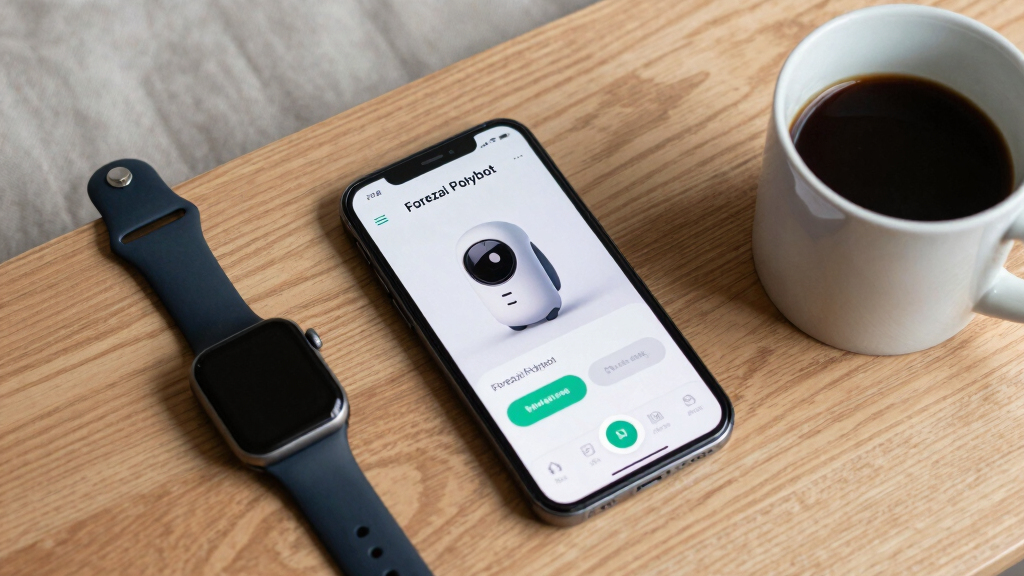

📊 Full opportunity report: Forezai · Polybot: When the AI Disagrees With the Odds on ThorstenMeyerAI.com — validation score, market gap, and execution plan.
TL;DR
Polybot is an experimental open-source AI designed to compare its probability estimates against prediction market prices. It trades only when significant divergence occurs, aiming to assess whether AI can reliably identify mispricings. The project underscores the challenges of beating markets and emphasizes cautious, calibrated trading.
Polybot, an open-source experiment from Forezai, is testing whether an AI can reliably identify when its probability estimates diverge from prediction market prices and act on those divergences. This initiative aims to explore the potential and limitations of AI in financial prediction markets, emphasizing risk and calibration over profitability.
The project involves an AI agent that researches public information on prediction markets, forms its own probability estimates, and compares them to market prices. When a significant gap appears, the bot considers trading, but only executes trades when the divergence exceeds a carefully calibrated threshold that accounts for costs, slippage, and model uncertainty.
Polybot emphasizes auditability: each estimate includes reasoning that can be reviewed after execution, aiming to improve transparency and calibration over time. The system prioritizes doing nothing unless the disagreement is strong enough to justify a trade, reflecting a risk-averse, disciplined approach common in research settings rather than aggressive trading.
Developers caution that Polybot is a proof-of-concept, not a money-making tool, citing the inherent difficulties of beating markets due to their informational density and adversarial nature. Backtests show promising results, but live market conditions—fees, slippage, liquidity—often diminish theoretical edges.
Polybot — when the AI disagrees with the odds
A prediction market puts a price on the future. Polybot asks: can an AI’s own estimate diverge from that price for real — and should it ever act on the gap?
Not financial, investment, legal or tax advice; not a recommendation or solicitation to trade, invest or use any software. Forezai · Polybot is experimental open-source software (MIT), provided “as is” without warranty of accuracy or profitability. Trading and automated trading carry a substantial risk of loss including total loss of capital; past or backtested performance does not indicate future results. Prediction-market participation is restricted or prohibited in some jurisdictions (including for US persons) — you are solely responsible for compliance with applicable law. Consult a licensed professional before any financial decision. Produced with AI assistance under human editorial oversight; independent commentary, the author’s own views. Product and company names are trademarks of their respective owners; mention does not imply endorsement.
Implications for AI and Prediction Market Reliability
This project highlights the ongoing challenge of developing AI systems capable of reliably identifying mispricings in prediction markets. It underscores the importance of calibration, transparency, and risk management in automated trading systems. While the experiment does not promise profits, it offers insights into the potential and limits of AI-driven market analysis, emphasizing cautious, evidence-based approaches over speculative trading.
AI TRADING HANDBOOK: Master Stock, Crypto, Forex & Options Trading with ChatGPT, GPT-4, Claude, Gemini & Custom AI Agents – From Zero-Code Strategies to Fully Automated Profitable Bots
As an affiliate, we earn on qualifying purchases.
As an affiliate, we earn on qualifying purchases.
Market Prediction and AI: The Current Landscape
Prediction markets are unique in their ability to aggregate collective information into a market-implied probability, often considered highly efficient. Historically, attempts to beat these markets with algorithms have faced significant hurdles due to the dense informational content embedded in prices and the adversarial nature of trading. Polybot’s experiment builds on this context, testing whether AI can meaningfully identify when market prices are misaligned with independent estimates, and whether such signals can be trusted in real trading scenarios.
Previous efforts in algorithmic trading and AI-based prediction have shown mixed results, often hampered by market costs, model inaccuracies, and strategic behavior by market participants. Polybot’s emphasis on transparency and calibration aims to address some of these issues, providing a more disciplined approach to AI-driven trading research.
“Polybot is designed as a research tool to understand when and if an AI can reliably identify and act on market mispricings, emphasizing calibration and risk management.”
— Thorsten Meyer, project lead
The No-BS Guide to Prediction Market Arbitrage: AI-Powered Strategies for Polymarket & Kalshi — Find Arbitrage, Manage Risk & Profit from Real-World Events Without Code (The No-BS AI Playbooks)
As an affiliate, we earn on qualifying purchases.
As an affiliate, we earn on qualifying purchases.
Uncertainties in AI Market Disagreement Detection
It remains unclear how well Polybot’s calibration will hold over long-term, live trading conditions, especially given market dynamics, slippage, and liquidity constraints. The extent to which an AI can consistently identify genuine mispricings versus noise is still unproven, and the project’s results are preliminary.

Beginners Guide On How To Evaluate A Trading Bot And Other Algorithmic Trading Services: A guide to help you properly evaluate trading bots and similar services that use algorithmic trading
As an affiliate, we earn on qualifying purchases.
As an affiliate, we earn on qualifying purchases.
Next Steps for Polybot and Market Testing
Developers plan to continue testing Polybot in live or simulated environments, refining thresholds for disagreement, and analyzing calibration over time. Further research will assess whether the system can evolve to reliably identify profitable mispricings without excessive risk, and how to improve transparency and robustness in real-market conditions.

Python for Finance Cookbook: Over 80 powerful recipes for effective financial data analysis, 2nd Edition
As an affiliate, we earn on qualifying purchases.
As an affiliate, we earn on qualifying purchases.
Key Questions
Can Polybot reliably beat prediction markets?
Currently, Polybot is an experimental tool focused on research and calibration. It is not designed to reliably beat markets but to study when and if AI can identify meaningful disagreements.
What risks are associated with using Polybot?
Polybot is a research project, not a commercial system. Automated trading involves significant risk, including loss of capital, especially in live markets with costs like slippage and fees.
Is Polybot available for public use?
Yes, Polybot is open source and available on GitHub and forezai.com, but it is intended for research and experimentation, not for live trading without careful risk management.
How does Polybot determine when to trade?
It compares its own probability estimates with market prices and trades only when the divergence exceeds a carefully calibrated threshold, considering costs and uncertainties.
Source: ThorstenMeyerAI.com