Your smartphone can take great photos in good lighting and for everyday snapshots, thanks to advanced lenses and software. However, it still can’t fully replace a DSLR in challenging conditions like low light, night scenes, or backlit situations, where dedicated cameras with larger sensors excel. If you want detailed, sharp images in difficult environments, a DSLR remains superior. Keep exploring, and you’ll discover more about how to choose the right device for your needs.

Get the latest gadgets delivered free with Prime
- Fast, free delivery on millions of items
- Prime Video, Amazon Music and more included
- Member-only deals all year
Key Takeaways
- Smartphones excel in convenience and quick shots but often lack the sensor size and manual controls of DSLRs.
- Dedicated cameras outperform smartphones in low light, night scenes, and backlit conditions due to larger sensors and better optics.
- Advanced software in smartphones helps improve images, but may introduce noise or unnatural results in challenging lighting.
- For professional quality, large prints, or complex lighting scenarios, DSLRs still provide superior image detail and control.
- Smartphones are suitable for casual photography, but for optimal quality in difficult conditions, dedicated cameras are preferable.
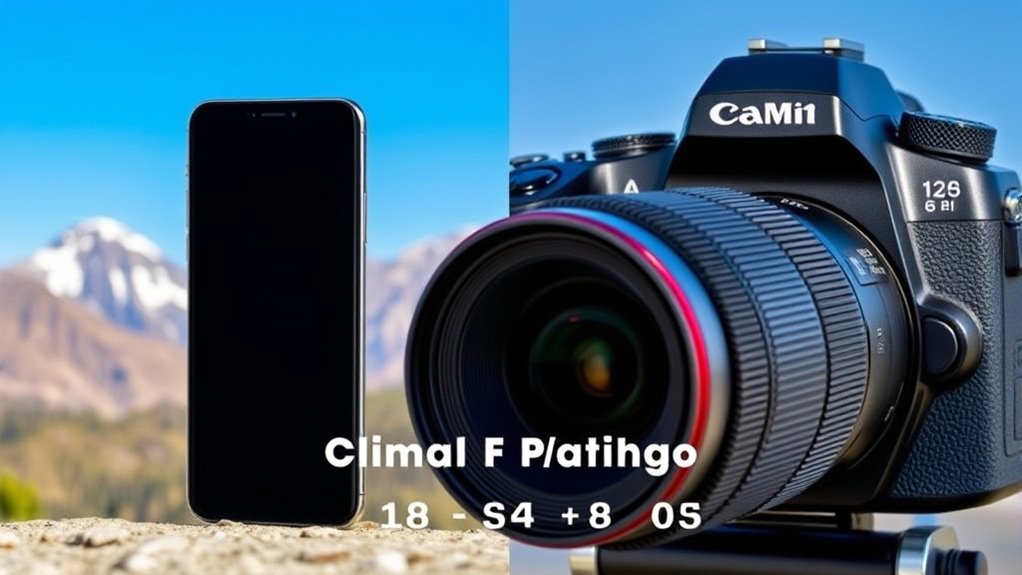
Have you ever wondered whether your phone or a dedicated camera is better for capturing life’s moments? It’s a common question, especially as smartphones continue to improve their camera features. When it comes to lighting conditions, your choice can markedly impact the quality of your photos. Phones are equipped with multiple lenses and advanced software that can optimize images in a variety of lighting scenarios. For well-lit environments, smartphones often produce sharp, vibrant photos that satisfy most casual photographers. Their automatic exposure and HDR modes help balance bright backgrounds and dark shadows, making your pictures look great without much effort. However, when you step into challenging lighting conditions like low light, night scenes, or harsh backlighting, your phone’s capabilities might hit a limit. While recent models have improved with larger sensors and night modes, they still struggle to match the image quality delivered by a dedicated camera with larger sensors and more manual control.
Dedicated cameras, especially DSLRs and mirrorless models, excel in these tricky lighting situations. Their larger sensors gather more light, which translates into cleaner, more detailed images in dim environments. Plus, they allow you to manually adjust settings like ISO, shutter speed, and aperture, giving you full control over how your photo is exposed. This flexibility means you can optimize image quality even in challenging lighting conditions, capturing finer details and reducing noise that often plagues smartphone photos in low light. In contrast, smartphones rely heavily on software algorithms to brighten and sharpen images, which can sometimes lead to unnatural-looking results or a loss of detail. If you’re photographing a dimly lit scene or trying to capture fast-moving action at night, a dedicated camera generally provides superior image quality, with richer textures and more accurate color reproduction. Additionally, understanding sensory capabilities can significantly influence the outcome of your photography in varying lighting environments.
That said, smartphones have become incredibly convenient and capable, especially for everyday photography. They’re always in your pocket, ready to snap quick shots without fuss. Their processing power makes it easy to produce decent images in most lighting conditions with minimal effort. But if achieving the highest possible image quality in complex lighting is your priority — especially for professional work or large prints — a dedicated camera still holds the edge. It offers better control over exposure, superior sensor technology, and the ability to adapt to difficult lighting conditions, ensuring your photos look sharp, clear, and true to life. So, whether your goal is casual snaps or professional-quality images, understanding these differences can help you decide which device best suits your needs.
Frequently Asked Questions
Can Smartphone Cameras Perform Well in Low-Light Conditions?
Smartphone cameras can perform reasonably well in low-light conditions, especially with recent advances in night photography and noise reduction technology. You’ll notice clearer images with less grain, even in dark settings. While they might not match a DSLR’s sensor size and manual controls, modern smartphones handle night shots better than ever, making them a convenient choice for capturing low-light moments. Just guarantee you use a steady hand or tripod for the best results.
Do Smartphones Have Better Image Stabilization Than DSLRS?
Sure, smartphones often seem to have better image stabilization thanks to clever image processing and tiny sensors that can be stabilized digitally. But don’t be fooled—DSLRs rely on physical stabilization mechanisms that keep your shots steady through hardware. While your phone might smooth out shaky videos with software tricks, a DSLR’s sensor size and optical stabilization still hold the upper hand for truly steady, professional-quality shots.
How Do Smartphone Cameras Handle Professional Video Recording?
Smartphone cameras handle professional video recording quite well, delivering impressive video quality for most users. They feature advanced autofocus performance, ensuring sharp focus during dynamic shots, and often include stabilization tools to minimize shakes. While they can’t fully replace dedicated cameras for complex projects, smartphones are perfect for quick, high-quality videos, offering a convenient and portable solution that still produces professional-looking footage.
Are Smartphone Lenses Interchangeable Like DSLR Lenses?
Smartphone lenses aren’t usually interchangeable like DSLR lenses, but you can expand your options with clip-on lenses and other accessories. Remarkably, over 80% of smartphone users add extra lenses for better shots, showing how popular accessory options are. While lens compatibility remains limited, these accessories give you creative flexibility without needing to upgrade your entire device. So, your smartphone can still pack a punch with the right add-ons.
Can Smartphones Achieve the Same Depth of Field as DSLRS?
You can achieve a similar depth of field with smartphones, but it’s limited compared to DSLRs. Modern phones use software and multiple lenses to mimic aperture control, creating a blurred background effect. However, true control over aperture and sensor size in DSLRs offers more precise depth of field, especially for professional-quality portraits and macro shots. While smartphones are improving, they still can’t fully replicate the depth of field capabilities of a DSLR.
Conclusion
So, next time you’re debating whether your smartphone can truly replace a DSLR, remember this: it’s ironic how a device always in your pocket might outshine a professional camera in everyday moments. Sure, your phone’s convenience and instant sharing are unbeatable, but when it comes to capturing breathtaking detail and quality, that bulky DSLR still holds the crown. Maybe the real question isn’t “Can my phone replace my camera?” but “Do I really need to carry both?”
Columbus Day / Indigenous Peoples' Day Picks
long weekend sales
As an affiliate, we earn on qualifying purchases.